Hi,
Changes in temperature and humidity give us a lot of trouble when we travel. Just like the reeds. Probably it’s happened with everybody that the conditions have changed between the stage and home, and it has caused a lot of problems for us during the gig, like the reeds going out of tune and things like that. It annoyed me and so I decided it to look for a solution.
After a bit of research, I had a discussion with one of my friends, and he told me a technique that is used in some Central European instruments. What we have to do is fill the air spaces (air gaps) in the tongue of the reed and impregnate the surface of the reed carefully because we don’t want to destroy the sound.
I spent hours and hours with the experiments, to apply the technique to Uilleann reeds, because originally it’s for normal-reeds instrument, but in the end it was worth the trouble.
I’d like to share my observations with you. Here is the process:
Besides the general reed-making tools, you need 500 ml (a bit less than a pint:-) linseed oil, a flat pot and a soft clout.
We follow the normal steps until we bisect the tongue. Then we buff the inside of the reed (let 0.05 mm free because the reed could bend during the cooking) we put the oil into the the pot and heat it until it reaches 80’ C. If you don’t have a thermometer: cook until the surface starts to froth. It works best if the oil is as clean as possible. We keep the temperature at 80’ and put the prepared reeds into the oil. Usually I use a fork for this.
Obviously, it’s easier to make more than one reed at the same time. (I do 40-50 at once, usually) The reeds start to froth when the air leaves the pores and is substituted by the oil. You shouldn’t bake the reeds to dark brown, because they could perish. Golden brown is the right colour.Then we take them out and put them into the clout to dry and rest for 30 minutes. Afterwards, we wipe away the spare oil from the reeds. We have to wait at least 3 weeks for them to dry, so the linseed oil can harden. Usually I wait 5-6 weeks. Room-temperature is absolutely perfect. After this, all the steps are the same. There are two dangers: The emery paper could become engorged too soon, and the sharp edge part of the tongue could snap too easily, but it’s not an extreme sensitivity.
I hope you find this information useful. I’ll take some pics soon.
Good luck!
Interesting. Are you sure your name is not really “Uilleann Hungry”, and you’re not just making a nice deep-fried reed goulash? 
I’m intrigued and eagerly awaiting photos; I was wondering if there was some sort of way to “seal” these little guys. And hey, when you’re done just throw a Snickers Bar or two in there and bobsyer  Like Saturday night at the chipper.
Thanks! If I can ever get some slips to the point where they’re worth boiling in oil, I’d love to give it a try.
I’d like to hear more on this. Pictures would be nice too.
LOL
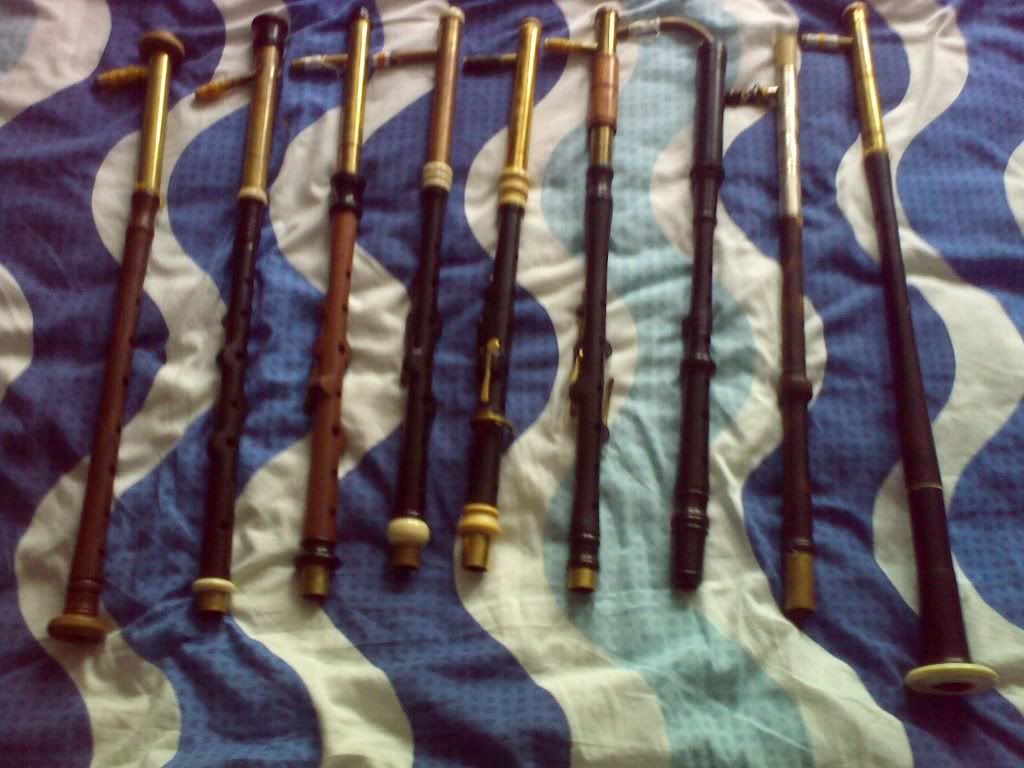
The two chanters on the RHS of the photo have had a similar treatment - they were deep fried in oil and the outsides set alight to get the dark colour (the wood used to make them was maple).
David
Maple is very hard to dye, however Fiebings leather dye works very well on it (see http://www.fiebing.com/Dyes.aspx). I know that there are wood dyes available too, but I had some leather dye already on the shelf, tried it and it worked wonderfully. It may be a less drastic solution than deep frying that bad boy! 
Hi Ceann Cromtha
The chanters were deep fried to expell water from the chanter and to replace it with oil - effectively proofing the chanter against atmospheric variations. The outside fire treatment was a cosmetic procedure tried as a experiment by the pipemaker.
David
Cool! 
BigDavy; How long was the maple deep fried? I have some light mahogany I’d like to darken. It is in the mouth at times, so I don’t want to use stain.
Davy ye could have also said that the same maker of the said pipes also fried some of his reeds years ago in cooking oil as a trial and they played ok.I think I mentioned this in one o ma earlier thread way back the world was a Golden Era and birds were tweeting and…thats enuff.
Uilliam
Hi Uilliam
If I remember correctly, the reed in the blackwood chanter third from the right had the hot oil bath.
Reeedmaster -
The oil itself doesn’t affect the colour much - the inside of the chanter remains maple coloured. The outside of the chanters was lit by a cigarette lighter to get the darkening effect - and it is uneven, giving a nice mottling effect.
There is the other point, that would you be comfortable throwing your mahogany into oil hot enough to make chips (french fries to you across the pond). If the chanter self destructed in the oil, Jim would have another ready (from billet of maple) in about 45 minutes, could you replace the mahogany in that time. As well as that, mahogany is a denser and heavier wood than maple and might not react in the same way to being deep fried.
David
I’ve heard about flute makers microwaving boxwood. I wonder if that would be a little neater? The cleanup’s gotta be a drag.
Where was it I read about microwaving reed slips to cure them so that they produce a distinctive “ping” when dropped? Can’t remember.
I’m so glad that you’re interest. The problem with enameling and external impregnate is that it’s really external. The inside of the reed will be disengaged and the inner pores won’t be filled just closed. Therefore if we need to buff the reed afterwards it’s going to disappear and let the free way to the steam and stuff like that. That’s the reason why we need to be careful with the time when we frying, we have to put out when it’s ready. If we over-fry the reed going do be destroyed.
I’m going to write down some more information about that and make some pics soon.
Maybe Fried-reeds is a better name instead of roasted…
Anyway, I LOVE goulash!
Richard
The two chanters on the RHS of the photo have had a similar treatment - they were deep fried in oil and the outsides set alight to get the dark colour (the wood used to make them was maple).
So how can you tell when they are done? Was this a common “cure” for softer woods in times past - before tropical hardwoods became common?
FWIW, I have heard of people treating both wood and reeds with ethylene glycol for the same purpose. But maybe that’s a different story altogether.
David Daye’s pages spring to mind?? but I can’t check at the moment.
Mr. Gumby wrote:
FWIW, I have heard of people treating both wood and reeds with ethylene glycol for the same purpose. But maybe that’s a different story altogether.
In a way it is another story. David Daye reported experimenting with PEG (polyethylene
Glycol) to make reeds more humidity resistant. He found it minimally effective for that purpose, but did find it tended to soften the reed. He offered the aside that this might be a possible course in dealing with the commercially available hard bassoon cane.
His current prescription for the stability of reeds appears to be the traditional one of taking time (perhaps weeks) to form the reed, and doing reeds in batches.
R.L. Mealy appears to have used this method as well. . .going about his daily business always accompanied by a reed he was refining. . .earning him the moniker ‘Squeak’ Mealy.
Bob
How about saturating the reed by placing it in a vacuum, this will remove the air from the reed and stabilize the reed, without having to heat the reed. I have a vacuum table that I use for casting, that would work for this.