I’ve heard that tapered bore whistles are made that way to facilitate easier fingering and better tuning and there are many examples of tapered whistle from cheap to expensive. But what are the advantages of a whistle being made with a reverse tapered bore, and why aren’t more made that way. BTW I assume that this means an actual tapering of the internal bore rather than a gradual thickening of the metal/wooden tube as in the reverse-taper Lochlan design which did have a cylindrical bore inside a thickening aluminium tube.
I think it means the headjoint is tapered and the body is cylindrical (ala Boehm flutes) - but I’m probably wrong…
Pat
I’d like to see a picture of the lochlan design (a picture being worth a thousand words). If you go searching on the net, there are no pics that I can find, but there is a rather interesting definition in the Urban Dictionary.
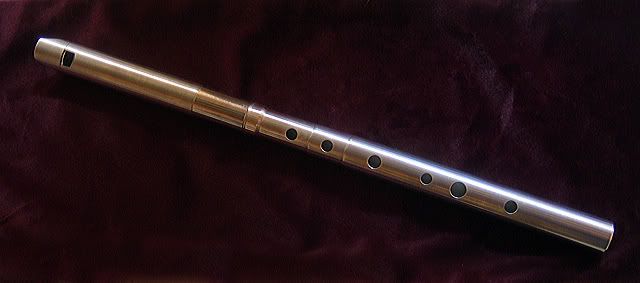
Then this.

There are more pics here: https://forums.chiffandfipple.com/t/cp-new-concept-design-from-lochlan-whistles/61512/1
Plunk111, sorry but I think you are wrong. If you check out the low D Garvie whistles, it is a reverse taper from the top hole to the bottom http://www.garviebagpipes.co.uk/info/whistle/whistle.html. BTW Greg Russell suggested his reverse taper design (cylindrical bore within a thickening and therefore tapering aluminium tube) facilitated an easier to play upper second octave (thinner metal near the B hole) while maintaining a strong bottom end . . . a kind of low whistle holy grail. But the Garvie has a tapering bore, I wonder whether that has the same effect or something similar. Again I wonder, if such designs offer this benefit, why are more makers not making them either of these ways?
Okay I’ll partly answer my question. Clearly Greg Russell’s design with a varying thickness of metal tubing I would imagine requires sophisticated machinery and a lot of expense. But is the cost factor relevant, with the other tapered design? If aluminium/brass whistles can be made with a tapered bore, would it be that much more difficult to do it with a reverse tapered bore, IF of course (big F), the design produced an easier to reach reach high end coupled with a strong bottom end.
Figured I probably was… 
Thanks Feadoggie, I thought I had seen them somewhere before!
There may be a bit of confusion here due to the terminology, I guessed that a reverse-tapered bore was actually an expanding bore. But no, that instrument actually has a straight bore with an expanding body, I think? Does that make any more sense?
Right, confusion all around here. I had searched for the Lochlan thread myself just to try to understand what was being discussed here. I understand what a tapered bore provides in flutes. I understand what a tapered head provides in flutes. And I understand what back boring provides in general.
The Lochlan approach leaves me scratching my head.
I read the Garvie web site description months back and had no real grasp of what they were saying. I have seen the term “reverse tapered bore” used to refer to the conical bore of the typical early 19th century flute. Reverse compared to what? So I was not sure what was going on inside the Garvie. So thanks to Ian Parfitt for clearing things up. It is a bore narrowing from the joint to the bottom hole and then back bored from the distal end up to the bottom hole just like many flutes.
Feadoggie
Ah! Got it now! Double tapered! Confusing, isn’t it?
So what is the advantage of such a design and why do not more whistles follow that tapered design if it has inherent advantages? Is it down to cost? Or have whistle makers historically allowed the design of the cheaper Clarke, Generation to dictate the design of today’s more sophisticated upmarket high and low whistles, ignoring the history of flute design. I’m not pointing the finger at anyone here, you understand, and in my ignorance, it may be that flutes have necessitated a different design. I’m just interested to know. If there is a way of making a whistle with both strong bottom notes and yet easy to access high second octave notes, as is suggested by the makers of reverse tapered bore whistles, then why aren’t they being made by more makers? Maybe there isn’t an easy answer. But I would still like to get to the bottom of why reverse taper whistles are even made at all.
I think it’s certainly much more economic to simply take a ready cylindrical tube and drill tone holes into it, or to take a sheet of tin and roll it to a simple tapered bore. For a complex double-tapering (as described by Feadoggie) you really have to carve out a rod of wood or polymer or a similarly workable material. So the material may be more expensive, but especially the process itself is much more difficult and time-consuming. At least, I wouldn’t know a simpler way to achieve this.
Oh you guys! This is a really good bunch of queries. Please understand there is no malice in any of my comments below. I’m just trying to draw out some alternate perspectives on things, some of which are held strongly as gospel in many whistle churches.
Them’s apples and oranges. Ain’t they? Cylindrical versus conical. Tin versus brass. Cedar versus plastic. Etc., etc. I really think folks make what they feel works best, for themselves at least.
Sophisticated? Upmarket?  OK. I’ll admit that we may be more worldly and globally aware nowadays but I wouldn’t think 19th and 20th Century musicians or instrument designers were not knowledgeable, sophisticated or discriminating. Remember that live music was the only music for much of that time. There were more players per capita I believe. If you wanted music you had to make it yourself. And there always were low whistles. Really! Look in the Dayton- Miller collection. So here we are in a global market with maybe a couple thousand players of the instrument that might be in a position to purchase an upscale whistle. So many makers and so few buyers. We do have different materials. Thank you NASA. ANd we do have better tools. Thank you military industrial complex. But they don’t seem to be used for making radically new designs. What’s a designer to do to distinguish themselves?
Well there’s a new strategy. Let’s go right to the unsubstantiated marketing claims. Actually, I’m kidding too much there. I am sure,as I said above, that those makers believe what they say. But beware, some others may not have a clue. You have to educate yourself and probably buy a few whistles to test out the claims yourself. I’ll quote another website from a maker of instruments for the counter argument. “Acoustical science can find no compelling acoustical reason for the reverse tapered bore. There is nothing of consequence which can be done with a tapered bore that can’t be done with a straight bore. It’s now generally felt that the shift to tapered bores in Europe during the Sixteenth century had more to do with construction methods than anything else.” Who can you believe?
It is possible and there are many ways to approach just that. The reason that you have so many disparate designs has to do with, as I said above, that each maker believes that they have the way of doing that in their own designs. Many ways to skin the cat, so to speak. One issue is that “strong bottom notes” and “easy to access high notes” are relative terms and dependent on the playing experience of the maker/designer. So things may be all over the map at the outset. But the maker makes what they think is an improvement or at least the best that they can make. Do all whistle makers actually play the whistle well? Probably not. But they likely have gotten feedback from other players. So in that case they are depending on the experience of third parties which may or may not be applicable to you and your experience and preferences. They still make the best whistle that they know how to make.
And I do not think that whistle makers ignore history either. If they did then we wouldn’t see so many design elements re-hashed over time. The fact that some may “claim” the element as a new idea may be due to their ignorance or just the fact that they are the only one using it at the time. Who knows for sure?
I should have started there. Would have been a shorter post. Right, no easy answer.
It’s a belief system.  Again, I exaggerate. But you can read the several really good books and websites on flute and woodwind physics and get a sense of what the tapered bore or back boring is all about. It’s really too much to go into here. I remember talking with Nelson (McAvoy, RIP), a one time forum member here, at Augusta Irish Week a few years ago. Nelson literally wrote the book on flute physics. Yes, he did! (He had a cracker of a cocobola flute too.) And much of what he talked about was way too deep to condense into a paragraph here. At least I can’t sum it up. Now, is the tapered bore the one and only true way to do things? Some makers do not think so. They go to a different whistle church.
The bottom line to it all is that you still have to play the whistle. To paraphrase a once honored but now disgraced user of PED’s, “It’s not about the whistle”. It’s not. It’s about the music. It’s about playing. And remember it is called “playing” so don’t take things too seriously. Buy as many whistles as you can. Find one you like ( for your own reasons) and play the heck out of it.
Just my observations, mind you . Trying to promote some discussion.
Feadoggie
Good answer Feadoggie. One thing you didn’t mention was the economics involved. The final cost of a whistle depends (to some extent anyway) on how much work goes into it. You can have all the double tapered/reverse tapered/expanding bodied options you like but what will the bottom line be? Especially compared to a whistle that uses a stock standard line of tubing. And especially when you compare the differences in sound that the extra treatment may/may not deliver.
Hi all
When you buy a Whistle (or other instrument) you get all the years and experience of the maker whether this is a commercial manufactuer or a individual hand crafing maker.
What I feel is the difference is the years of learning a craft that an individual maker has that can’t be acquired by a mass manufactured instrument how ever good, there can be however exceptions thank goodness. But these are very very rare.
Ask any solo violinest about the difference between a very good German factory made instrument and a Garnerius or Stradavarius and they will say that there is a spirit that lies within an instrument that has been hand crafted. Those who are fortunate to own a Copeland or Coldie and others that I in my inexperience am unable to list have something that transends intellectual/analytical understanding. There are many other makers who make whistles of wonderful quality but this is always in the hands of the person who attemps to play these works of art.
I am fortunate to have such a work of art.
Please keep posting your thoughts and opinions. We on the forum are blessed with the knowledge of so many individuals.
Ian
I agree wholeheartedly with you Ian.
Thanks for your replies especially Feadoggie for his indepth thoughts. Much appreciated.
“Acoustical science can find no compelling acoustical reason for the reverse tapered bore. There is nothing of consequence which can be done with a tapered bore that can’t be done with a straight bore. It’s now generally felt that the shift to tapered bores in Europe during the Sixteenth century had more to do with construction methods than anything else.”
I guess I came to create this thread after re-reading the old thread on Greg Russell’s new design of the Lochlan, the reverse tapered-bore, pictures of which have already been posted along with a link to the thread. I found it an interesting thread in which Greg goes into much depth regarding his research and findings. I do recommend reading it from end to end because he found affirmation of his findings from other C & F members including whistle makers. His tapered bore however was a cylindrical bore within an increasing thickness of tube, giving a thin tube at the B at a thicker tube at the D. And his design seemed to produce that “holy grail” idea of a strong low D coupled with a high second octave that didn’t need a lot of push. I wish I could try one to see if it is true. It is good to see such innovation.
However, I recognise that such unusual designs would be costly and possibly not economically viable.
You have to educate yourself and probably buy a few whistles to test out the claims yourself.
Buy as many whistles as you can. Find one you like ( for your own reasons) and play the heck out of it.
Valid thoughts Feadoggie but, sadly, as a missionary, I can’t afford any degree of WHOAD . . . much as I would like to . A high whistle and maybe a couple of low whistles is all I can afford. I don’t have the luxury of experimenting.
Those who are fortunate to own a Copeland or Goldie and others that I in my inexperience am unable to list and have something that transends intellectual/analytical understanding.
Having said, I have found a whistle that is, to me, near perfection . . . a Goldie Low D and I have to agree with Ian’s thoughts. It is a work of art and I’m fortunate to own it. There is something almost like alchemy at work. Many thanks Colin!
So not tapered bore at all!
But the outside of the whistle is also regarded as the bore so, in fact, yes!!
Umm, I wouldn’t agree with that, personally.
Can we have a show of hands?
Sorry to be such a … bore.
Feadoggie
Having said, I have found a whistle that is, to me, near perfection . . . a Goldie Low D and I have to agree with Ian’s thoughts. It is a work of art and I’m fortunate to own it. There is something almost like alchemy at work. Many thanks Colin![/quote]
Look inside the bottom end of the whistle and rotate it so light shines through the tone holes. Is there a perturbation near the E hole. Perturbations near the end of a low whistle give strength to the D and E notes.