If a wood flute, or parts thereof, were lined with metal, then, perhaps to help prevent any cracking of the wood, what is the best choice of metal?
Don’t think it matters. The coefficient of thermal expansion of the metal is very small compared to the alarming rate wood shrinks as it dries. So it’s wood movement, not metal movement that causes splitting. I’m sure you’ll find figures on the web for the various metals.
Temperature changes are also likely to be small (normally your flute doesn’t go where you can’t) and remember that temperature changes are referenced to O degrees Kelvin (-273.3 C). Humidity changes of 80% are probably available between say Washington’s outdoor summer humidity and indoor central heating dryness. And those extremes can apply for months.
So the challenge is to find ways to line the wood with metal that do not set up competition between them. I think make a fine neat slit along the back of the wood, and glue the wood to the metal only around the embouchure. Essentially like my “silver head”, but use a full size chunk of wood.

Won’t work for the barrel of course, but use it in conjunction with my “New Improved Tuning Slide” barrel.
But let’s hear other ideas!
Terry
Mercury ?

…john
Heh heh, I thought of that too. Also aluminium cooking foil!
Terry
Pre-cracked! Kind of like the expansion joints when you pour concrete… Maybe a little piece of elastic holding the wood together? 
With the lined Head that I made, I bored the head larger then the liner, allowing for future shrinkage. Made it a little tighter around the emb hole and dammed the end by the slide, and filled it with gorilla glue. The gorilla glue foams up and creates a custion between the wood and liner.
I won’t know for 100 years or so, so I will have to reincarnate to find out if it cracks. We shall see…
One of the problems I found with the antique flutes, the makers scored the liner with a awl and raised the metal to prevent the liner from spinning in the head. Most of the cracks follow these scores. The wood is usually shrunk as much a 1mm in the inner diameter of the head. 
Exactly so, and for precisely the same reasons.
Interesting aside - I notice that, at least around here, concretors have stopped using that squishable expansion jointing (felt soaked in tar, technically referred to in the trade as “Black Sh1t”). They pour paths as a continuous stream of concrete, then when it’s dry they come back and run a diamond saw through it at regular intervals to create a larger number of narrow gaps. I think the logic is that the Black Sh1t used to squeeze up in hot weather and could cause a tripping hazard. Or at least get all over your shoes. So maybe fine narrow gaps are in! Trust the McGee to be at the forefront of fashion. (Hurrumph.)
I won’t know for 100 years or so, so I will have to reincarnate to find out if it cracks.
In your line of business, I assumed you were planning to anyway …
And with three kids under ten, and a mortgage measured in Gigadollars, I’m still going to be working by then!
Terry
Have they introduced a new currency in Oz, then, Terry? Can we expect you to price your flutes in same soon, or will they be in Jigadollars? Any idea on exchange rates?
Yep, the Jigadollar replaces what we had before, the Reeladollar.
Terry
Thanks for the reply. I assumed that the metal should not rust or corrode, and that it should not expand too much, although apparently that is not a big factor. On another, quite recent FF thread, Clinton’s “flute for India”, an antique conical bore metal flute was featured, which appeared to have an embouchure in the form of a cylinder around the head. The apparent cylinder could have been made of bone or ivory, a material which perhaps could crack, as wood could. So, I wondered…
Thanks!
Beware: newbie question
So… If you are lining the wooden flute with metal, why use wood at all? (which I guess would lead to the “silver flute”)
Is the wood just being used for aesthetics?
…john
(john, who would be playing something else if the flutes were entirely metal)
indeed, unless my eyes deceive me, it does appear to have cracked along the underside:
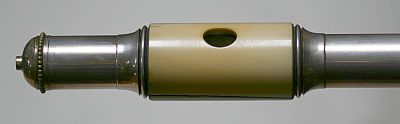
Yes, from here in cyber space it does appear to have a crack, but that does not detract from my liking of it. It is a wonderful antique, warts and all.
i suspect it is perfectly playable, since the barrel seems to be entirely metal and the ivory is overlayed.
i wonder if the baking-soda and superglue trick used by luthiers to repair bone nuts would work in a case such as this…
I see it as a model, for a future flute.
Flute manufacturing, anybody?
Hi,
The wood is important for the chimney depth of the embouchure hole. The smoothness, porosity, density and chimney hight of the material effects the tone of the flute. How Boehm got around this, was the raised lip plate.