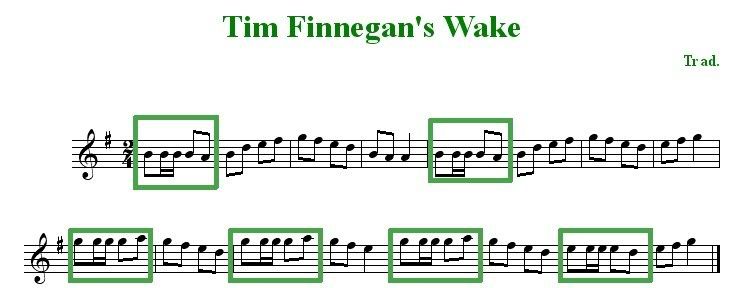
Well, since Bill wrote it out that way, I guess he wants you to play it that way.  Meaning, with those notes tongued. Either single tongued (TA TA-TA TA), or double tongued (hard: TA TA-KA TA or soft DA DA-GA DA).
To figure out what else you could do with it, there are several different approaches.
First, you can realize that the tune is really the melody to a song, with lyrics. So go take a look at the lyrics on Mudcat ([u]click here[/u]). Then try singing along, and notice how the words suggest different rhythmic variations of the melody.
[Tim] Finnegan lived in Walkin’ Street: |B/B/ B BA|Bd ef|
{He] had a brogue both rich and sweet: |BB BA|Bd ef|
[And to] rise in the world he carried a hod: |g f/f/ ed|e/e/ f g2|
and so on. Any of those variants would sound good, appropriately tongued.
Another approach is to notice that the form of the tune, as written, is that of an Irish 2/4 polka.
Now normally, when you have repeated notes over 3 beats (i.e. 3 eighth notes here), you’d think of substituting a full roll: |~B3 A|Bd ef| = |B{c}B{A}B A|Bd ef|. But that’s not so true for a polka, where you want the strong beats to stay strong and distinct. Which brings you back to the variant patterns above, or possibly a few other polka patterns, such as |B>B BA|Bd ef| or |B2 B>A|Bd ef|, with a bit of dotted swing, and again with some degree of tonguing.
You can also play around with phrasing patterns, such as |B/B/ B ({c}BA|B)d (ef)|.
There’s no one right solution, but there are several wrong ones which break the polka rhythm.
I’d say it’s OK, as a learning exercise, to experiment with different cut and tap patterns, like |B {c}B/{A}B/|{c}Bd ef|. But keep in mind that these cuts and taps may not give you the best effect, aesthetically. In general, polkas rely less on rolls, and more on tonguing/phrasing, and cuts on the strong beats.
Welcome to the world of Irish trad music.