Hello all,
I have a quesdtion about Seth Gallagher’s chanters - does he scallop the holes, and if so, how much are they scalloped?
Thanks,
James
Hello all,
I have a quesdtion about Seth Gallagher’s chanters - does he scallop the holes, and if so, how much are they scalloped?
Thanks,
James
I don’t know that I’d call them exactly scalloped, but maybe slightly. They’re not sharp-edged like a Lynch chanter. I guess they’re a tiny bit scalloped. I can post a picture of my chanter’s holes tomorrow if nobody else does before then.
Thanks! I would like to see that. Does it make the finger holes easier to feel?
I have a Gallagher C chanter, #76 I think, and there is no scalloping of the tone holes. I also have a Lynch D chanter and the tone hole finish is quite similar.
dave boling
The only Gallagher chanter I have ever seen with scalloped holes belongs to Kynch O’Kaine who is sometimes on this forum. He ‘asked’ Seth to do it, and after some reluctance, finally did. Sounds great. not sure what else he had to do to compensate for the change in tuning that comes from scalloping the holes.
Only one of my chanters has holes as such, made by Benedict. He adamantly states that scalloping is done for tuning and tonal issues… tonal more than anything else as I recall. To quote “i don’t do it for the looks of it.”
I know this is a much discussed topic here, so perhaps check into some of the other threads. But what I notice and have often pondered, is that as the finger leaves the tonehole, when the hole is scalloped, air can squeeze out through the scalloping in a very different way than if the hole is not scalloped. There are some architectural analogies that I could make, but in my very humble estimation, this adds to the buzziness of some concert pitch chanters (with scalloping)…
back to tenure document now… must resist chiff and fipple procrastination… give me strength!
I have a SG chanter that has slight to moderate scalloping that was done by Seth. In addition to any tuning benefits (or detriments as the case may be), I would say in my opinion that it is helpful for a new piper to find her or his way around the holes until they gain some perficiency.
Neil
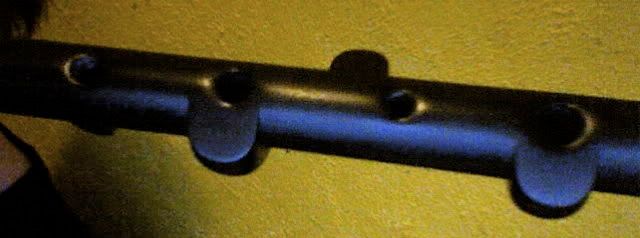
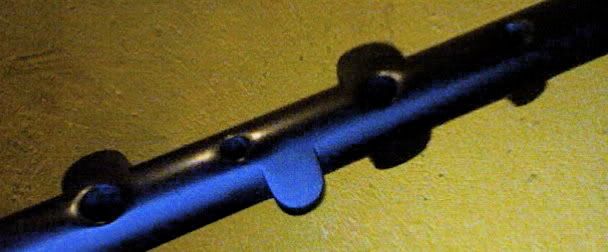
Thanks for the replies - it does look like there is some scalloping of the holes in your pictures, seisflutes. Thanks for posting them. I would like to get on Seth’s waitlist, but I have only gotten to hear his chanters, not see them up close. I would like my next chanter to have some scalloping, mainly for being able to feel the holes better, as Piobairi mentioned.
Actually, I think I have met both of you briefly at last year’s East Coast Tionol. (At least, I recognized seisflutes from her mypage site). I am hoping to see some of Seth’s chanters up close this year. And, if someone is so kind, to play one to try it out.
Cheers,
James
My S.G. chanter, #46, is slightly “scalloped” on the front tone holes. I specifically asked Seth to scallop the back D to facilitate the brushing triplets. In my experience, scalloping just makes for a more comfortable grip on a chanter + ones I’ve played that are left sharp don’t seem like the work is finished to me. Mine looks exactly like Kelly’s in the front anyway. I’ve found this work to have little effect on tone or tuning if just done with a slight curve.
Matt McNeely
James,
I have a Gallagher chanter, and likewise my chanter #204 is slightly scalloped around the holes just as in the picture above. So I think Seth is pretty consistent with that type of chamfering around the tone holes.
Ailin
PS - Check your PM!
As long as we’re on the subject of SG…
(& I simply love  my full concert SG set)
I have chanter 191 (before the modification he made to the bore design sometime in '03…)
Has anyone here taken/sent their chanter up to ColdSpring to be modified? Let’s talk! 