I was going to title this “Swollen Joints”, but I thought that might be too confusing.
Following a FB discussion on the topic of managing humidity in our wooden flutes, I would like to ask the consensus among the more experienced players here.
I have a lung condition that results in a lot of moisture in my airways. When I play my wooden flutes, the head joint to barrel connection becomes very tight after about a half hour of playing. I swab regularly, but by the end of a practice session, the pieces are soaked and often tightly stuck together.
The tenons are thread wrapped, and I am reasonably adept at rewinding as needed. I keep minimal thread on the on the troublesome tenon. The problem is that when the wood becomes saturated, the end of the joint flares to the point that the wood-on-wood connection is worryingly tight.
I started off my morning by adding a little extra oil to the open grain where the upper body joint enters the barrel. (Not on the threads) I am hoping that this will prevent absorption at the business end of the tenon. (Of course, it is just as likely to trap moisture IN the wood, and I’ve just made the problem worse!) Please tell me if you think this is a bad idea.
Shoot me an email if you want me to take a look at mine.
First thing to look at would be giving both the socket and the bore a good oil. Get it good and oily, let it sit for an hour and wipe off excess, and do it again, leave it over night, wipe excess and give it a try. It could be that the bore is just a bit too dry. Oil will help prevent (not eliminate) moisture uptake and therefore swelling.
Make sure the threads are good and greased. Not overly so, but with a nice layer of cork grease on them to prevent the fibres from absorbing moisture that escapes around the tenon.
In general, while removing material should always be a last resort, if you’re experiencing too much swelling despite all of the above, I’d recommend just taking a bit of sand paper (220) and slowly removing a small amount of material from the wood portion of the end of the tenon. Not too much, but take a small amount off, grease the threads (sawdust will gum them up a bit so cover them with some plumbers silicone tape while you sand) and give it a go.
If the problem is more severe and a small amount doesn’t do it, there are some more severe steps that can be taken with caution. They all amount to reducing the contact of wood to wood when swollen, mostly aimed at making the connection more conical by either removing more material from the tip of the tenon, or from the outermost 1/3rd of the socket. Fairly easily doable, but also fairly easy to over-do!
Thanks Travis! The problem occurs on both of my wood flutes, but even more so on my rescued small bore boxwood. I agree that removing material would be a last resort. I’m going to let both instruments be for the rest of the day and reapply oil in the morning if it appears that the wood has shrunk to a manageable size.
Boxwood can be THIRSTY for oil when it’s not saturated. It’s easy to really oil a boxwood, to a point where you think it’s overdone, and come back an hour later to see a matte surface. I’d oil that bore (and a little on the exposed tenons, careful not to get too much on the thread) until you check on it an hour later and still see a good bit of oil on the surface, then I’d wipe it down and oil it once more. Let it sit for a day before assembling after this.
With luck one of the makers here will make a suggestion. One of my flutes came new with the end grain of the tenon sealed with superglue.
On another flute the tenon went slightly oval and I got wood-on-wood contact. I worked out where the contact was happening by trying the fit with the thread removed and carefully sanded the tenon down just in that point.
Sanding the socket sounds risky - that what you are trying to avoid splitting due to the tightness. Damaged tenons are fairly easy to fix, sockets less so. I have this from a woodwind technician who heard my flute hit the ground in a pub car park.
I’m not quite sure from the descriptions above, but I did have a problem with one particular flute.
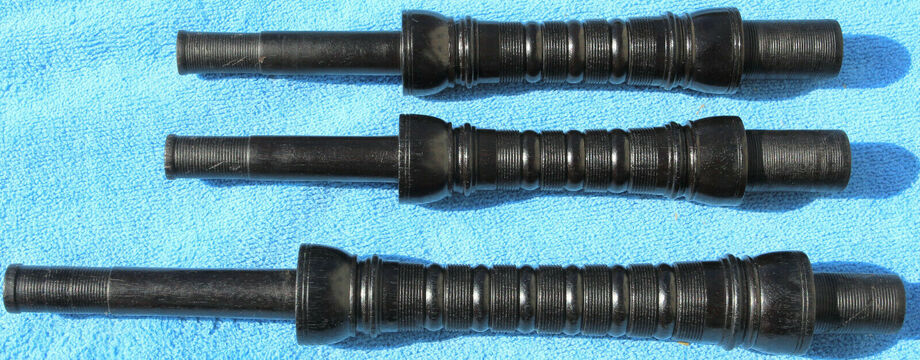
The problem was with the part of the tenon which on Scottish Highland bagpipes is called the “hemp stop”.
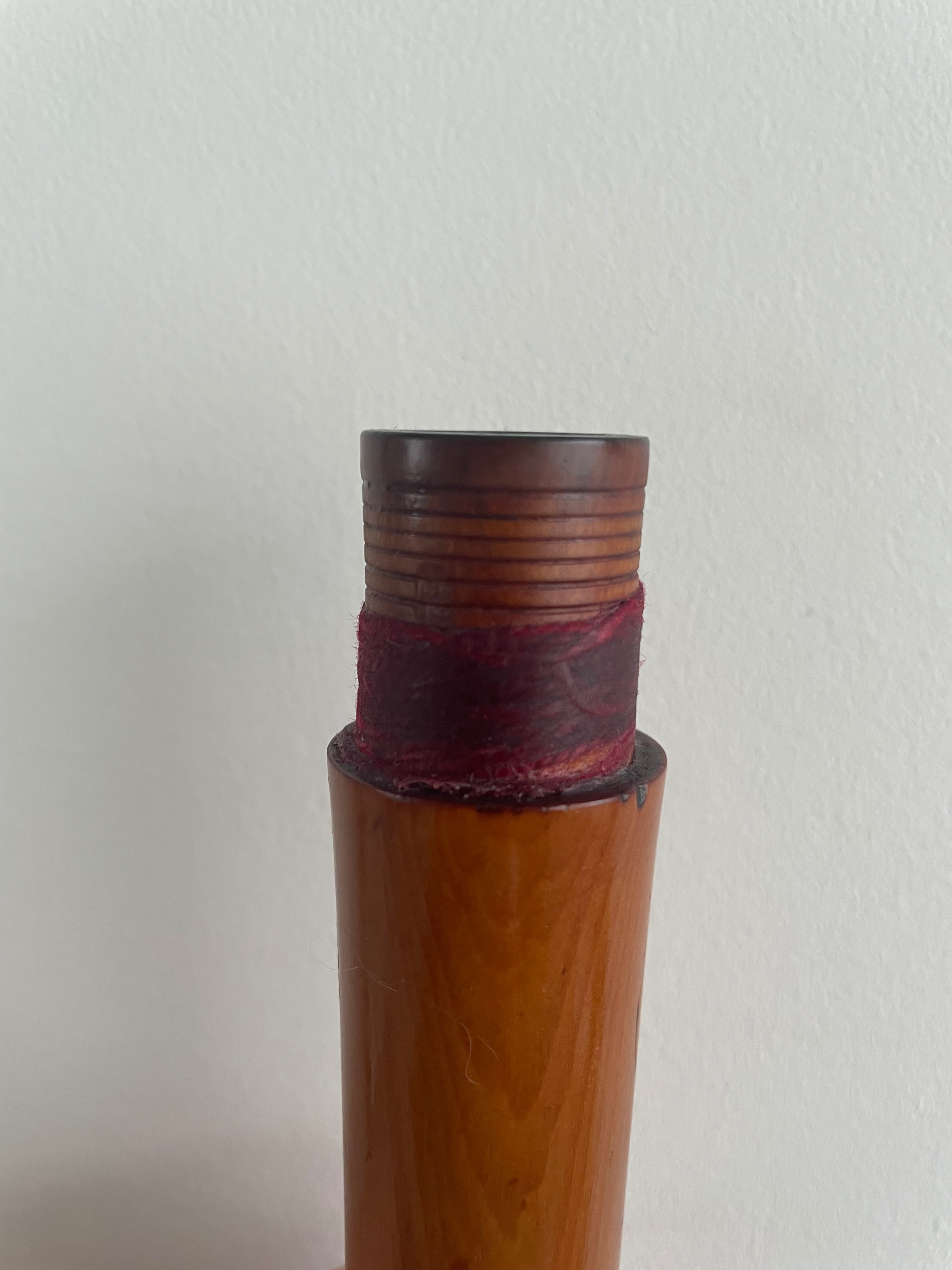
On those bagpipes it’s standard not to have the tenon all the same thickness, rather, the area where you wrap the hemp is lower/narrower and then there’s a thicker ring of wood sticking out a bit at the end of the tenon to stop the hemp from going off the end. (On some vintage bagpipes the hemp stop is ivory.)
Anyhow one of my (modern) wood Irish flutes had a prominent hemp stop turned into the wood, it was too “proud”, and with too much playing would swell and get in contact with the socket. My solution was a simple one: I filed the hemp stop down a bit.
I hemp my flutes the same as my pipes, with the pipers’ yellow hemp, well-waxed with soft beeswax, which makes the wrapping impervious to moisture.
Thanks PC. I was planning on posting an update on this today. I had an inkling that something like this may have been in play. To be honest though, I think the worst of the problem was (is?) that I don’t know how to properly care for a wooden flute. It’s clear that I had no idea how much oil is required to protect the wood, particularly on the open grain of the tenon.
As you can see from the attached picture, there is indeed something of a hemp stop on the tenon. Because the wood had absorbed so much moisture I had to strip back about half of the thread just to assemble the instrument. (Be kind. Don’t judge)
I spent a fair amount of time this past week alternately allowing the wood to dry and oiling the bore and end grain. I had no idea how thirsty my boxwood banana could be. The flute had been neglected for decades, and likely needed to be broken in with a good oiling regimen. I am now able to use the instrument for a good amount of time without any appreciable expansion.
One word of warning–and this applies to oiling flutes in general as well: never apply any sort of bore oil to the bore or tenons of your flute if they are at all damp. I think it’s generally a good idea to allow your flute to dry (in a climatically-controlled environment, of course) for 24-48 hours before oiling.
If you do a search through the C & F archives, you’ll find multiple posts from hapless, well-meaning flute players who acquired their dream flute, lovingly swabbed the bore with just a little bit of oil after each playing session, and then were heartbroken when the flute developed a crack.
When the wood of your flute absorbs moisture and then you apply a layer of oil over it, you’re trapping the moisture inside and not giving it anywhere to go. Sooner or later, something unpleasant is likely to happen.
We can probably assume it’s swelling of the tip of the tenon that is causing the jamming. Moisture coming down through the head and barrel collects at the tip and soaks into the end grain, swelling the tip.
I would be inclined to strip off all the thread and test the fit of the bare tenon in the socket. It should be loose. If you find any sign of friction, I’d try to locate it and sand a bit off that area. Sometimes you can see a shiny patch where friction has abraded the surface a bit. Use reasonably fine sandpaper, and fine steel wool to repolish. I use 240, 320 and 400 grit, and 00 steel wool to polish, but you probably don’t need to get that fussy!
And you really need to seal the end grain as well as you can. The end grain is what you are looking at when you point the body away from you. If you imagine wood as a bundle of straw, you can see how water is transmitted much more readily via the end grain rather than the side grain.
One approach is to let the flute dry off, clean off the end grain and apply super glue to the end grain. In theory it shouldn’t soak in, as the oil should have sealed the end grain. But if it does soak in, it confirms the oil wasn’t doing the job. You might even want to apply more, until it stops soaking in. At that point, wipe off any remaining glue, and leave it to dry totally before reassembly.
You haven’t mentioned what sort of oil you are using. I feel some oils aren’t really up to doing a good job of sealing. I reckon they wash out. I tend to go with the mineral based oils they sell for clarinets & oboes.
Hope something there might help you sort out the problem.
Thus far I have been using almond oil. (I know there are as many different opinions on this as there are actors to play Hamlet.) I like it, but I don’t think it likes the embroidery thread that I use for winding my tenons.
I am holding off on making permanent changes to the wood - at least until the season has fully changed and I can see how the wood behaves as the humidity rises.
I have been very careful in this regard. The flute came to me in quite poor condition, having been neglected for decades, if not generations. I will mark your words and blame myself if I cause further damage.
I am holding off on making permanent changes to the wood - at least until the season has fully changed and I can see how the wood behaves as the humidity rises.
OK, here’s a thought. Try smearing the tip of the tenon with cork grease and see if that reduces the absorption of moisture and subsequent swelling of the tip.