Playing C sharp I find very difficult to play on my low whistle. Even anchoring the whistle with the bottom hole covered it feels unstable. Can anyone think of good reasons why I shouldn’t cover the two or even three bottom holes when I play it since they appear to make no difference to the pitch or sound.
Because 1. over-gripping’s not the answer to an ‘unstable’ whistle and 2. it’ll add cross-fingering awkwardness to some note-to-note transitions?
I don’t do it but others do.
http://www.rogermillington.com/siamsa/brosteve/notlifting.html
Didn’t someone start making thumb rests for low whistles? I thought I saw a topic once upon a time…
But anyway, if you can get your hands on a thumb rest like Susato uses, it could solve the issue.
EDIT to say:
Check this out: http://www.susato.com/konakart/SelectProd.do;jsessionid=92644BF8AEBF3E442141C5008ED0C896;jsessionid=56AEB32A7B281242EB49F53F18C39DBC?prodId=2636&manufacturer=Kelhorn+Corp.&category=Susato+Accessories&name=Susato+Thumb+Rest&model=STHR1
Hi, Mike: At the risk of being smacked by an Overton or MK, I think that covering all 3 tone holes of the right hand on occasion is completely acceptable. I find it especially useful when moving to the vented d. Yes, I can hear a slight difference in timbre on some whistles, but nothing that is relevant, in comparison to dropping one’s instrument.
Cheers.
Byll
I’m with Byll on this with the operative words being on occasion. Sometimes it fits, sometimes it doesn’t; better on fast passages than those slow lingering notes, but definitely a useful technique in certain situations.
Best wishes.
Steve
Sure, I can.
If your grip is unstable when playing C#, it means your grip is inherently unstable. The C# is just exposing your bad balance that’s there all along, but “hidden” when other fingers are down. And that instability can affect your overall agility on other notes.
As Peter said, over-gripping is not the solution. Instead of fudging the C# with additional fingers, you should figure out what’s wrong. Don’t work around the problem, fix it.
If fixing it means a thumb rest or thumb strap / neck strap for now, that’s OK.
But you should examine your position. Playing C#, you should have a stable 2-point anchor between the thumb+B3 finger on the bottom, and your lips on the top. Your top thumb might push the whistle slightly upward, toward the upper lip. Your bottom thumb should be somewhere between the B1 and B2 holes, and shouldn’t move around as you play.
Try this: Play C# with only the thumb+B3 anchor. Then raise the whistle to the horizontal position, straight out in front of you. Now remove your lips and back your head away from the whistle. You should be able to hold and balance the whistle there with only your bottom hand anchor grip. (Do this over a bed or something soft, in case you drop it.)
Maybe you’re holding the whistle too vertically. Try angling the bottom of the whistle up more toward a 45 degree angle. This will allow both thumbs to play a more effective role as a passive supports underneath the whistle.
On the question of multiple fingers down, there’s nothing inherently wrong with that if it sounds OK. Good players use lazy fingerings all the time. For example, if I play |d C# d| with d = oxx xxx, I’m going to finger C# by simply lifting the top fingers, then put them back down again.
But you shouldn’t have to deliberately put extra fingers down just to stabilize the instrument.
Hope that helps, and good luck.
Thanks for all your thoughts and advice. I prefer to hold the whistle more vertically than 45 deg so that does add to the the problem but don’t want to use thumb rests etc which I’ve found scratch the whistle. But in trying MTGuru’s tests, I’ve discovered that the instrument is now not as unstable as I first thought, substantially due to a recent change in low D. My new whistle has a large 11mm bottom hole into which my ring finger pad actually sinks, creating a much stronger grip. But I do also like the possibility of being able to use the bottom three holes to play C sharp on occasions.
Forget thumb rests and straps, man - it’s not a saxophone. Seems like you’re not going to go down that route, from your previous post.
The answer’s obvious - what else is your little finger for, other than to hold the whistle when all other fingers are off? Assuming you play right hand below left, keep the little finger on your right hand on the whistle all or most of the time. Doesn’t affect tone cos it’s not covering a hole, but keeps a hold of the instrument. Case solved!
Good luck.
m.d.
You obviously have strange shaped hands or incredibly long little fingers. My right hand little finger can’t even touch the whistle when I’m using piper’s grip . . . and I have long fingers.
I would not think so! I have small hands and with the extra added feature of little fingers shaped like a dog’s leg that shorten their reach even further. Ok, I guess that is strange.  But I can still balance a low D or low C with my little fingers and thumbs.
One of the things that the P-grip does is to move your little fingers closer to the whistle body - when you are approaching it right. It does not really matter whether you are using the thumb and little finger of the right hand, the left hand or both hands to balance the whistle but the P-grip should allow you to do that.
And since you have long fingers you could maybe try to pivotfromthe second joint of the index fingers too. That would get the little digits even closer. And you don’t have to really take you hands off the whistle to play C#. You just have to open the holes up to get the note. Your hands and fingers can still be on the sides of the whistle. It’s all about being relaxed, playing loose and seeing what works for you.

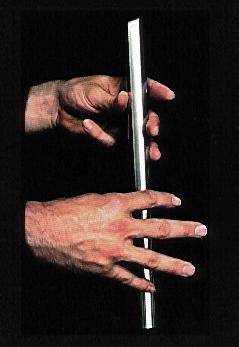
Your only other option, seeing as how you don’t go for the thumb rest of neck strap idea, is to develop a very strong grip with your lips. 
Feadoggie
Thanks for your thoughts. But you haven’t taken into account the distance between the D & E holes. If it is a stretch, then the ring finger will be more angled downwards, pushing the little finger further away from the whistle as in the first photo . . . but accentuated further (I’m not sure what the significance of the second photo is). But it’s all somewhat academic. I have what I consider to be a good orthodox piper’s grip and have now found with my new big hole Goldie that the D hole is large enough that my ring finger sinks into it providing me with extra support and giving me much better stability playing C sharp.
Well, yes I have. I’ve been at this for a while now and have spent some significant time working with players that want to take on the low whistle. May I humbly suggest that you are swimming against the tide when it might be easier to float down stream as the rest of us have learned. The wise old fools here (speaking mostly for myself) are trying to tell you what the straight skinny is. We all went through this at one time and have helped a few newcomers as well. What was it that the man said about ears to hear and eyes to see? Teaching is easy. It’s the learning that is hard.
Hey, this isn’t so easy. You asked for help and we are giving it without the benefit of seeing your hands on your whistle. The pictures may not be the best but they were ones that illustrated a couple things I suggested. I may have assumed too much by offering them to you as aid.
The first photo shows standard grip up top and p-grip on the lower hand. The lower hand is doing the balancing with the little finger. That was my point in using that photo.
The second photo shows how you can pinch the whistle between the thumb and index finger of the upper hand too. You can do the same with the lower hand as well. There is no real reason that you should ever feel like the whistle is out of your grasp. As time goes on and you become more experienced you will naturally develop all the bad habits we’ve alluded to, like lazy fingerings, which I feel are just something all players discover in trying to be as economical with their finger movement as possible. You don’t have to lift you fingers very high off the tube to let the notes vent themselves properly (on a well designed whistle). And you realize that in some cases, leaving fingers down causes no ill effects. Then you don’t think about it much, it just becomes habit.
The pivot point on the index finger does not have to be absolute either. It would not be uncommon to pivot closer to the first joint for some and more to the tip of the finger for others. The only real requirement is that the part of the finger you use needs to be able to seal the hole with as little stress or effort as possible. It might actually be better to pivot on the middle finger to find your best grip.
And no matter what we suggest, what seems to work universally is to keep trying until your hands settle naturally into what works best for you Our hands were not created from a one-size-fits-all mold. But they are marvelously well designed to enable almost all of us to play low whistles.
We can talk about the physics of large hole sizes on low whistles some other day. No need to open that manhole today.
Feadoggie
It’s late so I’ll just say thank you for your long post and I’ll get back to you tomorrow about it. Meantime I would be delighted if you wanted to P.M. me on the physics of large hole sizes. I would appreciate any information you have on what I can expect from a big hole whistle. I’m still very much a beginner with only six months under my belt (barely enough to get the piper’s grip down pat) so taking on a big hole low D was a tough decision.
What’s obvious (since you put it that way) is the unhelpfulness of that answer. Few players I’ve met can manage using the pinky as the stabilizing finger on a low D whistle. It simply won’t reach. Hence the almost universal use of one of the alternatives - including ring/B3, or less commonly, a support such as a thumb rest or strap.
Chiffer pancelticpiper sometimes uses a neck strap. I sometimes use the thumb strap I made (shown in Feadoggie’s photo above left), but usually just ring/B3.
And some wouldn’t do it even if they could…
While I make far more use of my right pinkie on flute (see that thorough Boehm training!), I prefer to avoid it on whistle most of the time and (despite its being taught as ‘essential’ by some who I respect) would caution anyone considering it that it creates problems as well as solves them.
Actually, since it’s my hand and finger …
Despite appearances, my pinky is not actually balancing the whistle there. It’s barely resting on the tube, and at an angle insufficiently opposite the thumb to give any real grip. Of course, in the photo that doesn’t matter, because it’s the strap that’s supporting. But without the strap it would be B3 doing the work. And with this grip my pinky generally follows B3 in its up-and-down journey, so it is naturally down while fingering D.
Just to clarify … I wasn’t suggesting all the way up to 45 degrees. Sure, most people want it more vertical than that. But even 5 or 10 degrees up from your habitual position might feel different. After all, that angle is one of the 4 main embouchure variables anyway - along with lateral angle, mouth cavity, and lip aperture. So it might be worth experimenting with.
Thank you Feadoggie for your answer . . . but I tend to side with MGuru on this and Peter Duggan. The little finger doesn’t really help me much and I would prefer to avoid using it even if I could. But as I mentioned before, buying a big hole whistle has produced the unexpected benefit of an 11mm D hole into which my ring finger sinks and produces a much more subtantial grip on the whistle when playing C natural. Thanks for all your comments though and do come back to me, Feadoggie on your thoughts on big hole dynamics.