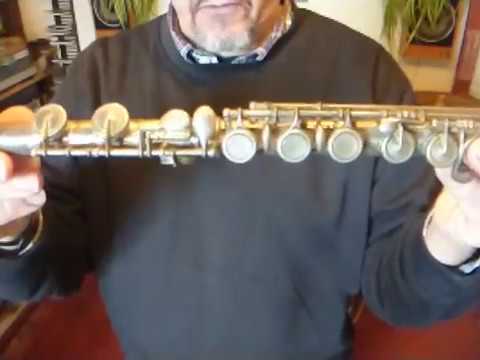
How do people normally turn the foot (on a 8 key) so that the low C and C# work (mechanically with the fingers… let’s ignore that those notes are hard)? But also so that the D# key isn’t all impossible to hit.
I think most ITM musicians turn the foot away and don’t use any of the keys  , but that wasn’t your question.
My hands are not very large, so the foot rotation position is primarily dependent on making sure that my small finger can reach both the C & C#; In that position, the Eb is still easy enough for me on my historic flutes.
With the R&R classic “claw-style” C/C# keys it is even possible (but not easy) to slide from (xx Eb to xx) C# to C (It’s easier of course to slide the other way). My problem there has to do with avoiding the accidental venting on my ring finger. And the claw on my flute is a little pointy, needing a small amount of filing.
Incidentally, for the first time I just noticed a little brass shim between the C & C# finger pads.
I tend to have the far edge of the Cnat key lined up in the centre of the last tonehole… On my flute, that is the perfect spot so I always know where my little finger will land on the keys. I like it so that my little finger naturally rests mostly on the C# key, with the tip just brushing the Cnat key. This gives me the easiest movement to Cnat going up, and D# going down.
“Incidentally, for the first time I just noticed a little brass shim between the C & C# finger pads.” I use a tiny bit of wadded-up cotton ball between the two keys; otherwise the C# key leaks slightly and makes my tone fluffy on the C. I wonder if OP has verified that the keys are leak-free. Those lowest notes are harder to play, but it is also very important to ensure that there are no leaks, otherwise you will struggle so much to play those notes, even with a really strong embouchure…
I agree that the low C’s took some time for me to play well. Consider the idea of breathing rather than blowing, but ironically training in the high (3rd) register has made the lowest notes easier for me.
My flute has been blessed with superb sealing on the low, pewter pads. Not a drop of the suggested “light machine oil”. I’ve also been told that the slightest leak anywhere in the flute kills the low notes. That reminds me to test my joint windings to make sure they seal absolutely.
I suspect that the C/C# pads could seal better, mostly since it does require some harder pressing of the keys to get them sealing well. When they do seal, I do get nice strong C/C#. Will have to check them, and see if maybe they can be improved.
My issue is rather that the often I accidentally open the E or D# keys; which has the expected result of nothing. So been experimenting with the position of the low foot and the right hand overall, and looking for ideas. 
Don’t really have a use for the low notes, but they do make good practise (that and the third octave).
My transverse fluting days are over, but in my 30 years of playing flute, the first half on an original c1830 Rudall & Rose, and the second half on an original c1860 Pratten, I always had the footjoint turned so that I could play Eb, Low C#, and Low C.
Opposite to many other people’s experiences, on my flutes those keys worked flawlessly. They always sealed perfectly, gave clear strong in-tune notes, and didn’t require extra pressure to close. In short they worked the way they were meant to work, the way the original makers built them to work.
The R&R had pewter plugs and, no, I didn’t have to put a drop of oil on each one prior to playing.
I used those low notes all the time. For example there are a number of Paddy Carty tunes that call for Low C or Low C#, however Paddy just played those notes an octave up (he apparently didn’t play those low notes).
Coming to flute from the uilleann pipes I was used to throwing in the note Eb here and there.
I’d also use the Low C# key to simulate a thing fiddlers do, hitting Bottom D as a double-stop, with the finger on the G string playing around C# and quickly sliding up to D.
(Like here, on the long Bottom D in the first bar) Bunker Hill (reel) on The Session
But! Every time I handed my flute to an Irish guy the first thing he’d do was turn the foot around so that the keys were rendered useless.
The second thing he’d do was shove the headjoint all the way in, the flute now playing really sharp.
2 Likes
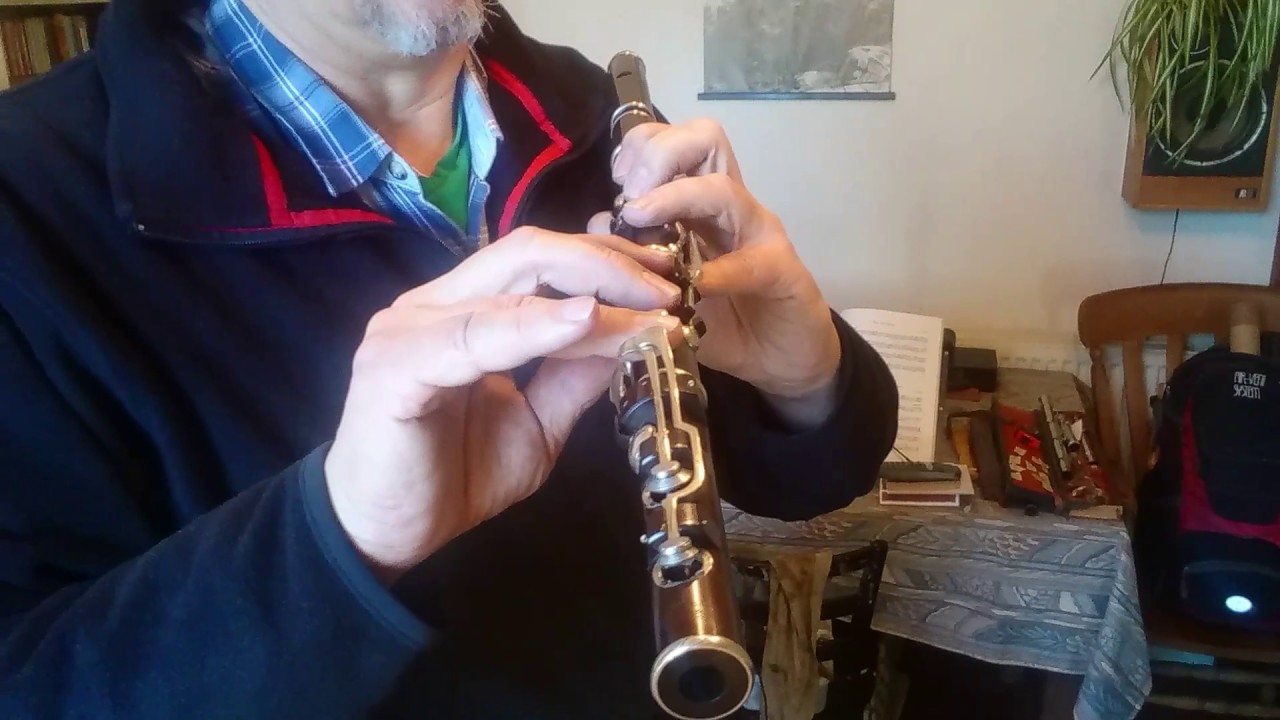
IMO/E, as a foot key user, the best approach in general principle is (assuming the key touches are correctly adjusted) to set up the footjoint rotation so that your R4 (little finger) simply falls directly and accurately onto the C# touch when you are in position to play a D, without accidentally hitting the C touch. That’s the neutral position. The precise ideal rotation to achieve that will depend on the proportions of individual player’s hands and their support posture as well as the design of the individual footjoint (they vary considerably!). Using that method of location/set-up for the player, the other keys will be as well placed for use as is feasible.
Here’s video I made some years ago for a customer buying a Rudall Carte 8-key flute who had exactly this question:
And here’s a similar one I made for a Böhm flute - the principles are exactly the same even though the mechanical design is different.