Sadly there are musicians who simply can’t imagine putting their instrument down and listen a bit. There’s some tunes that have many versions and even knowing the tune doesn’t mean you know the version of the person who started it, especially if you’ve never played with that person before. Ever had someone constantly playing an F natural when your version have an F#? 
I’ve just thought of a different way of putting it:
Some people may say (or think) that good guitarists can pick up chords on the fly. But here’s the thing: I have never come across ANY good guitarist who would try that in a session on a tune they didn’t know. If they do, they’re not a good guitarist.
Can’t say I qualify as “good”, but I would give a new tune a proper unaccompanied listen for at least one turn first, and that way if the tune’s evident chord structure is simple enough you can nail it fairly easily. But one should never bet on it, because what I’m hearing may not jibe in some cases with what’s usually done. And for me, at least, there’s the entirety of the tune as a package to consider, too. Just because two tunes have identical chord progressions, it doesn’t mean they have identical characters.
If it has one. And some tunes do. Others don’t or, as suggested back in my second reply above, invite alternative (not necessarily mutually compatible) readings depending on other factors. And, granted that I’m departing from your point here, some might defy just about all attempts to ‘fit’ chords at all…
See if I’m writing tunes, I generally conceive tune and chords together as an entity from the word go, as many trad tunes may subconsciously already do in terms of implied harmony through outlining triads, sequences, expected cadences etc. in the melodic line. But just occasionally I’m flummoxed by my own tunes, like a slow reel I wrote for smallpipes (to be played with just drones) then tried to chord so I could play it on flute with a harmonic accompaniment. And, since what works with drones doesn’t necessarily want to go with chords, I had a devil of a job to find both a ‘fit’ (in simple terms) and something that satisfied my ear (as logical, organic and enhancing the tune). You could say the tune has a satisfying, logical chord structure in outlining mainly Em, G, A and D over A and E drones, yet take away the drones to substitute just the ‘obvious’ chords and it doesn’t work. It needs more. A digression, perhaps (as well as possibly what I deserved for trying to chord the only tune I can recall writing without simultaneously chording), but also an illustration of the potential dilemma even for well-tuned ears.
Something else I just have to chuck in here… see tune books published with added chords? (And I mean books of genuinely trad tunes rather than composer collections.) They’re almost always wrong. Not, I think, because the editors don’t have ears, but because they’re working at speed to provide workable solutions (which aren’t always workable!) for whole books. It typically takes time, and increasing familiarity over time, to arrive at truly satisfying, idiomatic and logical readings for all but the most blindingly obvious, but the chords given in such books are rarely going to be the products of such time and familiarity with every tune. Most often they partially (or even largely) work, but spoil things by either glaring misfits or simply missing a trick or two. And surely the same’s going to be the case for the vast majority of these miracle accompanists picking up stuff on first hearing!
I was once told in a workshop by a Very Big Name Player (flute and whistle) that playing in sessions can destroy your rhythm.
I was once told in a workshop by a Very Big Name Player (flute and whistle) that playing in sessions can destroy your rhythm.
It really depends on who you play with. On one hand playing sessions will make you more flexible, playing with different people and the need to adapt to different (rhythmic) approaches. On the other hand it can stifle any individuality because you will have to conform to the group all the time.
You can hear a certain pulse that has developed in the past ten years or so in the playing of younger musicians, that’s completely session driven, it’s easy and catchy and will allow you to play with anybody easily. Some would call it a comhaltas style and if it’s all you do, it’s not a great development.
I remember a time ten, fifteen years ago when during the summer I would perhaps go out most night of the week during the summer to play music. After a week or perhaps two, I’d have to stay home and play on my own for a few days, just to cleanse myself and get back to my own music.
But it’s not all bad, playing with others can be a great way to bounce ideas off eachother and it can replenish your musical thinking, spark ideas and having to dig out tunes you may not play on your own will keep you alert and exercised.
I will first say that I don’t mean what I’ll say next to knock younger musicians or newer recordings; I’m of the (somewhat) younger generation myself and know many fine players. But I will say that going back and listening to older (60s and back) recordings is eye (and ear) opening. The “pulse” and ways in which the tunes are played varies so much more than I’ve heard in either sessions or newer recordings. It’s especially evident to me in the realm of polkas, hornpipes, and reels, all of which have many more subtle variations in rhythm and pulse in older recordings that you’ll find on trad band CDs or in sessions. Being a flute player myself I’ve noticed a somewhat uniform sound to many younger flute players; perhaps it’s also a comhaltas influence or just a product of everyone listening to the same Kevin Crawford and Matt Molloy albums and showing up at the same sessions and workshops. That’s not to say the playing is bad; on the contrary, I think the sheer technical ability has gone up considerably. But there is a difference, and I’d love to hear more variation today.
I find I have to do precisely that after every festival that I attend.
I agree with everything else you say about playing with others, too - about the ideas that others have that might not have occurred to oneself and about the tunes that one otherwise might have forgotten - but you (one) have (has) to be conscious of what you, yourself are doing, and, at least for me, that does seem to involve going back afterwards and taking my playing right back to basics before building it up again.
Just observation or a question perhaps. Why is the guitar more popular than the autoharp, if the main job of a guitarist in ITM, is playing chords?
Is there a need for a break into ITM for the autoharp, like the bouzouki did, or is it a matter of the guitar perhaps having more volume?
Sorry if this is offtopic slinks back into the shadows
Is it? How are autoharps on rhythm?
Because, I think, the guitar and other fretted instruments have capabilities beyond just chording. They’re more intuitively suited for contrapuntal accompaniment as well as melody. Note that I didn’t say that autoharp couldn’t be used for this, too, but I think it’s readily apparent that fretted instruments have clearly greater advantages and flexibility in that regard.
I’m not entirely convinced of Duggan’s rhetorical question. Put an autoharp in my hands, and I assure you I would insist on tackling it rhythmically indeed. The audience’s sympathies would be quite another matter. 
Well I don’t play autoharp, I have just see people play it. I would think it would be better for slower stuff or with less instruments, since
its usually used by a singer to accompany him/herself (as far as I can see). I would think you could do rhythm on it,
after all its just a matter of changing the chord bar to match the chord needed then strumming the rhythm I would think.
Yeah guitars have huge capabilities, but are those abilities being used in ITM? I don’t see too many guitar solos in ITM 
Just was an idea, since the autoharp takes most of the hard work of finger shapes out of the equation, and lets you just strum.
Neither am I, having just Googled autoharp videos and discovered it to be a more capable instrument than I’d imagined. Or at least let’s say I’m not convinced of my second question (‘How are autoharps on rhythm?’) when they clearly have rhythmic capabilities. The first (‘Is it?’) I kind of stand by… is the guitarist’s main job to play chords, or is it more complex than that (as effectively acknowledged by your comments on contrapuntal accompaniment, melody and flexibility)?
But can they produce chords beyond just their standard ‘auto’ shapes? I don’t know but, if not, back to flexibility/versatility…
Autoharps can play melody, but they are based on chords and of course the speed of the musician pressing the chord bar buttons.
I am sorry if I button holed ITM guitar players as chord players but much of what they do (in my understanding) is
like the rhythm guitarists job in rock.
Well the chord shape is based on the shape of chord bar, fretting/pressing down the strings, but they are very big chords, depending on
how many of the strings you strum.
Yes, indeed! Just look to the likes of Andy Irvine, Micheál Ó Domhnaill, Ged Foley, and many more who are famous, and many not nearly so famous as well. You should check out the aforementioned guys on YouTube. It’s killer stuff. These - and others like them - are the people worth emulating.
We call it “playing the melody”. 
I hope for more out of an accompanist than just strumming. Sure, some people do only that, but it’s a rut. It gets blah, and quite frankly it brings me down. Lift should be what it’s all about, however you provide it. If all you’ve seen in Trad are backers who just blandly strum, it’s a pity because you haven’t seen enough.
As for finger shapes being hard work, that’s a beginner’s complaint. If you REALLY want to do backup, you’ll gladly put in the time and effort, and count it a joy of discovery until it gets easier, for it will get easier. If that’s too much work, then maybe it’s better to stick to whistle. That’s plenty hard enough to do well as it is.
The autoharp is still more limited. You can get various voicings by selecting only certain courses, yes, but your choices will be confined to what the chord bar has to offer you. You get a much wider terrain with that fretboard.
The route of easy solutions, simply because they’re easy, is an unfortunate direction. There’s no exploration, no magic to it. And not much contribution, either.
Andy Irvine
Hmmm, nitpicking maybe but I am not sure I have ever seen him play guitar. He used it a bit during the early days of Sweeney’s Men but I really can’t think of anything much after that. Guitar shaped bouzouki, yes. Donal Lunny makes a good job of it though.

The autoharp is still more limited. You can get various voicings by selecting only certain courses, yes, but your choices will be confined to what the chord bar has to offer you. You get a much wider terrain with that fretboard.
I would think the main problem here is that autoharps are producing an airy, tinkling, high sound without much body, the sound traditional musicians tend to look for when they choose an accompaniment, for dance music, would provide more of a fill at the lower end. So yes, volume and body would be issues. Also, there’s availability: nobody here has an autoharp and getting one will require a motivated effort (although there used to be cheap-ish East German ones years ago) while there are a lot of guitars bouncing around and you can buy one in any old corner shop.
Well, at that point I was on about fretted instruments in general and my pet peeve about doing better than just weary strumming. Often enough in these discussions, the word “guitar” seems really to be a rough-and-ready catchall term conferred upon the whole body of fretted instruments that find their way into Trad playing, so I was hoping for the reader’s momentary indulgence.
As kids, my younger brother used to call anything with a neck a “guitar”. Even fiddles. Always made me want to throttle him. 
Fair enough. I tend not to conflate string instruments into one so I was following my own thinking, not so strange perhaps as you wee responding to a particular statement:
Yeah guitars have huge capabilities, but are those abilities being used in ITM?
But I’ll get my coat…
I have a few stringed snaps, for some light distraction and maybe entertainment:


Generally neither do I. Perhaps we could better apply the Hornbostel-Sachs classification of “lutes” for the whole shebang, but during casual talk I balk at calling a guitar a lute because a guitar is not even remotely a European lute, and by the same token neither is a cittern precisely a bouzouki, and so on. But in boffinspeak they’re all lutes - even fiddles, God help us. Argh. Problem is, outside of academia we don’t have an established popular (and brief) catch-all term for these yokes. I’m no academic and I don’t want to sound too much like what I’m not, so instead I wind up conflating and hoping the house of cards doesn’t fall down.
I always called my cittern The Gizmo. Maybe we could just call the plucked lute family “gizmos”. “Tuneable spoons” has also been used, and I especially like that too for the snarkiness of it. 
Agreed. Plus, I tend to see the autoharp as a solo instrument, not really suited for backup for the reasons you mention; it’s awfully ethereal. On the topic of playing melody on them, here’s Blarney Pilgrim and Humors of Ennistymon:
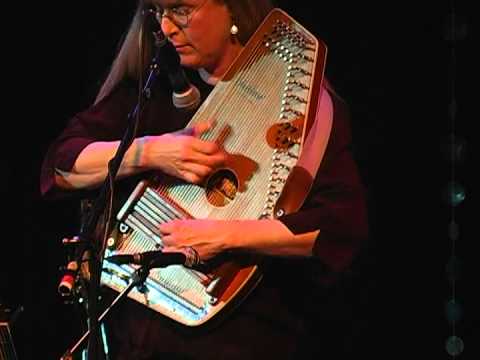
So it can be done, and impressively. However, any other instrument playing the same melody would drown it out because it’s plain to see that even done well, an autoharp’s melodic capabilities are more in passing and not very strong. So it’s either solo, or we’re back to just chords. As backup, I could see it as a one-off for the craic, but not as an ongoing presence; I confess I’d get pretty tired of it.
Great photos, BTW. 