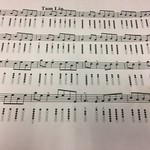
So, my friend who plays accordion with me is out of the country right now and we agreed to learn a reel apart then see how close we are when he gets back. We chose Tam Lin (Glasgow)reel and I found this version since I’m still not very good at reading music. I did my best to listen to a lot of variations of the tune and then set to work learning this version. I can play it alright at very slow speed but then when I went back to listen to a few different versions again I realized that I wasn’t even close. Well, maybe slightly close. I watched a few whistlers in slow-mo and we are definitely playing a different tune. I’m aware that there are endless versions of every tune but when I hum this one to myself it isn’t what I’ve been practicing. Whoops. This is just an observation. Not really looking for help or to start a debate unless you really need to.
Having said that, that tab doesn’t look right. The tab for all of the Cs looks to me as if it would produce Gs. Also, it’s not clear - to me, at least - that you’ve got to half hole in order to produce the Fnats. I haven’t gone any further than that. Reading it sideways gives me a crick in my neck and, as I’ve said, I’m not too good at tab, and I’m guessing that it’s the tab that you’re using and that’s why you’re not playing it right.
It’s a terribly difficult tune to play in that key on a D whistle. Personally, I wouldn’t do it. (I mean, personally, I would never pay the horrible, nasty thing in the first place, but that’s another matter.)
Notice the part where I mentioned courtesy to the people you are asking a favor of?
I did. But not everybody knows how to work things on the interwebs. It’s just as easy to make a case for extending the courtesy of allowing for that and not have a go, Especially when the problem is easily dealt with. Wrong side of the bed day, we allow for those as well, sometimes. We all have them, after all.
And it doesn’t matter what key you play a tune in. As long as the people you’re playing with do the same, ofcourse.
Last night for example I had a notion of playing the second Matt Peoples reel a tone down. Lovely. And I just realised the first part, when played that way, is very close to the first part of The West Clare Railroad. I wonder if Junior knew, when he composed the latter. But never mind, carry on.
I’m surprised to see that the tablature has a little down arrow to indicate the first octave. I would have expected an up arrow for the second, but there you go.
Pat, the tune is easier in Em (as per the tablature on your photo) because you don’t have to deal with half-holing the F naturals. But the first part comes out sounding higher than the second, which is not so great.
So I think it would be better for you to learn it in Am as shown in the dots, not the tab. Good practice to get used to playing F-naturals. Perhaps some kind soul on here can produce the tune for you in Am whistle tablature?
BTW it will be nice and easy for your friend to play it in Am on his B/C box. But the best key for it on that system would be Dm, low and growly, and even easier. (You’d need a low A whistle to play along with him in that key, using the Am fingering I am proposing that you learn, if you see what I mean.)
It’s a gimmicky tune all right, but no harm in learning it and playing it until you get tired of it.
BTW, as to it being “terribly difficult” on the whistle in Am, the only real difficulty goes away if you try this trick.
In the second bar, once you have established your F-natural on the long first note by half holing, thus (v indicating the half-covered hole):
[| xxx xvo]
then leave the first and second fingers of your bottom hand where they are while you play the remainder of the bar. This gets rid of the difficulty of hitting the F-natural accurately in the “pedal” bits.
Keeping those fingers down will make your A and your C-natural slightly flat, but you will probably find it’s a reasonable price to pay for making the tune relatively easy instead of terribly difficult.
Very helpful!! I’ll give that a go. Just curious (like a new born baby) what constitutes a gimmicky tune? I actually don’t know. Hah This particular one was suggested and I proceeded to listen to it.
I would say this one is gimmicky because the first part is less of a melody than it is riffing on on a chord progression, which is not how traditional tunes are constructed, for one thing, and for another, the sequence of chords stated (Am-F-G) really belong in rock music rather than in trad. (Anyone who has ever strummed a guitar has discovered that the Am-G-F sequence underlies a barrowload of songs and ridiculously easy to jam/blow/wail away on top of.) Using it in a trad context is just a cheap thrill.
This is a brilliant fix for the first part – now I want to find a decent tune with that pattern in it – but doesn’t help with the F-natural roll (followed by E and F-natural again, double ugh) in the second part. I can remember pre-teen Sean Gavin celebrating in delight because he figured out how to do an F-natural roll on whistle, but I’ve not the slightest clue how he actually did it.




 – but doesn’t help with the F-natural roll (followed by E and F-natural again, double ugh) in the second part. I can remember pre-teen Sean Gavin celebrating in delight because he figured out how to do an F-natural roll on whistle, but I’ve not the slightest clue how he actually did it.