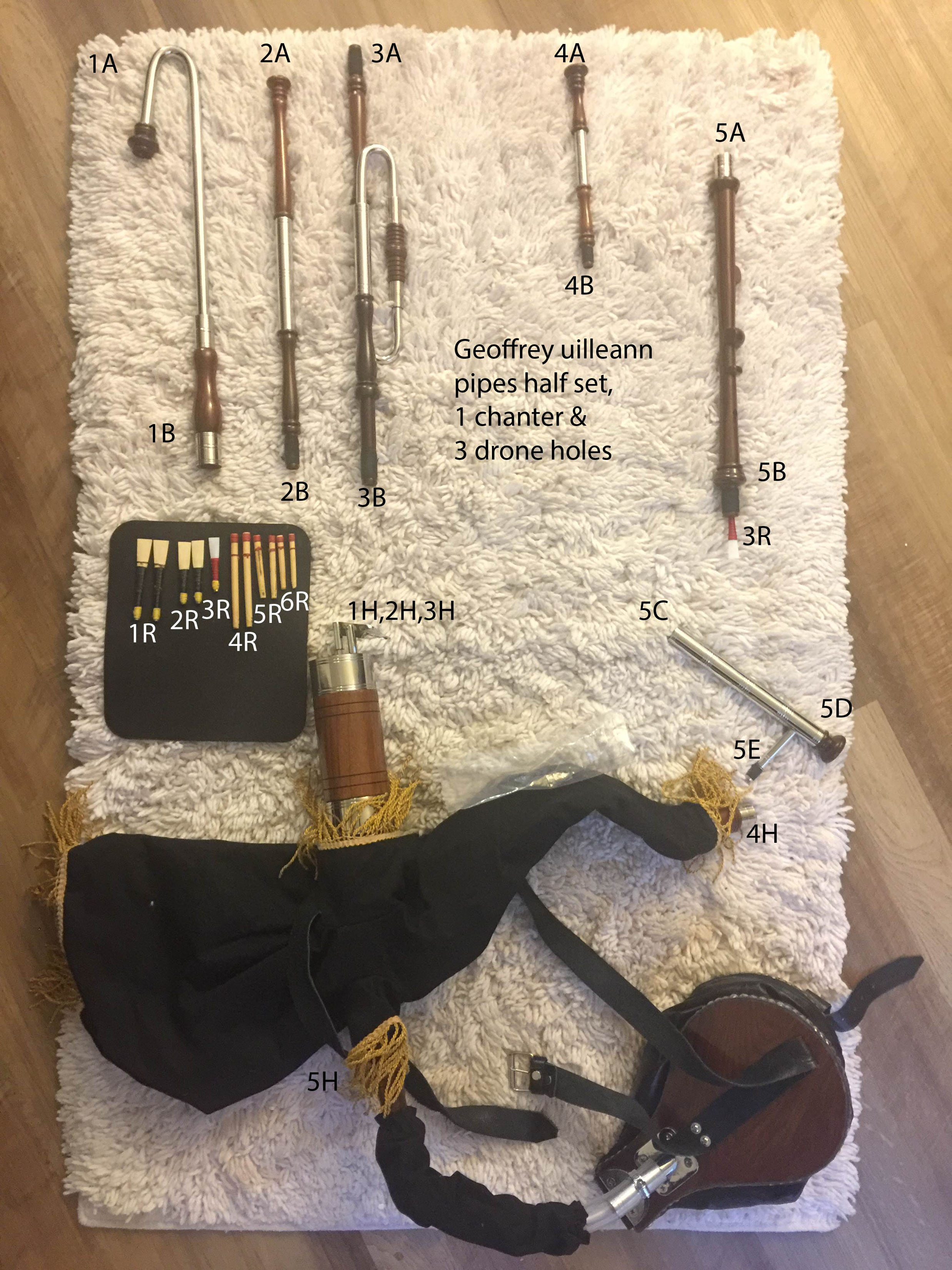
Well, since it isn’t going anywhere… in the interests of an educational experience, here is how the parts would fit together:
Bass drone:
1B connects to 3A, and then one of the 4R reeds fits into 3B, with the red threaded end of the reed inserted into the reed seat (the hole).
Then 3B is inserted into one of the holes on the mainstock (1H, 2H, 3H). You’ll need to determine which one based on size.
Baritone drone:
One of the 5R reeds is inserted, red threaded end, into the 2B reed seat.
Then 2B connects into one of the holes on the mainstock; again, whichever one matches the size.
Tenor drone:
One of the 6R reeds is inserted, red threaded end, into the 4B reed seat.
Then 4B connects into the final hole on the mainstock.
Chanter top:
5E is inserted into 4H.
Chanter:
They included three different types of reeds which are ostensibly for the chanter: 1R, 2R, and 3R, though as JMacfie mentioned, 2R is really for a Great Highland Bagpipes chanter and 3R is for a Great Highland Bagpipe practice chanter.
None of these reeds are likely to give satisfactory results, but just for the sake of argument, let’s treat 1R as the “real” uilleann pipe chanter reed, and insert it into 5B.
Then 5B is inserted into 5C.
And that’s how this set is physically assembled.
But it’s pretty much a guarantee that it won’t actually make music without extensive re-working. And even then, playing it probably won’t be a smooth experience compared to a set of pipes made by a skilled maker. A couple of pipemakers used to take these Pakistan-made sets and make them playable for customers who were stuck with them, but they quit taking these on since the time and costs involved were counterproductive.
Since you’re in the Bay Area, a good resource for uilleann piping is the San Francisco Pipers’ Club: http://www.sfpipersclub.org/
They might be able to set you up with a loaner practice set to try out, as well as recommending a teacher for lessons.