I am working on a early Rudall that is missing the long F block, it is a complete replacement, as the original had been replaced about 100 years ago…
Would anyone have a close up photo of the long F key/ block on a early Rudall & Rose pre #1000. The ones with the
pre-pinned block. I checked out Dayton’s but they only have one that old, with no pin.
Thanks in advance.
Jon
Jon, is this any good to you?
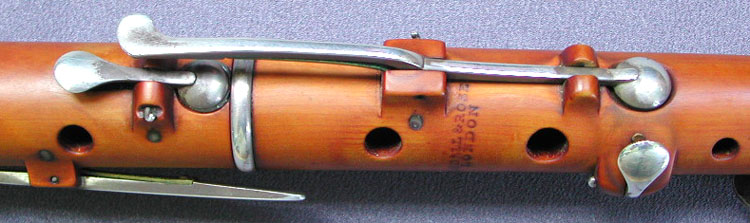
From R&R #742, owned by some fella called Chris Norman.
More at http://www.mcgee-flutes.com/RR742.htm
Terry
Thanks Terry, that is perfect! It looks just like the R&R I am working on, except this is Coco instead of Box.
Here is a photo of the badly repaired block, or where it used to be… Kind of wondering about the strike plate slot on the flute, double spring? Added later? Hmmm…

Mcgee’s photo is of Chris Norman’s flute (formally belonging to Linda Hickman).
I mighthave a few, Jon. Lemme look.
Yeah, boxwood takes better photos!
Here is a photo of the badly repaired block, or where it used to be… Kind of wondering about the strike plate slot on the flute, double spring? Added later? Hmmm…
Hmmm, indeed. I don’t think I’ve ever seen a double spring on a long F, but that’s sure a funny place for a single spring to come down. Any sign of a screw hole or broken stub of screw in the funny place? Perhaps the person who replaced the original block had never seen a real one and tried to imagine it from the other keys? I imagine you haven’t got the key either?
I happen to be working on another boxwood R&R of that same model (but rather later). It had also lost its Long F key, but not the blocks, so if you want any block dimensions, just ask.
Poor thing had had a hard life. The Left Hand had both tenons savagely broken away, and the remnants of a replacement tenon also broken away but stuck inside. Interestingly the replacement fragment was ebonite! Not only had the lower tenon broken off twice, on the second occasion it took the G# hole with it, which makes for an interesting repair challenge. There’s some pretty ugly patching on the foot keys too.
Lucky we love them!
Terry
Thanks, I can still see the impression of the original cut off block, it is in the same location as the Boxwood photo. The slot must have been for a stike plate that was put in on the block repair, as you said, he probably was flying blind, as far as how to make the key and block. (No internet to research!) No broken screw or screw hole. I will inlay new wood in the slot.
I feel for you on the R&R repair, “been there, done that, got the Tee shirt!” You might remember this basket case RRC…  On the right you will see the lower tenon and about a inch of replacement on the upper section, had to replace the upper tenon. Reinstalling the G# post key was a big challenge.

Finished the block replacement yesterday, here it is next to my Fentum.

What are the marks at the base of the long F, G# and C key blocks? They look like there is a large pin running through the base of the blocks. I’ve seen these once before. Something to do with the springing?
Cheers, Dan
Rudall & Rose pre-pinned the blocks to prevent the flute cracking at the key slot. The one I am working on is a sterling silver screw, but they also used steel.
not actually, Jon
the pins that low under the slots would not prevent a crack at all.
They would, however, prevent the key from being stripped and ripping the entire block from the body.
Many of the flutes in the day have ripped Eb blocks, F blocks, even a G# block.
that’s what only some blocks have the pins and others do not.
dm
What does that mean?
I beg to differ, I don’t see how a threaded pin across the slot will keep it form being stripped, actually that is what happened to this Rudall, the block was torn off, but it didn’t crack the lower section… As you can see, the threaded pin is in the body of the flute well below the block, so it doesn’t protect the block at all. When I cut in the new block I barely grazed it. What I have seen many times, is the flute cracking between the block, especially on the Eb key, but also the long F. and the G#, that are close to the ends of the section, it just splits right up the middle. But that is just my take on it.
To quote Terry from his site (just to get him in the fray)
“the axle blocks have steel pins though their bases, presumably intended as a strengthening device”
Yeah, I reckon you’d have to be right, it has to be about preventing a split running down through the block, between its cheeks. It certainly won’t stop the keys being ripped off in an accident - if that happens, the block will usually break at the hinge pin hole.
Earliest example I can immediately bring to mind is my Geo Rudall Willis Fecit, which dates to 1821. Strangely, it only has the extra pins on the three foot keys, whereas later flutes tend not to have them on the C and C# blocks. Perhaps significantly this flute has the cursed silver slot liners, and a split right through the Eb block because of it! So the extra pin in the Eb block didn’t stop the split happening. Leaving the slot liner out probably would have! The C and C# key touches on the same block do not have the slot liners or the extra pin and there is no split. Mother Nature wins again.
I’m not sure when they dropped these extra pins - maybe David has been observing them and can tell us? I think it was probably fairly early, and probably when they realised they didn’t help and actually made things worse, by preventing normal movement of the wood. I’ve also seen flutes where the steel pin has rusted and swollen, and actually split the block it was intended to secure.
Terry
not early at all, Terry.
My own #6208 has them.
I have a pre-1000 boxwood flute and it doesn’t.
Jon, I’m not disagreeing that it’s possible. But the issue then become why have them on some blocks and not other?
Why on the G# and not the shoulder of the long-C…but on the Bb?
This is pretty typical for those that have it.
Granted it seems to be a socket issue, with blocks nearest the socket. But that wouldn’t explain the G#, which is near the tenon and much less likely to crack. Fact is, i’ve never seen any flute cracked at the G# block side, even without the pins.
consider, too, Jon…if the flute you have didn’t have the pin…and the shoulder was stripped because of whatever accident…wouldn’t the bore have been compromised because of the accident? I’m suggesting the pin is to prevent the bore being stripped