I find that I can’t use a key with my thumb, so I’m wondering which would be the next logical location for this key. I was even considering leaving this key out in order to save money, but I’ve been told that there are some instances in ITM where a Bb is appropriate. Would anyone here know of some examples of that? Personally, I’ve never heard either Bb or Eb in any ITM.
The Bb and F keys are the ones I use most of all, directly after C. Need it for D minor and G minor, and my band’s fiddler loves those keys… 
A right hand index finger Bb key is fairly usual. Many makers offer them as an option, some even offer combo keys, i.e. a key with two touches.
Why is it you can’t use your thumb for the Bb key? Have you thought about changing your hand positions instead?
When I started playing on a keyless flute, I naturally adopted the pipers grip from the low whistle and supported the flute with my thumb under the flute body. When I started thinking about keyed flutes, I researched different grips. The standard flute grip did feel very unnatural in the beginning. It felt nearly impossible to get the top hand fingers to work, playing a B roll was out of the question. However, it didn’t take as much work as I thought from the beginning. Now I use the standard grip, which frees all the fingers (including the top hand thumb) to work with holes and keys without effort and without risking to drop the flute. It really isn’t so hard to learn. Or is there another reason why you can’t use your thumb for that Bb key?
Don’t feed your cat with
whisky 
FWIW, I find Bb exceedingly easy to half-hole.
Just put the center of the finger down on the
bottom lip of the hole–the edge toward the
foot of the flute. A key may be a bit
better but not much. Certainly don’t
need it.
What Henke said.
If you are holding the flute so that the knuckle of the left hand index finger presses in, and the thumb of the right hand presses out, then your chin makes the third point of contact and you should have completely free use of all your fingers and your left thumb; those three points of contact are enough to hold the flute quite solidly in place with little effort or pressure.
Sometimes when teaching flute I play a tune with my left thumb hanging off into the air to illustrate the point.
–James
Or, alternatively, use the rt pinky to push away instead of the rt thumb.
I can’t use the thumb, tried it but not for me. The pinky works
well for me.
Here is a picture of a flute with two Bb touches from Wilson’s Historical Flute website:
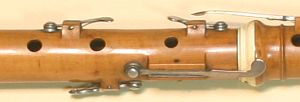
Sorry I couldn’t find a picture from a contemporary maker.
I find Bb pretty easy to cross finger (X 0 X 0 0 0), and exceedingly rare in Irish music. Even the handful of D minor tunes I know all avoid the Bb. You could certinaly get away with omitting the key. Or, as others have mentioned, a RH index finger key works fine.
I agree with most of the above, especially Henke… James’s point about practising with the L thumb hanging free is also something I have advocated and do myself as an exercise occasionally if I am getting L shoulder and neck tension problems.
My original R&R has an extra “Tromlitz” lever for its Bb thumbkey which I do make some limited use of - easier to trill, for example, and in certain turns involving Bb. If you search the forum you’ll find some pictures of my flute and various others from previous discussions on this topic. Sure, there aren’t all that many ITM pieces that use Bb, though I do know several tunes that do, and it can also be a handy chromatic interjection/ornament. Yes, you could play ITM for ever and never “need” it, but there’s quite a bit of material that does use it if you seek it out, and if you play song accompaniment it can sure be handy - otherwise you may be forced to shift to a flat-key whistle just when you want the tone-qualities of flute… Many flutes will give a decent cross-fingered Bb for an occasional passing note with xox xxx or xox xxo in the lower 8ve and xox ooo in the 2nd (the latter is usually hopelessly sharp in the bottom octave).
As for examples of using Bb…how about The Twopenny Jig (in O’Neill’s) just for starters?

Here’s a link to one of the old threads I was referring to…
There is an odd little tune we play in session–I call it “odd” and I’m pretty sure it’s not trad–called “Jump at the Sun.” It uses B-flat.
I play the hornpipe “The Mountain Top” in B-flat major. It’s full of…you guessed it…B-flats!
Another popular session hornpipe, “The Galway,” uses the B-flat in the B part.
Three examples of session tunes off the top of my head.
By the way, as far as cross-fingered B-flats go, xox|ooo is a pretty decent 2nd-octave B-flat. For the first octave you need to add the right-hand fingers to pull it down closer to pitch, like this xox|xxx.
For the second octave, you can also go for the partial, which works better on some flutes than on others, use xxo|xxx and blow hard.
–James
Jump at the Sun is a catchy tune by the very famous English melodeon player John Kirkpatrick that has entered the tradition fairly generally since he wrote it 30-odd years ago and crops up in all sorts of contexts, usually unattributed or misattributed. (Nowt wrong with the former - just shows a tune has “made it”, but the latter is lazy and rude!)
The Fiddler’s Companion > says this about it:
JUMP AT THE SUN. English, Jig. G Minor. Standard tuning. AABB. Composed by English melodeon player John Kirkpatrick of Shropshire, England. Kirkpatrick communicated to Susan Songer (1997) that he later heard the opening four notes in the dream sequence of Walt Disney’s Dumbo, though he denies a conscious connection. The tune was very popular in Australia and New Zealand after an influential recording of it by the band The Bushwackers. Barnes (English Country Dance Tunes, vol. 2), 2005; pg. 77 (appears as “Look Both Ways”, the name of a dance by Rich Jackson set to the tune). Songer (Portland Collection), 1997; pg. 116. Wild Asparagus - “In Season” (1985). Cathy Custy (appears as “The South of France” and listed as ‘traditional’).
T:Jump at the Sun
C:John Kirkpatrick
B:Opus Pocus - The John Kirkpatrick and Sue Harris Tune Book
R:Jig
M:6/8
L:1/8
K:Gm
GBd ^c2 d | GBd ^c2 d | gdd gdd | dcB A3 |
GBd ^c2 d | GBd ^c2 d | gdd edc | BcA G3 
|: gdd bag | add c’ba | bag bag | a^fd e2 d |
gdd bag | add c’ba | gdd edc | BcA G3
Apparently it is not infrequently heard in other keys, especially D minor. The G minor version requires Ebs as well, of course. However, since this is unequivocally an (whisper it!!!) English tune, maybe some would prefer to disqualify it from consideration??? 