Mystery Flute

Hey Everyone -

Anyone up for a little “who am I” mystery?

I have an old flute of very dubious quality moldering in my hands, and I’m wondering if anyone has any thoughts.

It’s a 10-key (standard 8+ RH Bb and RH very high hole- whatever it does). The headjoint and barrel are not original, as they are some kind of polymer, with some marking visible on the barrel (SUPETTONE?). The body is in two parts, the first with the left hand holes and 5 keys, the last with the rh holes and keys and foot. The keys are nickle-silver, I presume by the greenish tarnish, and post-mounted

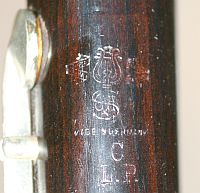
There are a series of marks at the top of the body, which I will attempt to describe, as I doubt I could make any of it show in a photo. From top to bottom:

First is a lyre, I think, with a squiggly ribbon-like figure on either side. The ribbons may have letters on them - if so I can’t read them.

Below that, three (or so) innitials superimposed, a big S and two smaller letters, maybe a C and H?

Below that, quite clearly though in tiny letters, “MADE IN GERMANY” [ODG, but marked?]

Then a solitary C,
below which it seems L/P has been stamped heavly over the number 870.

No other marks are visible.


Near as I can tell it is not pitched in D, at least not in 440. If I set my tuner around 434 I can make a bit of a go of it. I’d venture to guess that the L/P may indicate Low Pitch? Not as low as C, though close to C#. I guess there’s no real way to know the intended pitch, if the headjoint isn’t original (and incidentally it fits rather poorly, with a different bore diameter than the body)


Any thoughts? I’ve no particular use for it, though if it might be of some quality a new headjoint could be fashioned, I suppose.

Thanks!

Cool. Ebonite or Bakelite headjoint and barrel?

Does the key adjacent to the long Bb do a D trill? Most times I’ve seen this, the foot also goes to B or Bb. Curious. Sounds like a Nach of a slightly different colour.

Pics showing the keywork would help, but I’ll try to track down the mark you describe. Sounds familiar.

A=430-435 sounds about right.

Where’s Jon?

How did he miss one?

:wink:

Geez! The one that got away… :sniffle:
I have the original 10 key, so I worked that desire out!

just one?!!!

Unlikely if it was made in Germany – low pitch translates as “tiefe Stimmung” so the abbreviation, if any, would have to be “t.S.”. I’ve never heard of such an abbreviation used on instruments though. (No, I’m not an expert, just a native speaker of german.)

Seems I’m wrong, see: http://www.oldflutes.com/german.htm. One of the pictures at the end of the page shows a stamp very much like the one you describe, and L/P is indeed interpreted as “low pitch”. Maybe these flutes were made for export to anglophone countries.

Uuhhh - how would I tell? It’s black, it’s smooth, it’s shiny.


D trill? Hmm - tried this and almost hurt myself. Oh yes - 3rd octave - this must be what you meant! :wink: ) Definitely no B or Bb - I looked again.

I’ll try for some photos, but not likely before the sun goes down. It’s a glorious fall day here in Maine, and I have firewood to throw around.

Thanks, Chiffed!

Aerowhip,

The markings make it sound like a Huller Flute that I got a while ago. Mine has an ebonite head (not as greeenish as the picture suggests) I think that dates it to 1920s - 30s.
The head is fully lined and a good fit - with no markings.

I posted some pictures here )or search for Huller
http://chiffboard.mati.ca/viewtopic.php?t=39138

Mine is marked HP and does play at 440

Chris

Chiffed! Chiffed! You found it!

It is on the page you referenced regarding German flutes -

Exactly the same but clearer, the Hüller flute, with an explanation of the C, even!


“The stamp on the Hüller is shown below. There is a lyre and the initials GH inside an S. Below that is “made in Germany / C / L.P.” As it is unlikely that the words “made in” would have been used before they were required, this allows us to date the instrument after 1923.”

and

“The “L.P.” stamped on the Hüller also appears (in another place) on the Kohlert, and stands for “low pitch”, A=435 in the case of these flutes. These two instruments are the same size and play at the same pitch. Yet one is stamped “D” and the other “C”. Why? The Kohlert is stamped “D” because of the long-standing and perfectly logical idea that the standard size flute was “in D” because its basic scale was D major. The Hüller is stamped “C” because the way terms were used was changing and it became appropriate to say the flute was “in C” because it was the standard size and not a transposing instrument.”

Mystery solved, thanks!

Now, what should I do with it…?

Thanks Chris - you found it too. I checked your photo, and it does appear nearly identical. The barrel on mine is the same as the head (ie not wood - I ask again how do I identify Ebonite?), and it has the extra 2 keys. See note in my above posting regarding dating and the Made In Germany stamp.

Linda


How did I do, hey? (photo is from Oldflutes.com website, not my own)

Play it? :slight_smile:

It sounds as if it needs some work, though. If you don’t have the means to have that done now, I’d suggest getting help from an expert for old flutes how to store and handle it so that it doesn’t develop either cracks or molds. These experts do hang around here.

cheers,
Sonja

Give it a smell. If it kinda smells like rotten eggs, that’s it! I believe Ebonite was made using sulfer, like rubber, J.

Mine has no particular smell (except for “old flute” .. a compound of polish, and bore oil - I hope). How I do know it’s ebonite? I don’t except that that’s what the guy I bought it off said it was. Sorry not to be of more help.

Chris

FWIW, Turlach Boylan’s ebonite Chappell is rather olive-colored. Just don’t bump the thing when it’s cold; it may shatter!

Wow - now I’m intrigued. I tried to google some information about ebonite, and didn’t get a whole lot that’s relevant (like, when did folks start using it for flutes, specifically), but I do come up with a date of invention/discovery, of 1851! (and yes, it is some kind of a relative of rubber, whatever that means).

Does anyone have better information about this substance and its inclusion in our obsession, er, I mean interest?

As an aside, a year or so ago I was chatting with my parents and friends of their generation (in their 70’s and 80’s now), over some really good rum in Jamaica, though that’s irrelevant. They were all junior faculty together, back in the '50’s, in chemistry at UC Riverside. I mentioned something about flutes made of delrin, and their eyebrows all rose simultaneously. It seems some of them had been involved in its development way back when, maybe at DuPont? They were, I might add, very pleased that something good had come of it!

DuPont Delrin® acetal polyoxymethylene (POM) resins are highly versatile engineering polymers that bridge the gap between metals and ordinary plastics.

Ebonite, to the best of my knowledge, is a tradename of hard-rubber (Boosey and Hawkes Edgeware is another). Heat or alcohol makes it turn green, and, while it’s a bit bendable, impact will shatter it. Don’t wash it in solvents or hot water (cool is OK) and don’t drop it on concrete!

Sax and clarinet mouthpieces have been made of the stuff for a century, and clarinets have been ebonite as well (but also Bakelite, ABS / resotone, really cruddy polystyrene (?) and thermoset wood composite, similar to Burke whistles). The good news? Ebonite / hard rubber is about as stable as anything, and 1920’s mouthpieces are still played today.