I’m playing some non-trad music with a local band, but I have a problem cutting through the high volume of pianos, bass, and drums with the relatively low volume of my Optima. Sometimes, I can’t even hear myself play! I’m thinking I need a microphone and an amp.
Can I pick up a cheap set at the pawn shop? They always have beginner guitar amps and mics. Or should I get something that’s more geared toward vocals or piano? It doesn’t have to be the best gear in the world, since it seems most venues around here provide amps.
Electric guitar amps have funny EQ curves and distortion to make electric guitars sound “right” – probably not a good choice for a whistle, unless you are specifically looking for that sound.
Here are two visual clues you can look for: You will be looking for an amp that has an XLR input on the front labeled mic, or microphone, and you will want two speakers in it. If it has those features, then it will probably work.
You need a microphone. An SM57 is a good choice for stage work because it is very durable.
I’m thinking in a similar vein to highland-piper. I think of whistles as a similar sound source to a voice. The big difference is that you can’t “eat the mic” when you play whistle. That means you can’t get real close to the mic without introducing a lot of hissing (air) into the whistle sound. But other than that things are similar to what you would use for a vocalist.
I would normally suggest playing through a PA. That’s what I generally use but I have been at this for decades and have accumulated a lot of gear. Reasons being similar to what has been mentioned - proper EQ. And as has been mentioned acoustic guitar amps frequently have a channel with an XLR input. Many acoustic guitar amps are basically a PA system in a single box. And they may also have a reverb which can be used for your soaring solos. I have used a Peavey Ecoustic 112 over many years now for both guitar and vocals as well as flute and whistle for smaller venues and when I do not need other inputs or greater dispersion. So look around for a decent acoustic guitar amp. An alternative would be a powered PA speaker with a mixer for multiple sources built into it - a acoustic guitar amp (sans effects usually) that can be mounted on a pole.
The mic is a topic for some debate. The Shure SM58 is fine. it is a very versatile mic. What I don’t prefer about it is that it is designed to be eaten by vocalists. I’d try the SM57 (as has been suggested above) or a Beta 57A myself. So start with a 57 or 58.
Still I actually prefer to use condenser mics. They are more sensitive and generally have a greater output - a blessing and a curse. I have used in various situations a stand mounted condenser, a lavaliere velcro-ed to the low whistle (or flute) as well as a head worn condenser. One thing many will mention about the condensers is that they need phantom power. It’s true they need power. But many condensers will use a battery (carry fresh spares) either in the mic body or in a belt mounted power pack. The advantages of a hand/stand mic is that it can be used for vocals and other acoustic sources. The downside is that you have to learn where to play into it (which is not a big deal) and stay close to it - you can’t groove all over te stage as you play.. The advantage of the lavaliere and the headset mics is that the position to the whistle is pretty much constant - and you can move around all that you like. The downside of these is that they are always there. You can’t walk away from a headset to talk on stage - you can push it out f the way some. The downside of the velcro-ed lavaliere is that it has to be moved from whistle to whistle if you change keys frequently.
A guitar amp may work fine if it has effective EQ controls. Bass amps have a flatter, wider, cleaner EQ curve, so a small bass amp may be better. Keyboard players sometimes use bass amps when a keyboard amp isn’t available.
The problem with a small beginner’s or practice amp is power. Small practice amps are often only 10 or 15 watts. If you crank them up toward 11 to cut through an electric band, the distortion characteristics really kick in. You probably want a 25-50 watt amp or so to avoid that - in which case, you’re no longer looking at a beginner’s practice amp, but a small performance-quality amplifier.
I’m not sure why you’d need 2 speakers. A single 8" or 10" speaker would work fine. And remember that speaker magnets are a big part of the weight of the amp.
A real SM57 or SM58 mic (or equivalent) is a good investment. Avoid condenser mics that require phantom power, because most guitar amps won’t provide that. If the amp has only hi-Z instrument inputs, you can use a XLR (lo-Z) transformer adaptor on the end of your mic cable, but with some loss of signal level. So again, you want an amp that you can turn up without distortion.
If it doesn’t have a tweeter then it can’t play high frequencies very well. If it just has a single big speaker and doesn’t have a tweeter then it’s going to stop producing frequencies more or less where the whistle starts. It won’t /completely/ stop, but it will be very inefficient, compared to an amp with a tweeter. Might still be able to get it to work with the right EQ settings, but it will take more power in the amp.
Probably most amps that only have one large speaker are designed for either bass or electric guitar. Most keyboard and acoustic instrument amps will have a tweeter. Sometimes they’re hard to see though, especially if there is a cloth grill.
It would probably be a good idea to get the microphone and a mic stand and then go shopping for the amp.
Yes, that’s true enough. You can’t always see a tweeter, as you point out. As an example my Peavey Ecoustic 112 uses a coaxial speaker. You would not be likely to see the high frequency driver mounted in the middle of the 12" speaker even if you are looking for it. The point here is that some amplifiers and speakers are designed to reproduce a wide frequency range others are not so much. And keyboard and acoustic guitar amps should always be full frequency range units - portable PA’s should full freq be as well.
If the OP was playing high whistles the tweeter might be a really important requirement. The Optima Low D might do OK through a small guitar amp. It is well within the frequency range of a typical electric guitar.
Does this mean that there are PA’s provided in the venues where you are playing? If it is then I’d concentrate on finding a decent mic and spend some time getting used to using it and working with whoever works the mixer at the venue to get to a level you can work with.
Wear a wide brimmed hat. It will reflect the whistle’s sound around the brim to your ears. Starched felt works well. Stay away from fur, knits or other soft brims - they absorb the sound. I don’t suggest using the Tidy Cat isolation booth as an on stage approach - but it would be functional.
Yeah, but if you could really get full range from a single speaker there would be PA speakers made that way. A lot of times with a bright flashlight you can see through the cloth to the speakers. I’m just trying to think of ways for someone who doesn’t really know what he’s looking for to quickly get an idea of what he’s seeing in a pawn shop. If you see a tweeter, then it’s definitely full range.
If the OP was playing high whistles the tweeter might be a really important requirement. The Optima Low D might do OK through a small guitar amp. It is well within the frequency range of a typical electric guitar.
[/quote]
Good point, although it might depend on the tonality one is after. Don’t forget about the harmonics. The bell note of my mezzo G has strong harmonics at 2khz and more up to; it might depend on the specific amp… some designs are brighter. The best way to know for sure is to give it a try before you buy. Sometimes audio stuff comes together well in unexpected combinations and sometimes things that seem like they ought to work great just don’t.
I often end up being hired to play background music on the uilleann pipes, and the venues are sometimes too big/noisy to not be mic’d.
I picked up a used keyboard amp fairly cheaply. It has the speakers, amp, and mini mixing board all in one unit. It’s perfect for what I do. The nice thing about the keyboard amp is that it’s designed to reproduce a full range of sounds, so I get a nice bass sound from my drones and a fairly realistic sound from the chanter. I play whistle through it, too.
When I was playing various whistles and flutes with a celtic folk-rock band I used a headphone vocal mic. It’s great because I can switch between any number of instruments.
When I was playing flute only in one band I used a Barcus-Berry flute mic. It’s specifically designed for flute and gives a fantastic sound. You put the mic right up against the embouchure hole so there’s a nice strong signal and no feedback. I used an Alto Flute mic because the body O.D. of an Irish D flute is about the same as a silver Alto Flute. I imagine that that same mic would work great on an Irish low whistle.
I’m not at all trying to point you in any particular direction here. I just I thought I would share my experience with Guitar Amps in the hopes that it might help you make a decision:
There are two basic types of guitar amps. Solid state and Tube Amps. If you get a tube amp from a pawn shop, chances are fairly good that it hasn’t been serviced in a long time. So, if you get a tube amp, it may need to be serviced before you can trust it to be stable.
Your solid state amps, which are typically cheaper than your tube amp, is more and likely what you will wind up with. This type of amp requires much less maintenance and care.
I have a Fender Hot Rod Deluxe tube amp at home and Fender Jam Solid state amp. I’ve never ran a mic with the HOT Rod Deluxe for fear I would blow something by driving it incorrectly.
I have used my Solid state amp with a mic and here are the results. The impedance did not match, so I have to turn the volume way up with the mic. Where as If it was that loud with a guitar, your ears would bleed.
Using my guitar amp for vocals didn’t sound that bad. It kind of puts a megaphone effect to the vocals, but it is not awful or way too much. The Fender Jam has Chorus and Reverb effects that both could be used with the vocals. The Reverb sounded okay. The Chorus was unusable.
I can’t say I’ve tested all models of guitar amp, but I think chances are fairly good that you’re gonna get a bit of megaphone effect regardless of the EQ settings on the amp. It is probably best to just try it and see what sounds best to you.
I’ll second the advices about acoustic guitar amps : they have a broader bandwith than electric guitar amps, and some of them have an xlr input designed for a mic. You can use one amp for you on the whistle and you friend comping on a guitar. Models such as Marshall acoustic, Vox ada, Carlsbro acoustic, Roland acoustic and others provide xlr imputs, some even provide a phantom power if your mic needs one. I’ve had good results with whistle using a Shure 58 mic and a Vox ada amp, which is also a good amp for jazz guitar BTW. The distance between your mic and the whistle, as well as the mic placement ( close to the fipple, end of tube pointing toward the mic, etc. … ) result in HUGE differences in sound.This tends to relativise the value of the sound samples that can found on the net…
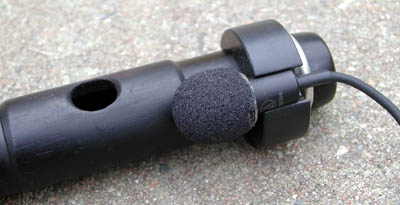
With regards to mic’s I’ve seen some that fit to the barrel of the whistle, they look similar to those used by TV news readers etc. Does anyone know what they are?
Yep, the same animal as the lapel mics used by newscasters, etc. These are the lavaliere mics I mentioned briefly above in my first post to the thread. They may also be miniature instrument mics like you frequently see mounted on a sax. They come in a variety of pickup patterns and specs. I use a velcro strap and pad to mount one onto my flute and low whistles sometimes. These are usually condenser mics and require their own power but that is generally provided through a small battery belt pack. They do work but you have to move the mic from instrument to instrument as keys change. You could develop a mount similar to these for each whistle barrel if you are industrious.
You would position the mic just below the voicing window on a low whistle. There are a variety of commercial mounts offered by major mic providers made to mount a mic on a Boehm flute which can be adapted to low whistles.
I don’t think any of these mounts work particularly well on high whistles though, just too much bulk.
A headset mic provides much the same function without having to swap it when you change instruments. And headworn mics also come in dynamic mic varieties so you can just plug right into any hi-Z input without phantom power.
An acoustic guitar amp is essentially a single-cabinet, self-contained PA system. Those are the ideal choice for your situation as they give the most accurate reproduction from a microphone. Only the smallest of these lack an XLR jack for a low impedance microphone. Many of these come with phantom power to operate condenser microphones if you choose that route. Personally, I avoid condenser mics in live sound because they can be difficult to control. A good quality dynamic mic like a Shure SM-57 or 58 is hard to beat.
Even if that venue has its own sound system a separate amp is useful. If you choose a model that has a balanced line out you can place the amp near you to use as a monitor speaker and run a line from it to the main PA system.
I don’t care for the small clip-on electret condensers. They eliminate your ability to use the proximity effect of a stand-mounted mic. By moving into and away from a microphone you get very different dynamic effects. A clip-on mic negates that ability.
Lots of good suggestions, here. Our band uses individual small stage monitors - multiple Roland CM30s. This small powered dual-concentric monitor contains 4 inputs - including one XLR input with a mic preamp. It also has EQ controls, and can be daisy-chained. There have been venues that were small enough, that we turned around the monitors and used them not as personal stage monitors, but as house monitors. Very good sound, and they covered surprisingly well. The monitors are capable of playing loud and clean, when needed… They are microphone stand mounted - and with an inexpensive brass stand disconnect, are very road friendly.
For what it is worth, Marshall makes some superb all-in-one acoustic amplifiers. And they are priced, accordingly.
I concur with the general slant toward the SM57 and SM58 mics for stage use. Because all four of us sing on stage, we use 58s, and because we also all play instruments, the 58s become our defacto instrument mics. However, there is a bit of a sleeper mic we use on many occasions. It has a flatter frequency response than the 58, and is very forgiving and musical, when used with whistles. This is the Audix i5. I wish we had a few more…
Mics physically connected to the whistle have one large drawback. One cannot step away from the mic, either for volume change, or for effect. We use small condensers on our hammer dulcimers, but tried them with whistles, and did not at all like the ‘in-your-face’ sound.
I play on St Patty’s day with the tin whistle.
I use a Mustang I 20W Amp I purchased at Amazon for 99 bucks. The worst problem is this amp has a number of presets, and I had to download presets to make the amp sound “normal” (as opposed to “60 Jazzmaster Reverb Psychodelic (or somesuch)” preset. Basic mic stand, and a Sennheiser e835.
I play in small venues and it does what I need it to do.
 I’m thinking I need a microphone and an amp.
 I have used a Peavey Ecoustic 112 over many years now for both guitar and vocals as well as flute and whistle for smaller venues and when I do not need other inputs or greater dispersion. So look around for a decent acoustic guitar amp. An alternative would be a powered PA speaker with a mixer for multiple sources built into it - a acoustic guitar amp (sans effects usually) that can be mounted on a pole.