My husband wants to play this tune at the end of a piece for his Grandmother… the only notation I can find does not match the tune as I’m hearing it played… anyone familiar with it? Good source for tab or notation?
I learned it when I was playing with Jay Ungar and Molly Mason, and it’s on their “The Lovers’ Waltz” CD (1997, Angel). It’s not as difficult as it sounds either. I found several transcriptions on the web just typing in the name, but if you’re stuck on a passage, write me.
Best,
L.E. McCullough
And its available in either The Waltz Book or The Waltz Book II. Cool tune!
Thanks much, guys!
It finally started to make sense when I finally remembered that the e on my C whistle wasn’t going to be the same as the e on my D… (sound of palm slapping forehead) 

I love Jay and Molly’s version!
That name sounds extremely Finnish. I think I’ve heard of this one, I might be confusing it with some other tune but isn’t this the Canadian style tune that was written by a Finnish guy?
Apparently a Finnish Waltz, “the Forest Flower”.
Ah, okay. Yeah, came to think I was confusing it, the Canadian style tune was named something else. Any idea who wrote it? The accordion player in my band is originally a Finnish trad player, he’s an expert on these sort of things.
Hi!
Actually it’s “Metsäkukkia” and means “Forest Flowers”. It is the most or second popular wedding waltz in Finland. It is traditional and probably have arrived in Finland from East (Russia). Earliest recording in Finland was made in 1937 and after that it has been in numerous recordings. In Finland it is played often instrumentally with accordion, but in recordings it is the song-version one usually hears (The most popular ones being versions by Olavi Virta and Georg Ots -if anybody is interested). One finds sheet music for it at least from The Session.
Now I, as a Finn, am very interested in how this tune has arrived to Ireland and into irish repertoire? Because it’s known by its finnish name, it has certainly came from here, but when. ? Does anybody know, when this waltz came to Ireland?
Dee
And for instrumental version by accordion go to: http://uralica.com/music2.htm
It is played there by Viljo Vesterinen, who was also the first to record it in Finland.
Dee
Finally this rung a bell. :roll: I have played the tune with Jackie Daly a few times. He called it the Flower of the Forest. I learned it off him but never managed to remember it by the time I got home. It’s a simple tune though and lovely too.
The “Boys Of The Lough” recorded this several years ago, - the"Sweet Rural Shade" album, I think, so I reckon it was Cathal McConnell who brought this into the Irish repertoire. I seem to remember it as a whistle-duet with Christy O’Leary. Music for this has been posted on the “session” website, along with more comment and discussion than is probably needed, and I will not guarantee the accuracy of the transcription. Hope this is of interest.
On reflection, since Christy O’Leary has a well-known affinity for music from the Scandinavian countries, there’s a strong possibility that he brought the tune to Cathal and the “BotL”, so he might be the link between this tune and Ireland. Whatever - I’m sure it was one of them, unless the sleeve-notes say different. I will check, and amend the above if the old memory is playing tricks again.
For Dee Whistler - Boys Of The Lough sleeve notes say as follows :
“heard played at a musical gathering in Stromness, Orkney in 1986…”
…so it came via Scotland, somehow, but there again, the Orkney islands do have musical connections with Scandinavia.
Another great “foreign sounding” waltz I discovered recently is “Close every door”. I think the tune is from the show “David and his amazing…” It has a Jewish feel to it. Works great on the whistle.
Thank you for the info!
So, I’ll have to get the Boys of the Lough Cd somewhere. Love their stuff, only have not heard that paricular record.
Dee
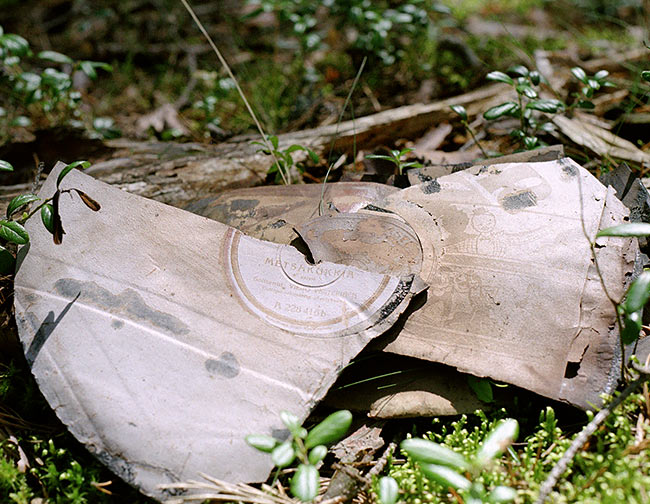
I have found this in the ruins of Finnish installations at the Mannerheim Line (Ink-6 pillbox of Inkila sector). Cracked disk “Metsakukkia” of Valjo Vesterinen.
Now I, as a Finn, am very interested in how this tune has arrived to Ireland and into irish repertoire? Because it’s known by its finnish name, it has certainly came from here, but when. ? Does anybody know, when this waltz came to Ireland?
It does appear to have come to Ireland through Cathal McConnell. I gave him a transcription of the tune around 1985 or 1986 after he heard us playing it in Stromness, Orkney. I learned it from the Danish band “Sand på gulvet” (now disbanded) and I think it was their box player Henning Nørgaard who learned it in Fyn (Funen), Danmark. Sand på gulvet gave it a Danish translated title “Skovblomster” and it was a friend - clarinettist Richard Robinson - who came back from Minnesota providing us with its title in Suomi.
We played it in A minor but Cathal, being Cathal, recorded it in some odd key. I have since heard him play it on a Chinese flute with about five holes in it.
Many years later, an Australian friend was singing the tune on Iona and said she learned it in Tasmania from someone who got it from Cathal. Nice to know that I played a part in its meandering round the world.
Ah… so you’re to blame. 
Glad you posted to this thread and reminded me of this great little tune. Thanks!
http://www.youtube.com/results?search_query=Metsäkukkia+&search=Search
The first and fourth hits are worth a watch/listen. The third hit might fit nicely in an episode of the Addam’s family. 
At that link -
Metsäkukkia (Woodland Flowers) - Valssi, Viljo Vesterinen ja Lasse Pihlajamaa, 1950. Composed by Felix Burns. - Scotsman with a Finnish touch!
A link there yields the following info on the Composer http://www.footstompin.com/artists/felix_burns
FELIX BURNS (1864 - 1920)
Felix Joseph Burns was born in Perth on 5th March, 1864. He showed a remarkable musical talent from an early age, progressing from the tin whistle and mouth organ to the piano. He became a fine organist and, joining the local band, mastered a variety of brass and woodwind instruments. From an early age he showed a flair for original composition.
According to Leo Burns, Felix’s youngest son (now 97 years of age and living in Coventry), his father ran way from home at the age of 16 in 1880 and joined the ‘Moore and Burgess Travelling Minstrel Show’. As well as his instrumental skills he had a lifelong love of the theatre and showmanship as reflected in many of the titles of his tunes.
From there he moved on to be a pianist with a travelling ‘Diarama’ Show and it was during this time that he met and married Catherine Burns, his first cousin from Motherwell. During a long and happy marriage they had thirteen children, nine of whom survived into adulthood. They were - sons Frederick, Douglas, Felix Jnr and Leo and daughters Catherine, Winifred, Susan, Leona and Doris.
In 1885 Felix, Catherine and their first two children arrived in the ‘Border City’ of Carlisle with the Diarama Show. Unfortunately the manager of the Show absconded with the money, a not uncommon occurrence in those days, leaving the Burns family and the rest of the crew stranded.
Felix however, expressed his belief that they would be all right in Carlisle since he liked the look of the place. From his introduction to the Border City at the famous ‘Matchbox Music Hall’ he quickly established himself as a music teacher and working musician. His teaching studio above the Market Arcade in Carlisle contained two grand pianos and a concert harp.
While trying a piano in a local music shop one day he was asked by the manager about the tune he was playing. Replying that it was one of his own compositions the manager asked for a copy and sent it to a publisher in London who accepted it for publication.
This was to be the start of another very successful side of Felix’s career. He published a total of 16 ‘Popular Dance Albums’ (the last three were published after his death by Felix Jnr) which sold at 2 shillings each, is addition to a great many piano solos. Just for the record the dance albums were entitled Royal (1905), Imperial (1908), Greater Britain (1910), Flag of Empire (1911), Royal Standard (1912), Harlequinade (1913), Vaudeville (1914), Vanity Fair (1915), London Town (1915), Merry Makers (1917), Gaiety (1918), Old Drury (1919), Black and White (1920), Tower of London (1921), Dickens (1922) and lastly Frivolity (1923) . Collectively they contain no less than 120 compositions, an impressive collection in itself. His own personal favourite was a Barn Dance tune entitled ‘Woodland Flowers’.
Many of the titles therein reflect the period during which Felix lived, with the British Empire becoming the mightiest the world had ever seen during his lifetime but seeing the sun set on it in the Great War of 1914-18. ‘Pageant of Empire’, ‘Queen Mary Waltz’, ‘Somewhere in France’ and ‘Over the Top’ to name but a few. His piano solos were published under several nom-de-plumes, a custom of the time - Leona Lacoste, Claud Roslind and Leon Fabrina.
Despite the fact that he was not blessed with the best of health he was able to cram an amazing amount of musical activities and achievements into his short working life. It is impossible to calculate the total number of his compositions as there were at least twenty-two known Publishing Houses turning out his music under his real name as well as his nom-de-plumes.
He had several part time activities as a musician also. He was Bandmaster of the 4th Battalion Border Regiment (Volunteers). He was also organist and choirmaster of St Mary’s and St Joseph’s Church in Carlisle and he provided piano accompaniment at the Winter Concerts organised by the Town Council. He was engaged to organise and play at dances in fashionable houses throughout Cumbria and to accompany celebrated performers of the day when they visited Carlisle to give Concerts.
Felix would take pride in giving one of his latest compositions its premier at one of the Carlisle Winter Concerts. He is remembered with much affection in his chosen ‘home town’ as a man who was proud of the Border City and contributed to its quality of life an its future. He was always eager to volunteer his services to assist any charitable cause or simply to help or give a little pleasure to those in need.
During, and following, the First World War there were many who needed all sorts of support and to have their spirits lifted. Felix knew that he was fortunate to be blessed with rare talents and that he should use them for the benefit of his fellow men and this he did on countless occasions. He was very well aware of the beneficial and therapeutic effects that music can impart.
In person Felix Burns was a pleasant, quietly spoken and earnest man. Despite his relaxed ways he was a man of great warmth and kindness and very great personality. He was a popular and good natured public figure and, in private, a loving father and a dedicated family man who had attained his own success and brought up a highly talented family by his endeavours.
In later life Felix suffered from prolonged ill health (he was possibly diabetic) but never complained. He died very suddenly on 19th January, 1920 at the age of 55. He had given 4 music lessons that day and still had 79 pupils on his register. Catherine, his wife, outlived him by 19 years and died in 1939.
To conclude, from impressions gained from my researches and from speaking with Leo, I should say that Felix Burns knew that it was not given to everyone to be a virtuoso but that everyone can enjoy music. He hoped that everyone who is blessed with the ability to play will try to appreciate music in all its forms and work to improve their skills for the betterment of their own enjoyment and satisfaction as well as the appreciation of those who listen to the music they play.
As Scottish Dance Band musicians we are indeed lucky to benefit from so many fine tunes, bearing in mind that they were originally composed for a completely different musical idiom. The tunes in this book have also faced and passed the ultimate test - the test of time, which sees them in everyday usage a century after their composition. I hope that everyone, especially our younger musicians, enjoy the tunes that follow. I have no doubt that will be the case, just as I have no doubt that Felix would have been delighted with this publication.
Tom Cowing
Hexham
July 2003