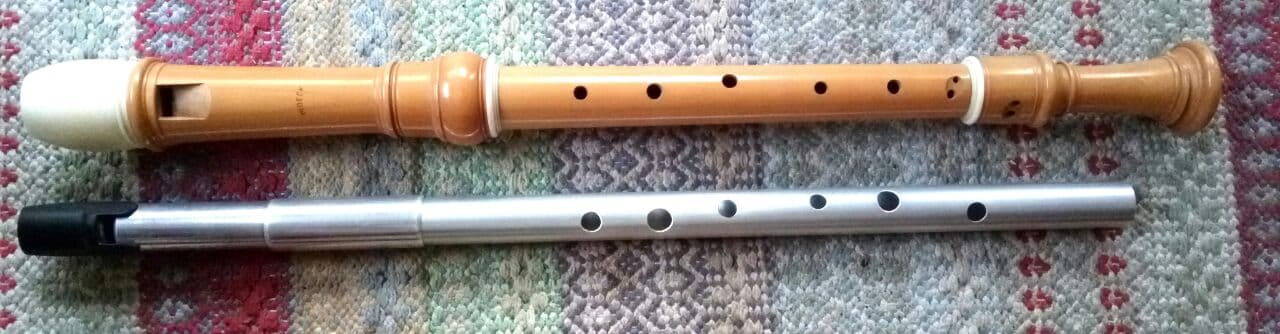
Sorry if this has been answered elsewhere- I did a quick forum search and didn’t come up with anything.
In general, what low whistle would have the approximate finger spacing/spread as tenor recorder? I do realize there’s variation between makers, and that life is happier playing piper’s grip on low whistles, which is fine. Just sussing the relative more-or-less, kinda-sorta size comparisons. : ) FWIW, I’ve got a Yamaha 304B tenor recorder that’s in the current quiver.
I used to have recorders, (sopranino/soprano/alto/tenor, all Yamaha), & from what I can remember of my tenor, my Howard low ‘D’ would be nearest, & it has a good tone.
Hello Glacier,
I happen to have the YRT-304BII right here as well as an older Howard Low D (wide & relatively short cylindrical metal tube with plastic head) and a Walt D. Sweet “Onyx” (conical bore, heavy ABS turned out of full block). So here is a brief comparison for you:
Distance of your hands from the mouth: Howard is the shortest
Finger spacing top 3 holes for the left hand: all 3 fairly similar
Finger spacing bottom 3 holes for the right hand: total span from hole 4 to 6 fairly similar,
…BUT: The major difference is that hole 5 for the middle finger on the recorder is closer to the ring finger hole, where it is (much) further up on the low whistles – that is why the piper’s grip is much more relaxed on the right hand on low whistles.
I hope this helps.
(P.S. This is my first post (I’ve been an occasional reader for some time here); I just wanted to help out glacier with this info – if forum etiquette askes me to introduce myself anywhere, please let me know.)
I’ve made that low D whistle myself, the head is a recent development. Body with offset finger holes for my personal preference. The sixth hole is perhaps a bit larger than usual and therefore sits a bit lower, with more spacing to the fifth hole. Fine if your hands are large. Tuning is just intoned, which widens the distance between fourth and fifth hole, making it a bit more easy for the right hand. Some ET tuned whistles have a smaller fourth to fifth hole distance , and a larger fifth to sixth hole distance.
I just want to say I love your whistle calculator. Its the base of all the whistle bodies I make. I tweak the hole sizes, but the positions it gives me is always excellent tuning, and is better than some whistles I’ve bought at playing in tune easily.
Thank you! I like to give full credits for much of the math in the calculator to Pete Kosel. - Yes, I end up tweaking one or two hole sizes too. Which shows the calculator does not provide a perfect model, but still is a good first step approximation for designing a whistle.