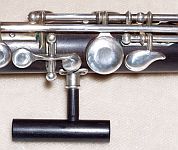
Yeah, that was the other approach that I referred to above as “brings the body of the flute into low whistle position”. I couldn’t immediately find a snitchable image, well done, Conical! The convolutions that have to be imposed on the bore to get from horizontal to vertical worry me a bit. Especially when we remember that the air stream in the head starts out spiral, and smooths out to longitudinal over the first handwidth - the combination of that process and all those bends seem ominous. Perhaps I worry too much!
There is also an intermediate arrangement with horizontal head and sloped body, taking the form of the numeral “7”. Hold your flute up to your lips, then take it away to a relaxed position in front of your chest. The head is probably now over your left shoulder. Imagine keeping the body in that relaxed position, but bending the head back so that the embouchure meets your lips. That would only require a single gentle curve, not a “question mark”.
“Now, how many of these you could sell in such a narrow and “traditional” niche like ours, that’s another question…”
Indeed, but we’re all getting older, aren’t we, and a little bit stiffer. And we should never rule out accident. My recent tumble over some unexpected stuff in the dark and subsequent dislocated shoulder should serve a good reminder.
Perhaps all we would need would be one maker to come up with the curved, bent or folded head that could be adapted to any of our bodies?
On the brighter side, I was talking yesterday to the chap who makes my tuning slides, whereupon he revealed he’s hit ninety. And he’s still knocking out my tuning slides. What a man! There go all my excuses. Down to the workshop!
I’ve located free voice-activated software online. For what it’s worth the company is lily. The free software includes ads, and you can get it without ads for $30 a year. I’m using it now. I don’t know what will come of this, but I do think voice-activated software has come a long way. I’m using the microphone on my laptop, not a headset. I’ve been typing a lot, and I think it’s contributed significantly to the problem. Hoping this will help. We’re talking a lot here about aging, I turned 80 in March, and I think an ounce of prevention is, as the saying goes, worth a pound of cure. Now I would settle for the pound of cure. This thread continues to be encouraging and helpful. Kind regards
I met someone who plays one of these (though maybe on a standard body), due to a shoulder problem I think. The geometry would give another alternative for left-hand angle. The air molecules seem to find their way. Would a metal U-bend (or 90 degree bend, or whatever) in a wooden flute be much different to having a lined head?
I would expect some loss from the energy in the vacillating wind column, but I would imagine it isn’t dramatic, otherwise we wouldn’t be seeing any of these images from the Boehm flute world. And given the Boehm flute is so much easier to hold than our beasties, we deserve a crack at these technologies more than they do!
So far we seem to have identified 4 discrete approaches, in the order shown above:
the swan neck (the least bent, so perhaps the least loss?)
the question mark (perhaps the worst?)
the numeral seven (perhaps the second least loss?), and
the U bend (just a bit further round than the 7)
I could visualise an intermediate between the numeral seven and the U bend - why force the body right back up to the horizontal - why not let it relax a bit at the foot end? IE don’t go for the full 180 degrees, aim more for 135 or so?
An interesting aspect of all of these is that they would work better on our flutes than on the Boehm, as the head & barrel section on our flutes are longer. If the bend were placed near the top of the LH section, it could allow a bit more straight tubing after the embouchure hole, allowing the spiral air column more room to straighten out before encountering the bend. The curve could be less tight. And it could allow the flute body to be more well centred in front of the player.
But this is all surmise until we can give it a go. I wonder where we can find a bit of bent up tubing we could try out? ID would need to be around 3/4" (19mm). Thinking caps on here!
The tube bending process is really pretty straight forward. Here https://www.youtube.com/watch?v=xAF4l12xnSg is a short video detailing the process for brass winds.
When I worked in a Copper and Brass shop we fabricated two bent thirty foot exhaust pipes, each approximately 18 inches in diameter, made of Naval Gun Brass, in exactly this fashion, for a US Naval Anti-submarine Chaser. The difference was that it took about a week of melting buckets full of pitch to fill each pipe, and nearly as long to ´burn´ them out. We had to use the overhead crane and slings to handle the tubes. It took a week to cool the pipes before bending. We had an old multi-ton coining press from the philadelphia mint (foundry dates on it from the 1890´s) to ´bump´ the bends into each tube using enormous wooden shaped bending blocks.
There is enough disagreement about whether we can even hear the difference between lined and unlined head joints that I doubt it would be a major concern.
Although, the aesthetics of a wooden curve would be so much better. Or maybe a Delrin tube curved that way to match an otherwise blackwood flute. Can Delrin be bent that way? Or would it have to be injection molded or 3D printed in some other material?
I have a similar problem in my left wrist. For me, I believe it is the combination of a few problems. Not only is my wrist bent but my fingers are short forcing me to stretch the fingers with a bent wrist. Either one is not the problem but the combination is.
Since the finger spacing can be helped but not eliminated all I can do is try to straighten the wrist as much as I can. I am no longer comfortable playing a single body flute as I once was. I play a flute more often now in which the body is in two pieces. I turn the left handed piece more inward and have the right hand piece where it is a more natural grip as well. The bad part is that my keyed flute is a Nicholson type with a one piece body. Even when we find the right flute it is not always the best permanent fit.
Sounds like we can safely put Bob in charge of coming up with the prototype!
The video method shown would probably get us as far as the swan neck approach. I’m imagining (there’s that word again!) that if you try for a really tight bend (eg the U-bend or the numeral 7) you would find that the metal “work hardens” along the way, so you might need to anneal it again (which would require emptying and refilling it with the pitch). But again, a conjecture only at this time.
Note that the ? approach (shown below) was achieved by fabricating the bend. This isn’t as hard as perhaps it looks. You cut angled segments out of a tube, but leave the bits just joined along the outer spine to simplify line-up. Then bend, and hold together, solder and subsequently clean up each joint. The whole process would be pretty tedious though!
I’ve sent an image of the U-bend to my 90 year old tuning slide maker to see if he has any bright ideas.
It would be pretty desirable to be able to practice on thin-walled brass before risking sterling silver. Anyone have a source of 19mm ID (3/4"), circa 20mm OD brass at the ready?
Two realizations about keeping my wrist straight. First, I’ve been playing with the thumb hole on keyless flutes. I think using the thumb hole bends my wrist. No more Thumbhole. Second , A long stretch to the L3 hole bends the wrist. If my wrist is straight it’s hard to reach the hole. Fortunately I have a Siccama Flute where the hole is much closer in. As a PostScript, the voice-activated software seems to be helping.
Second , A long stretch to the L3 hole bends the wrist. If my wrist is straight it’s hard to reach the hole. Fortunately I have a Siccama Flute where the hole is much closer in.
OK, keep us in touch with whether that helps.
As a PostScript, the voice-activated software seems to be helping.
Ah, again very interesting.
It’s tempting to think that, if playing the flute presents a problem, that the problem arises from playing the flute. But if the problem is also or partially caused or exacerbated by other activities, we need to know to be able to advise others.
The physical therapist has explained the anatomy to me, and shown me charts and diagrams. There are muscles in the forearm that turn into tendons as they approach the hand. These tendons pass through the wrist through Sheaths, and then on to the fingers. The tendons and the sheaths become inflamed through overuse. The wrist is a busy place. If it is bent the problem can become worse.
It occurs to me that if you play the flute a couple of hours a day, and then type a couple of hours a day, as I often do, you can imagine how much the tendons and the sheaths in the wrist can be overused. That’s my idea, anyway. I’ll see if it really helps.
I saw a physical therapist a few years ago with left wrist pain after playing much more than I normally do. We worked out it was probably related to a minor childhood injury - she isolated just the spot that reminded me of pain after a fall. So not tendons in my case. Amongst other things she recommended a wrist brace and as the problem subsided I discovered that I could play the flute with the brace on and it stopped me doing what made it hurt. I occasionally wear it still if I feel a twinge.
If your physical therapist thought it was OK I wonder if it would help in finding a non-bent wrist position where you fingers could still do their job.
OK, got a bit of intelligence to share. I made a “Bent Barrel”. Imagine a normal flute barrel but with a single sharp 45 degree bend in the middle of it. I made it simply by cutting a normal barrel in half with the saw guide set to 22.5 degrees. Reunite them and they are still straight, but rotate one of them halfway round and they now sit at 45 degrees. I just glued the two ends together at that setting. Audacious, eh? (Don’t try this with a fully lined barrel!)
And putting it on my flute in place of the normal straight barrel doesn’t seem to weaken the tone or produce any odd effects.
And holding it to the lip confirms that it takes all the stress away from the left wrist. You can experience that yourself just by holding your flute in front of you with the head going up just grazing your left cheek and the flute body at around 45 degrees to vertical. The left wrist is perfectly relaxed.
The downside (and I suspected that this would happen) is that the force you need to press the embouchure into your lower lip and chin now has much more leverage, and rotates the flute body against your will. A Boehm Crutch would probably solve the problem, but might introduce more!
I tried tying a length of cord around the stopper end of the flute, passed it over my left shoulder and used it to counter the lip and chin pressure. Very effective, and again allowed even further relaxation of hands and arms. And I felt, improved the tone I could get. But I’m not sure we’re quite ready for flute straps yet!
You can experiment with that approach on your own flute by getting someone else to press the cap towards your left shoulder, or using your right hand to do so, and just playing the left hand notes. It feels very secure!
So the Bent Barrel might not be the final solution, but the experiment does seem to suggest that it should be possible to come up with an approach that works.
As I was reading through the thread I was glad to see you were going to consult with an OT. PTs are great, but as mentioned in a previous post, OT’s focus of expertise is best to help you crack this particular nut. If you found your particular OT was not that helpful I’d recommend reaching out to players the the wind section of an Orchestra near you if there is one, or a college. Professional players have hand and wrist issues often, and will figure out the best practitioners in their area. Their livelihoods depend on it.