Lakewood Flutes Review
Background
In early August 2024 I had some interactions on Facebook with one Gulraiz Deura, a supplier of “Irish” flutes from Sialkot, Pakistan. The upshot was that I challenged him to send me some samples of his output for review. I suggested a sample of 6 and specified that they should be standard production items from stock, not ones given special attention for the intended extra scrutiny. He offered just one, but I responded that that would hardly be a representative sample. We compromised on three, which I think was reasonable given the costs of international carriage involved. I had my choice of materials from his available range. The deal was that I would assess and review them, give him feedback and publish my review in relevant places online and then either buy some or all of the sample flutes or return them to him at my own expense. I chose to receive flutes in “rosewood”, olive wood and polymer (Delrin or equivalent) and eschewed the offer of one in African Blackwood.
There was no stock already held in Britain and it seems there was none immediately on hand in Sialkot as there was a preparation delay of 9 days from our agreement on August 7th until I was informed the flutes were ready for despatch from Pakistan on the 16th and that they were en route on the 17th. It therefore seems questionable as to just how representative of general production quality these samples really are! The package duly arrived on August 27th. Since then I have been slowly assessing them and taking notes – admittedly I’ve taken rather a long time, but giving them attention has had to be fitted in when my general busy-ness allowed.
Trying to research Lakewood online didn’t come up with very much - only this hit. (For clarity, there is no association whatever with Lakewood Guitars!) Mr. Deura’s Facebook profile (now altered to “Gul’z Luthier”) is locked and there is no business FB Page for Lakewood that I can find and he tells me they don’t have a website. Apart from the sketchy information in the Export Hub link above, which suggests a large business/factory, I have no idea what their scale or conditions of production are, though Mr. Deura has told me they make “lots of flutes for Irish companies” based on samples those customers supply. (That begs the interesting question of what exactly are these flutes based on???)
The quoted prices (£GBP) for the flutes were:
Rosewood £95.00
Olive Wood £125.00
Delrin £165.00
African Blackwood £195.00 (not chosen)
Other “Irish” flutes from Pakistan
I have quite a bit of prior experience with apparently similar “Irish” keyless flutes made in Pakistan (by assorted makers unknown) in the general style of Pratten’s Perfected flutes (one-piece body, large tone-holes), having bought quite a few over the years when they’ve turned up second-hand on eBay for under c£40. These were bought with a view to possibly improving them, especially by bushing and recutting the usually hugely over-sized and badly cut embouchure holes and by re-finishing the usually rough bores and tone-holes and badly done tenon lappings. Some of the other designs of “Irish” flute to be found on eBay and in music shops, especially the keyless ones based on a Meyer type body configuration (with lower body and foot in one piece rather than the upper and lower body sections being in one like the Pratten style models) are invariably absolutely execrable in all respects, totally unusable musically and an immoral waste of even low grade timber and maker effort. I’ve had a few of those acquired cheaply too, and they’re always irredeemably awful. On the other hand, the Pratten style ones usually at least have the tone-holes fairly accurately sized and sited and play in-tune scales, but the embouchures are bad and the execution and finish mostly pretty poor. I’ve had a couple where, although not well cut, the embouchures were not oversize which allowed me scope to improve them and then sell them on. I’ve long said that if the Pakistani makers would significantly up their game on production values (certain design details improved and then consistency and finishing and quality control) it would not be beyond them to produce worthwhile instruments.
Review
This review will be set out in two main parts – a physical inspection/description and evaluation first, then a musical one. There is a general point which will come up repeatedly - consistency of accurate production within design is an important aspect of flute-making, significant in assessing a maker’s output. That is one reason I requested multiple sample instruments. Where relevant in what follows, I will refer to the three flutes as R (rosewood), O (olivewood) and P (polymer).
(My apologies that the image numbers in the text below are according to the sequence in which they were taken, not the order in which they appear here and also that I cannot control the image sizes. The Images can also be viewed full size in this folder).
There are three composite demo videos on YouTube (referenced where relevant below) which form an integral part of this review:
Video 1 - general demonstration of fingerings and intonation etc. with comparisons
Video 2 - tune-playing comparative demo
Video 3 - bore examination with bore scope and direct phonecam videography
Physical
General description
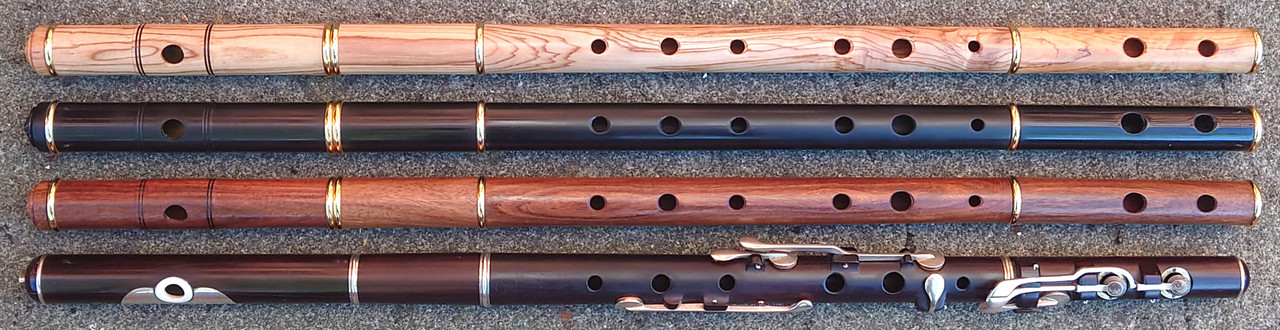
All three sample flutes are quite well finished externally and look fairly attractive.
- The flutes
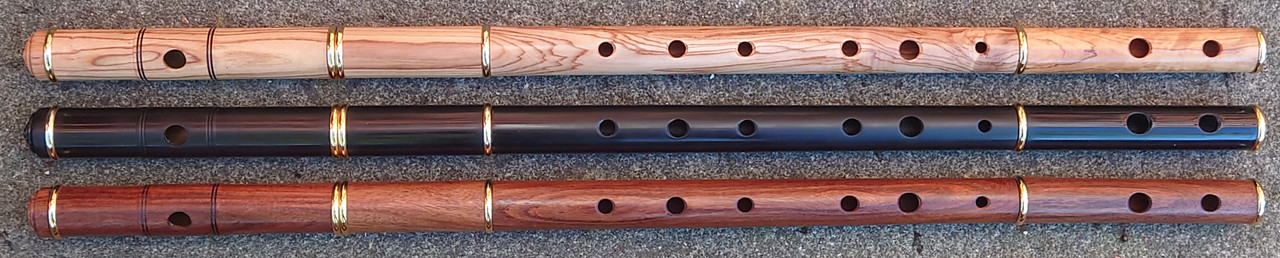
- Rosewood flute (R)
- Olivewood flute (O)
- Polymer flute (P)
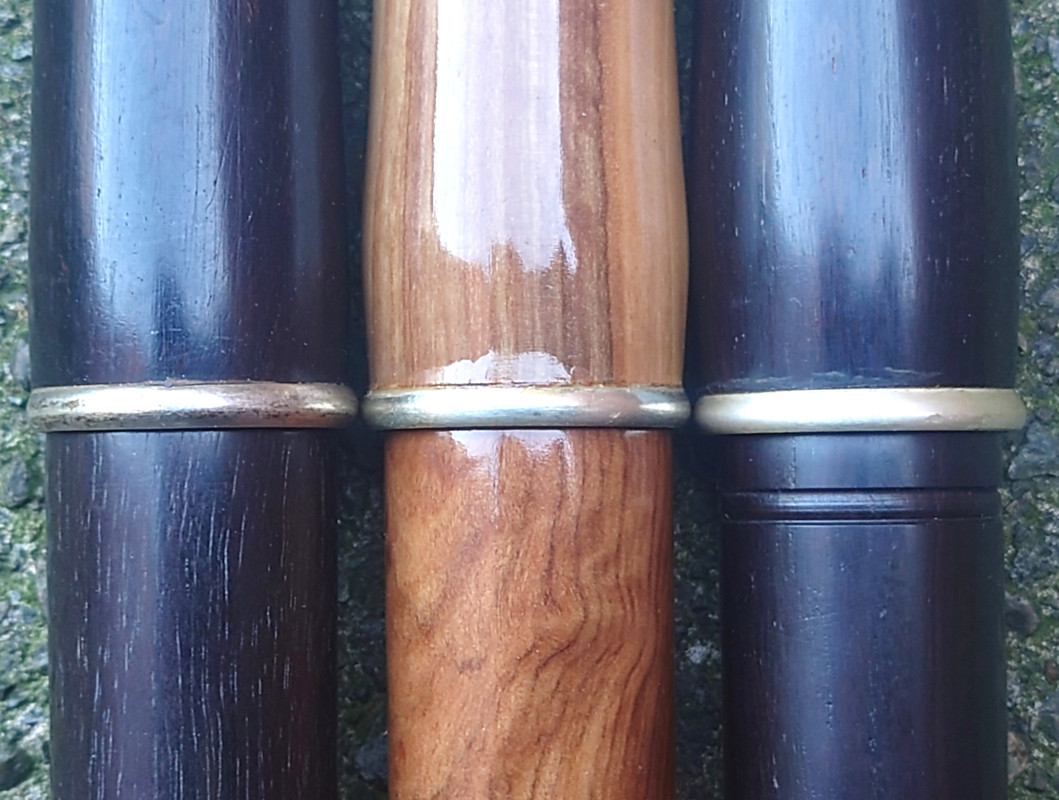
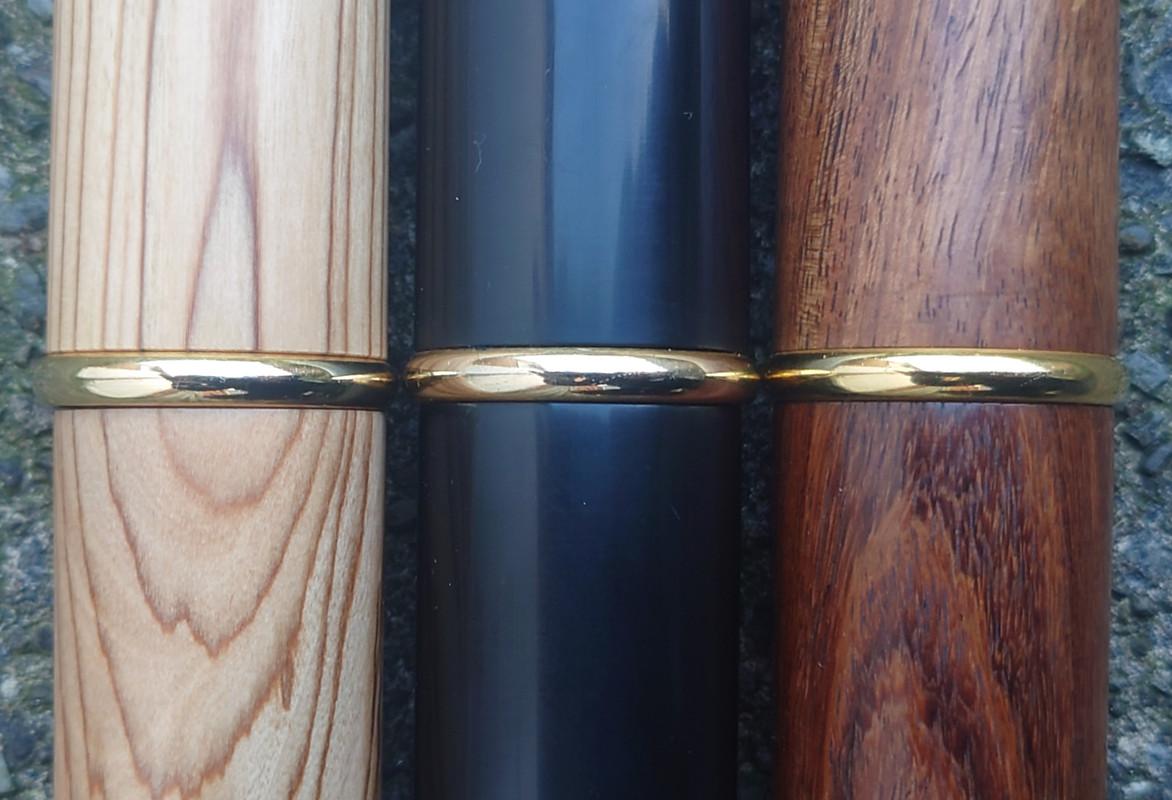
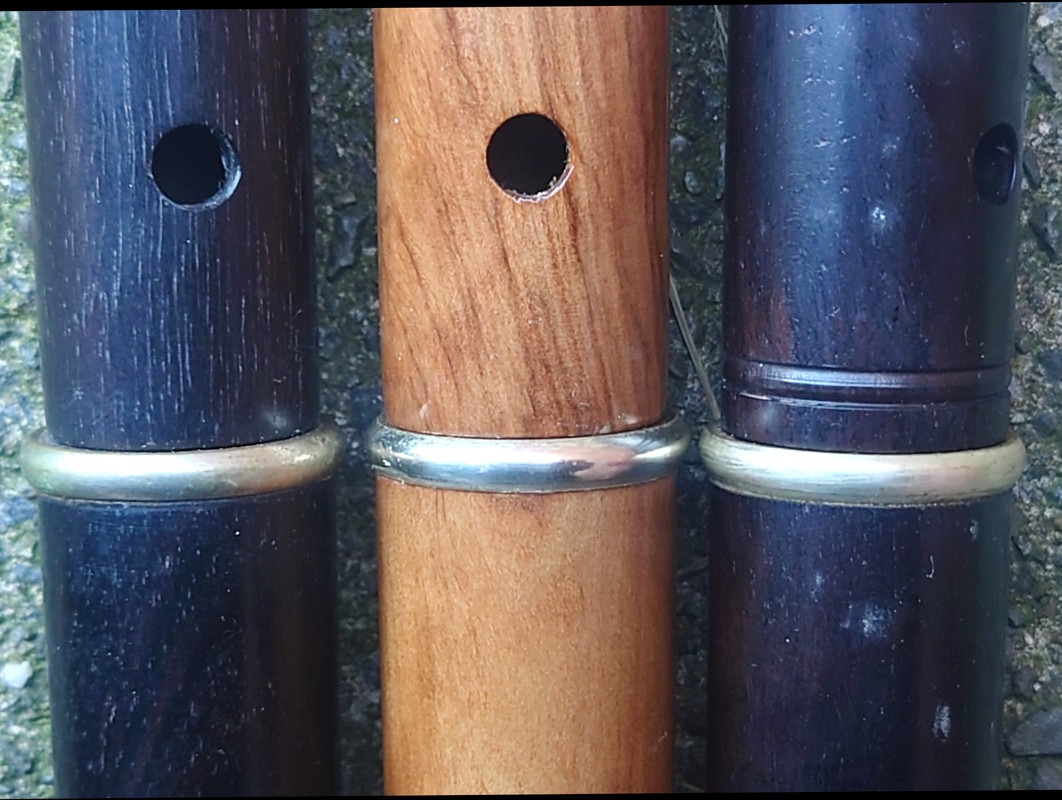
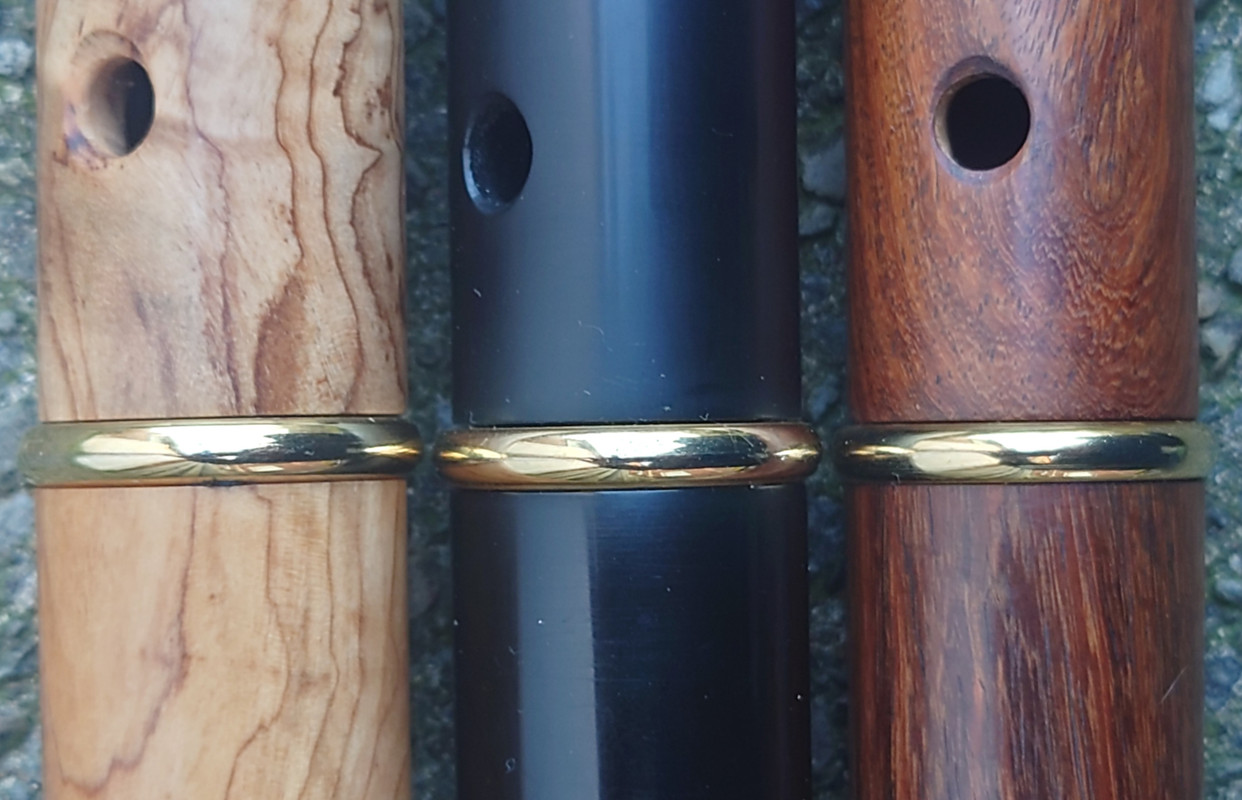
The diameters of the parts are quite well (but not perfectly) matched at the joints, unlike many Sialkot-made instruments. From other Sialkot makers typically the body is much narrower than the barrel and foot, creating an unsightly step at the joints. These do have a very slight reduction, but it is not too obvious at a glance, though there’s room for improvement still.
- Other Pakistan-made flutes - barrel joints with obvious discrepancies
- Lakewood flutes - barrel joints - much better matched
- Other Pakistan-made flutes - foot joints with obvious discrepancies
- Lakewood flutes - foot joints
The overall looks are somewhat spoilt by the heads having a reserved, slightly raised section (less turned down than the rest of the head) at the embouchures.
- Embouchure holes and tube bulges - note discrepancies of embouchure hole shapes
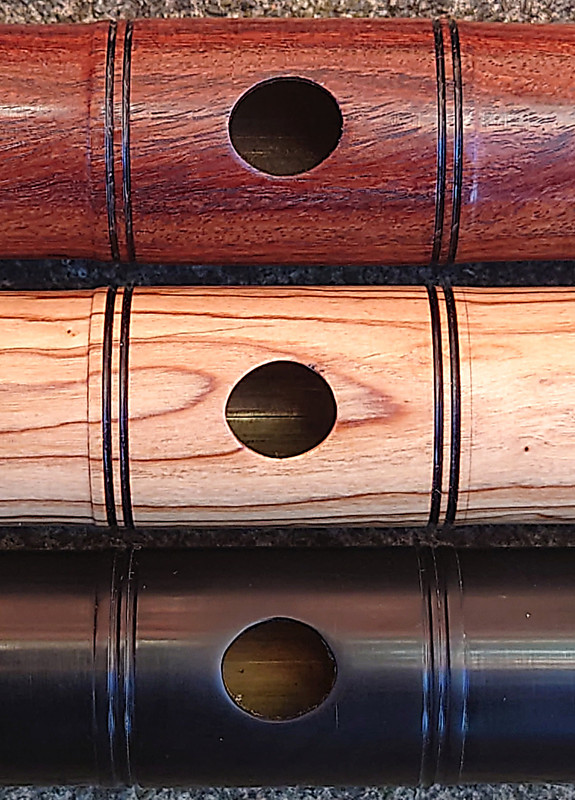
If this is to provide a deeper embouchure chimney than the main diameter would afford (more on this later), why not just leave the whole head at the larger diameter (no unsightly bulge and adjust the diameters/tapers of the other parts to match at the joints), which would look better and more “professional”? The raised segment is delimited by double “decorative” turned grooves near each end, which have been inked black on the two wooden flutes. This silly, ugly feature really spoils their looks in my opinion and gives a cheap and nasty “tourist product”, non-serious impression. I also find I feel the grooves noticeably and irritatingly against my chin when playing.
On the wooden flutes there is no attempt to match the grain across the joints (see Image 1), but at this price level I think that’s quite acceptable. Less acceptably, on the wooden ones all the holes are drilled in the V patterns of the flat or table grain - typical of Pakistan-made instruments. In my experience all good quality “western”-made wooden flutes, both antique and modern, have the embouchure holes and the main run of tone-holes drilled in the narrow, close-set side grain at right angles to the Vs - clearly historically established good practice (no doubt for good reasons from intimate knowledge of timber but not known to the Pakistani makers)! (To be fair, admittedly on O the body and foot have rather confused grain patterns!). To see what I mean, either study some antique flutes (in the flesh or in online images) or browse illustrations on e.g. this web-page of a very fine modern maker (other makers’ websites will corroborate!), paying attention to grain orientation and hole placement.
Ferrule rings
The metal ferrule rings are gold-plated brass and do look smart (while the plating lasts - and it’s already wearing away on the rings which tend to contact surfaces when the flutes are laid down), certainly better than the plain brass or chrome-plated rings usually seen on Pakistan-made flutes, though personally I’d prefer the look of either un-plated nickel-silver or solid silver (which won’t get rubbed away in time). The rings are not all as tidily fitted on their rebates as they should be (Images 9-11) and both those on the foot of the rosewood one and the lower head ring, both barrel rings and one foot ring on the polymer one are loose.
- Foot ends showing ill-fitted rings & extreme counter bore (a)
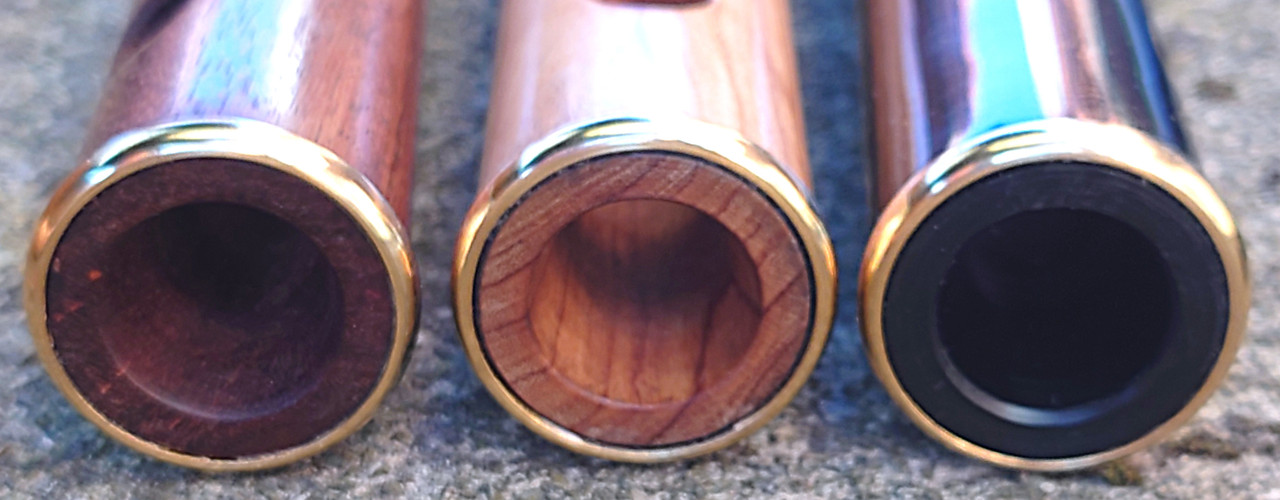
- Foot ends showing ill-fitted rings & extreme counter bore (b)
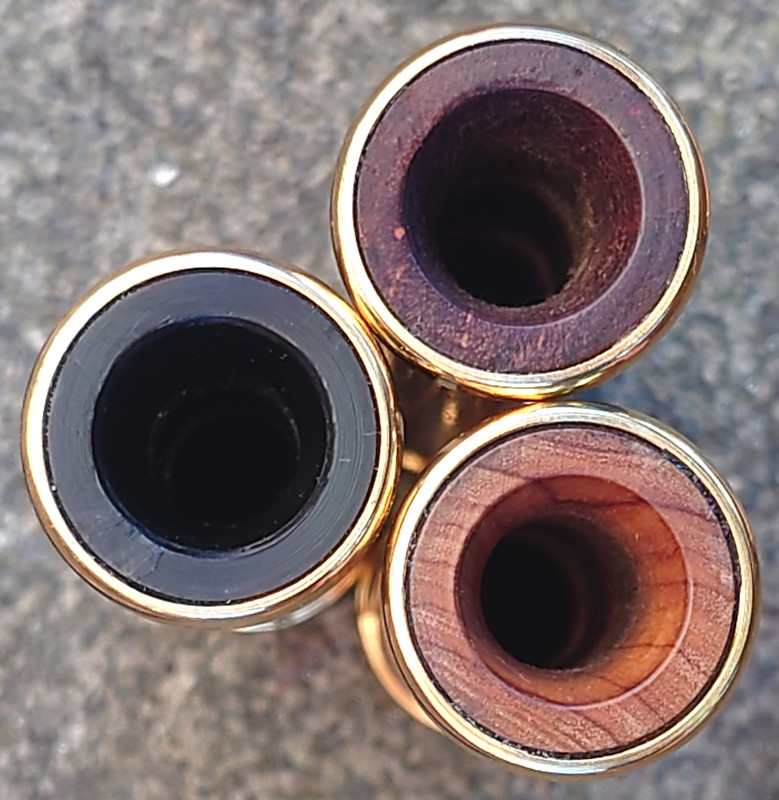
- Foot ends showing ill-fitted rings & extreme counter bore (c)
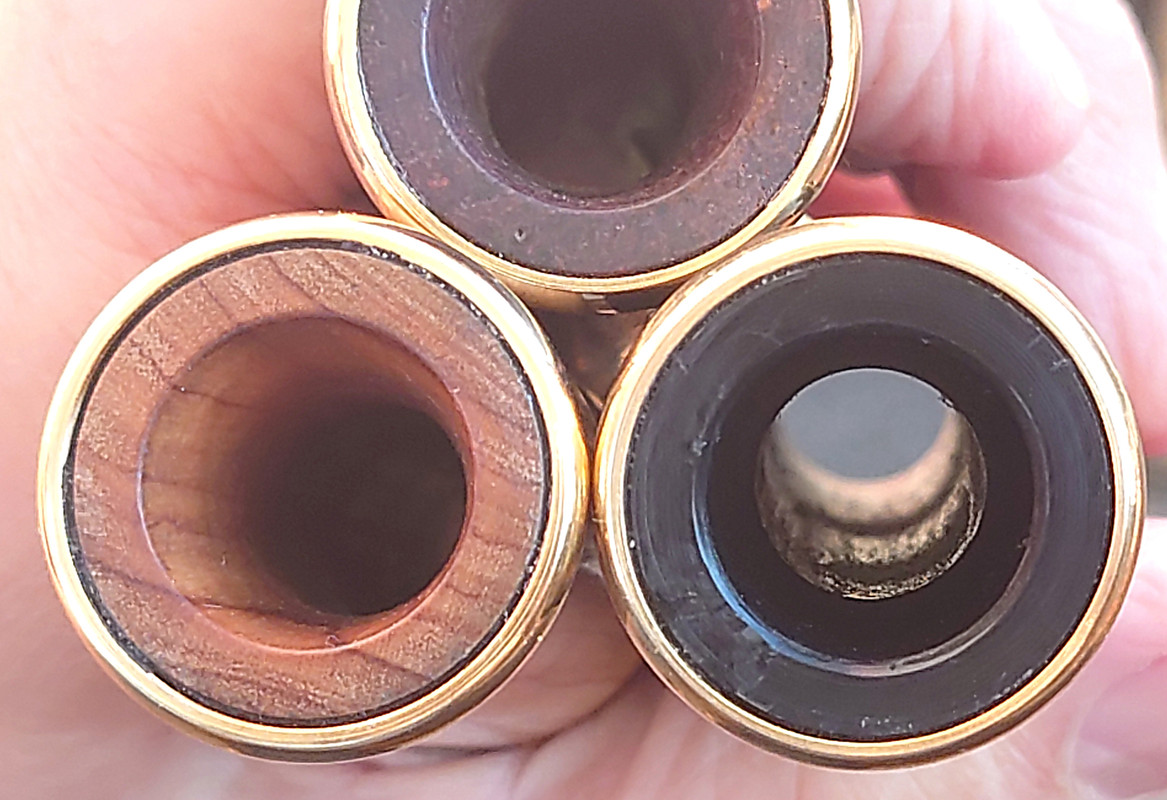
General construction
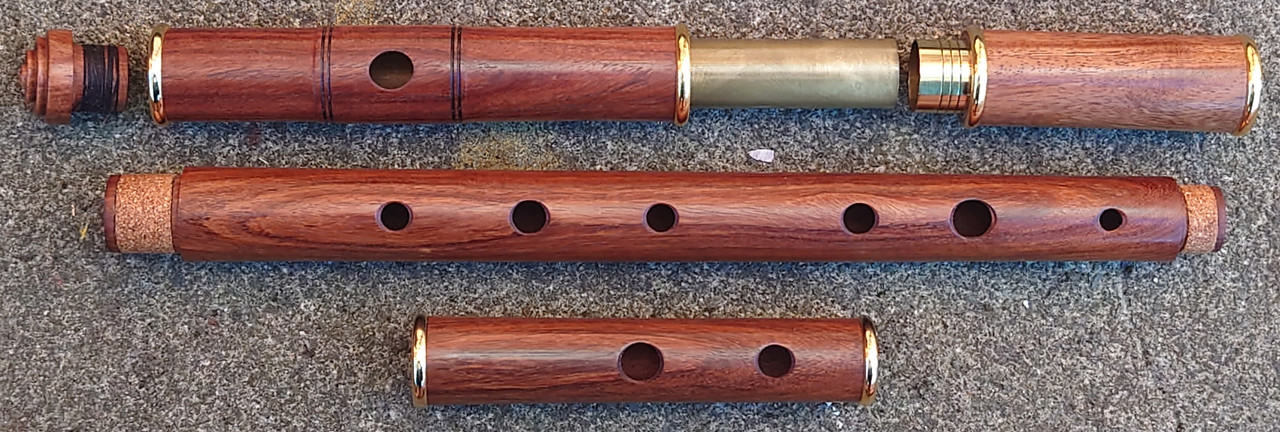
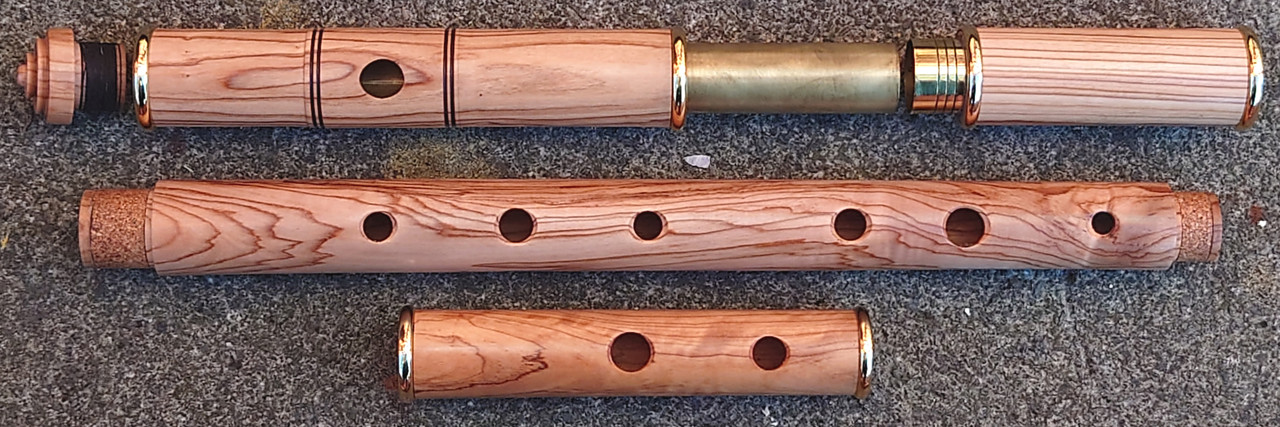
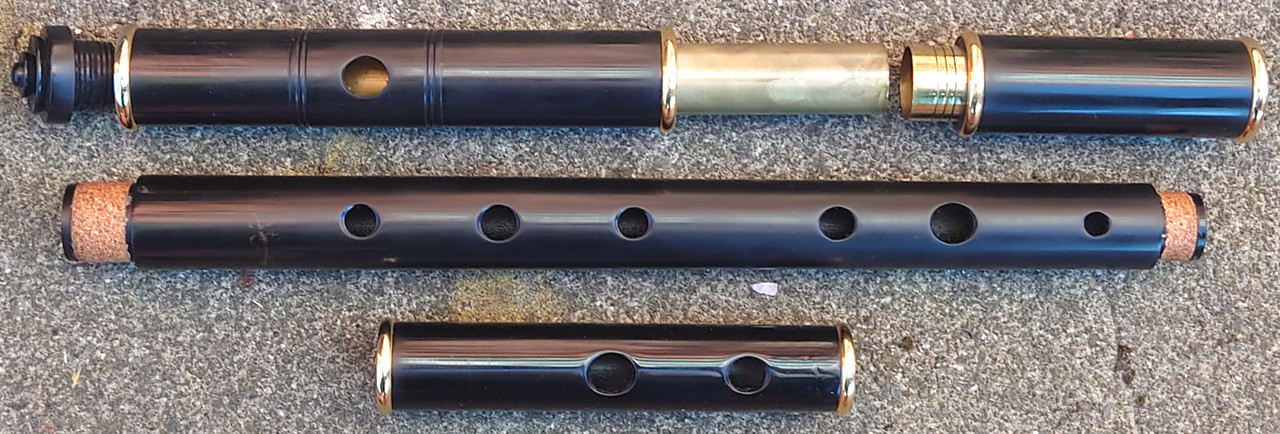
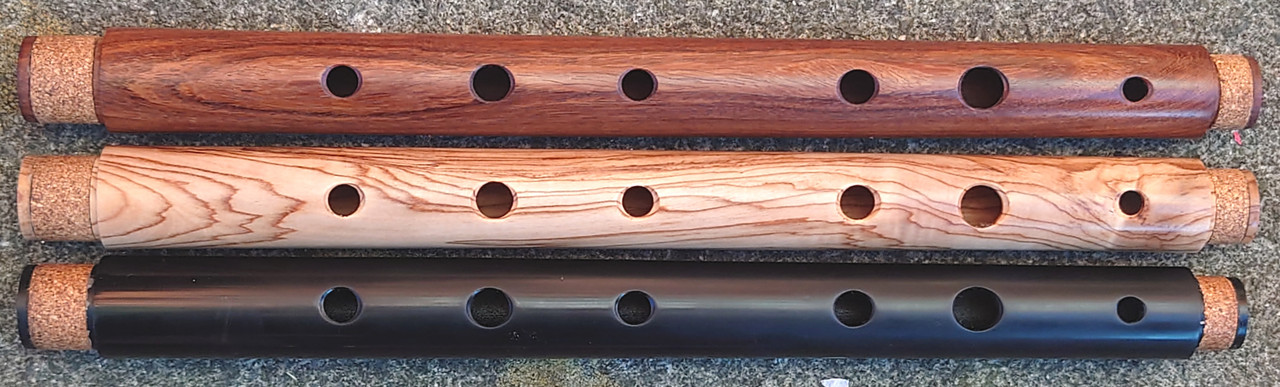
The various parts of the flutes are tolerably consistently made outwardly, the section lengths all being within 2mm of each other, though not totally identical as they ought to be (Images 6-8 of the bodies).
- The bodies
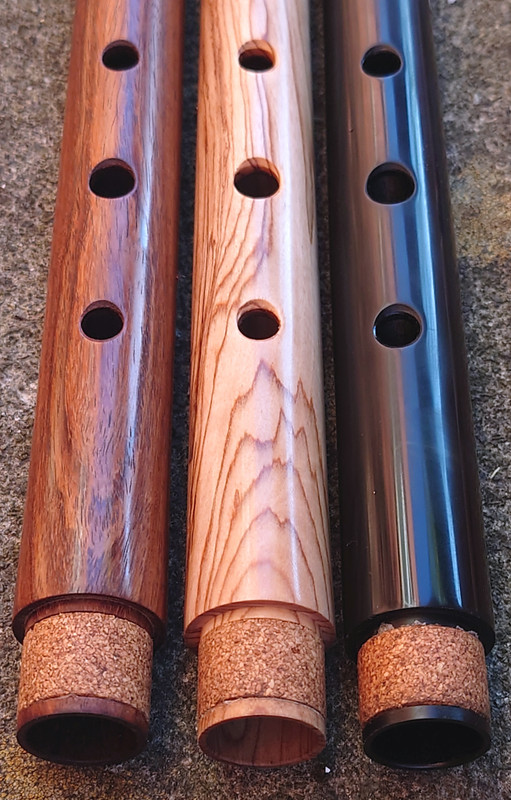
- Upper ends of bodies - tenons and L-hand holes
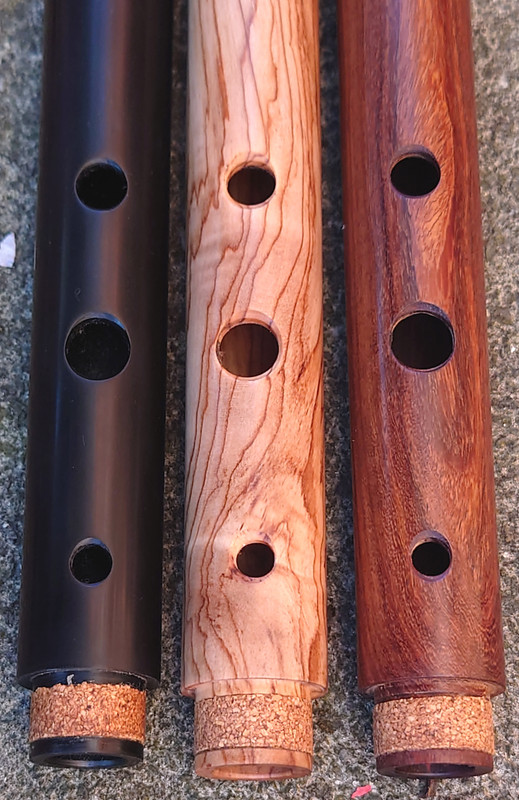
- Lower ends of bodies - tenons and R-hand holes
Perfect consistency on this aspect should be a quite easily attainable production goal! I haven’t taken and compiled measurements of the actual sections, but I have recorded some significant details in the table below. The discrepancies are not huge and any slight intonation issues caused could easily be adjusted for in other ways, but again, these dimensions really ought to be identical. With the tuning slides closed up, I measured the sounding length (SL = embouchure centre to foot end), the distance from the embouchure centre to the centre of hole 1 (Emb-C#) and the distance between the centre of holes 1 and 6 (C#-E).
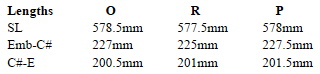
(There are also some inconsistencies regarding turned outside diameters [ODs], but I didn’t take exhaustive measurements of all parts. I did measure the heads, but will deal with that when I come onto the embouchure holes below.)
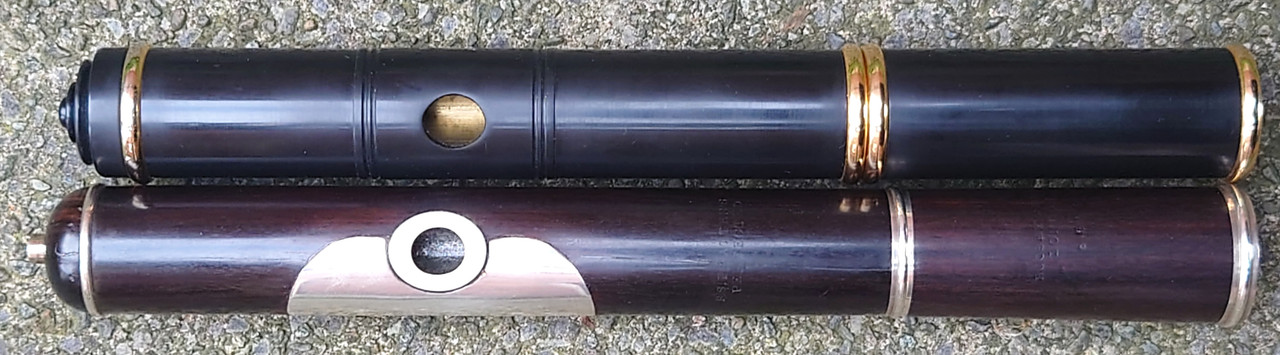
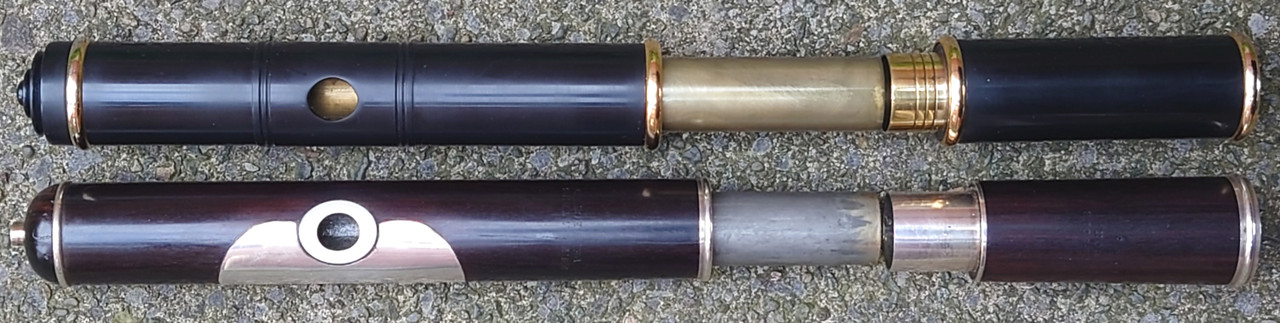
I am puzzled as to why the tuning barrels are very long - unnecessarily so and much longer than any I have ever seen on antique or other modern flutes. This doesn’t matter at all functionally, but the proportions would look rather better with more normal barrel/head lengths.
- The flutes with my original Boosey & Sons R. S. Pratten’s Perfected flute #6259 (made in 1860) alongside them for comparison
- Heads/barrels of original Boosey Pratten #6259 and P to show comparative proportions - tuning slides closed
- Heads/barrels of original Boosey Pratten #6259 and P to show comparative proportions - tuning slides separated
Conversely (and ironically given the length of the barrels!), the tenons at both ends of the bodies, but especially the foot end, are much too short (see Images 7-8 above and also 35-37 below to compare the tenon lengths on the body of my original Pratten).
- Bodies of original Boosey Pratten #6259 and P to compare tenon lengths
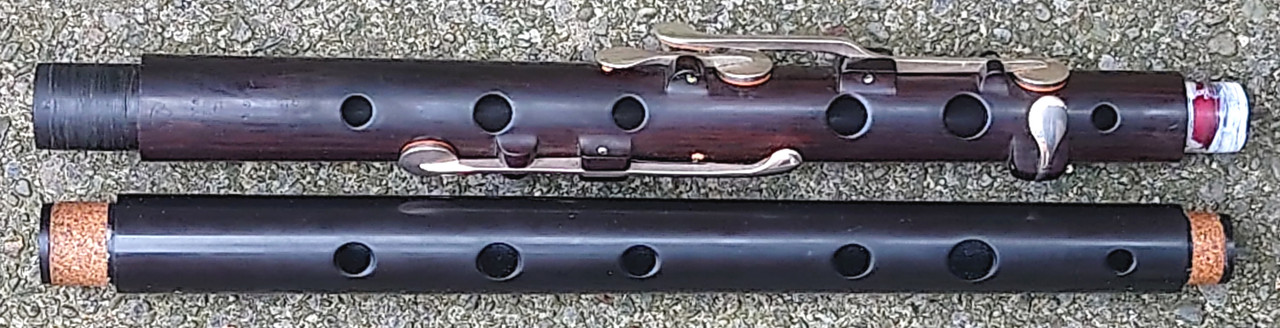
- Upper tenons of original Boosey Pratten #6259 and P compared
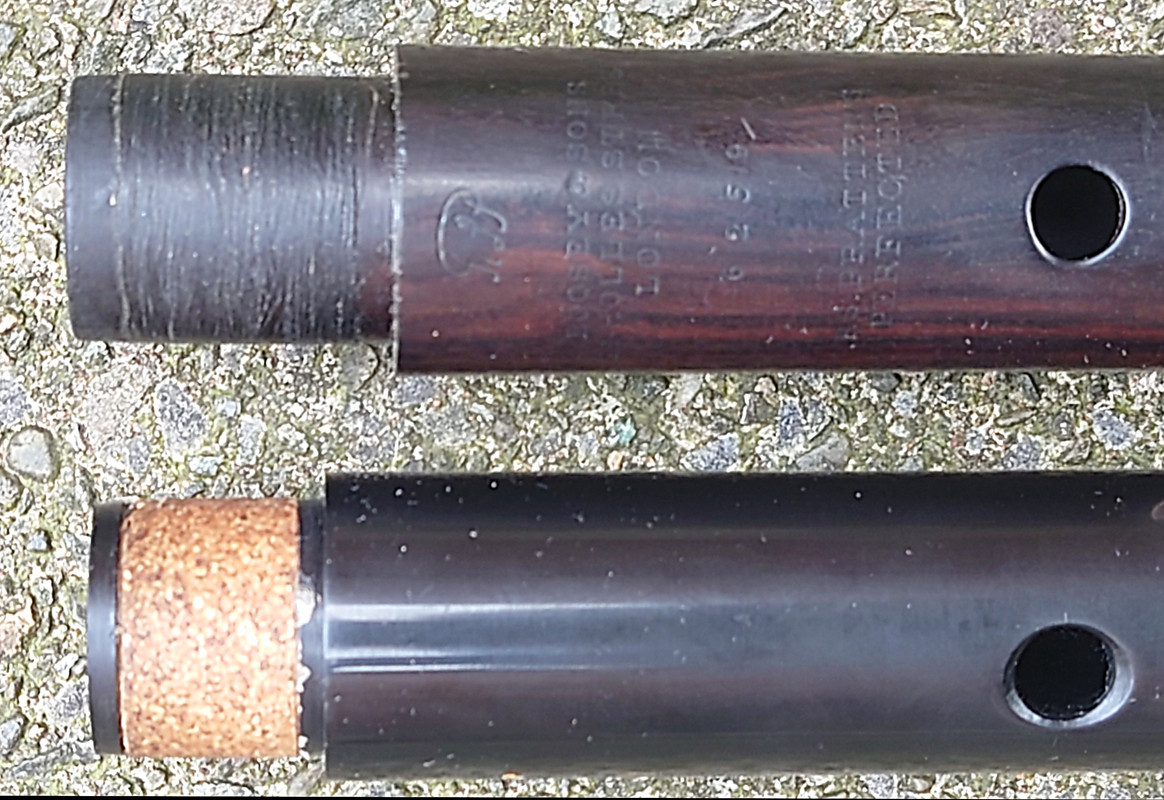
- Lower tenons of original Boosey Pratten #6259 and P compared
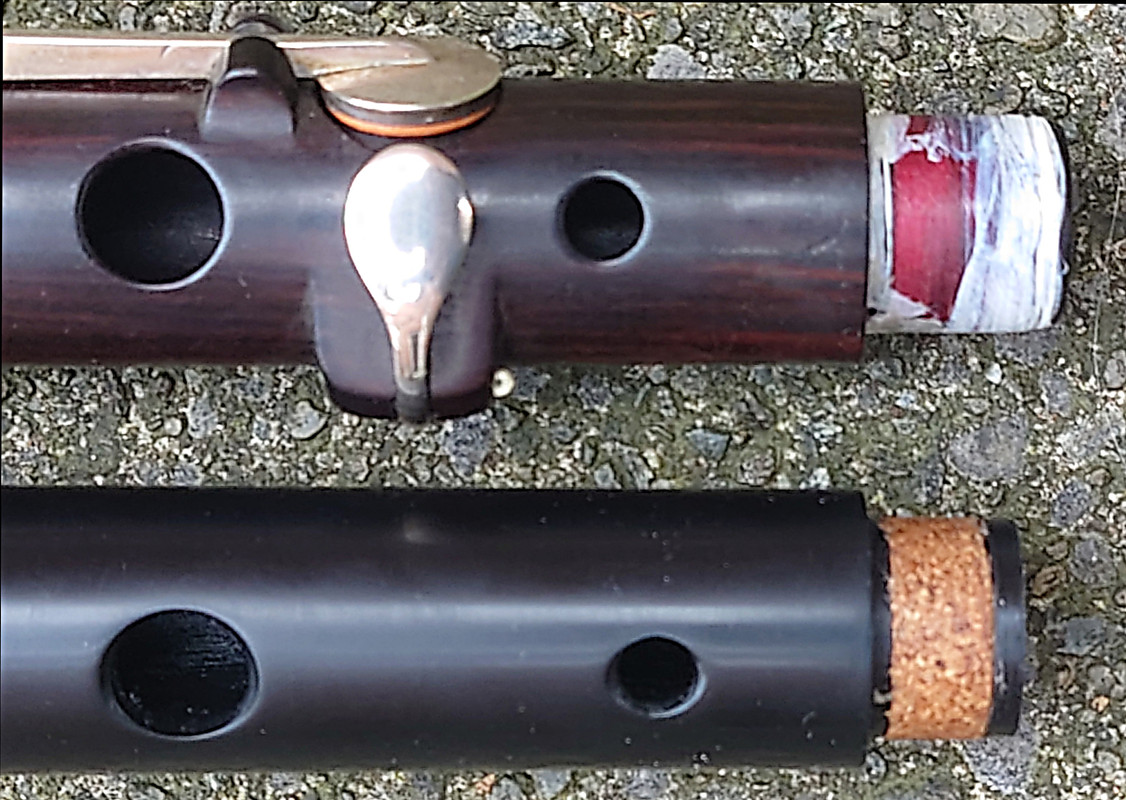
Obviously the sockets in barrel and foot are also short to match. This leads to some instability when assembled, particularly of the footjoints - all three are wobbly, as are two of the heads/barrels on the bodies (see Video 1). There is plenty of scope within the overall design to correct this with longer tenons and sockets) The poor quality and scruffily applied, nasty, reconstituted cork sheet lappings (Images 7-8 above) don’t help, but even with better quality natural sheet cork and more careful application/finishing, the lapping beds on the foot end tenons are too short because the tenons are too short. All this is an easy design fix, but a problem as-is. Also, the socket diameters of both barrels and footjoints are not identical between flutes, so the parts are not interchangeable between the three sample instruments (apart from the heads, which all fit in every barrel because the brass tubing is standardised). This non-interchangeability is of no practical or musical significance for the owner of an individual flute, but again is not a sign of good standardisation of production.
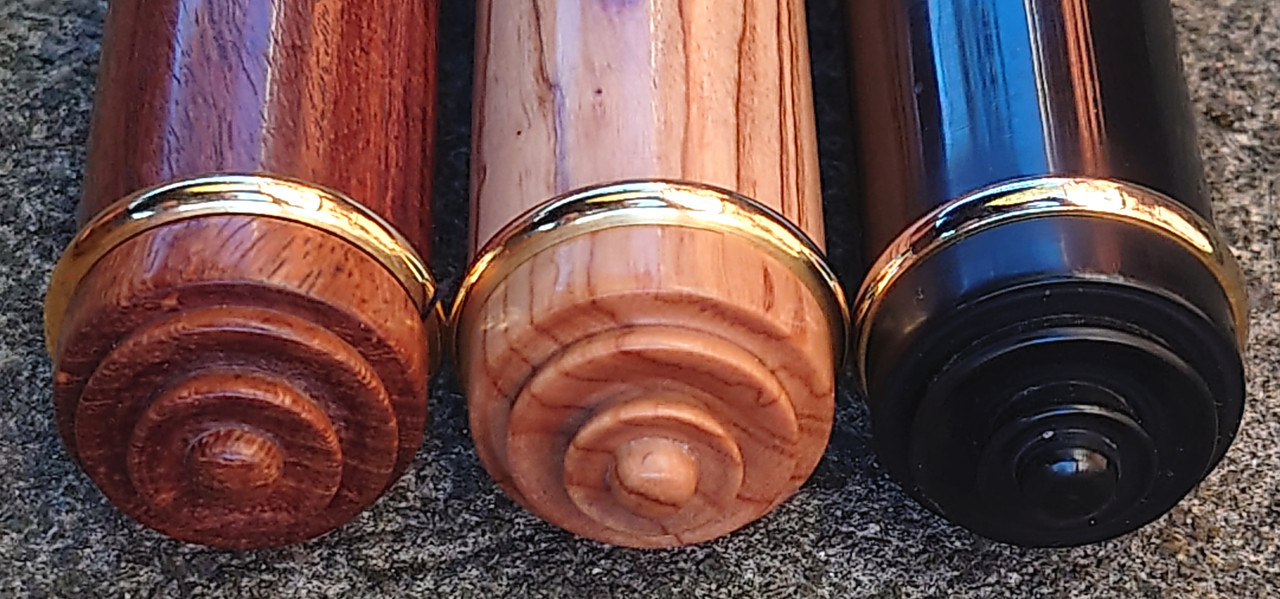
The crowns, simple push in ones (not connected to the stoppers, which I wouldn’t expect at this price level in a keyless flute) have an unusual but tolerably attractive stepped profile.
- The crowns
The cork stoppers were all more-or-less correctly placed at 19mm from the embouchure centre and are airtight, but are not very tidily made (the face of one is noticeably not cut straight and the other two aren’t perfect) and they are also made of the horrid composite/reconstituted cork and had not been greased prior to insertion and placement (Images 44-47).
- Stopper corks (a)
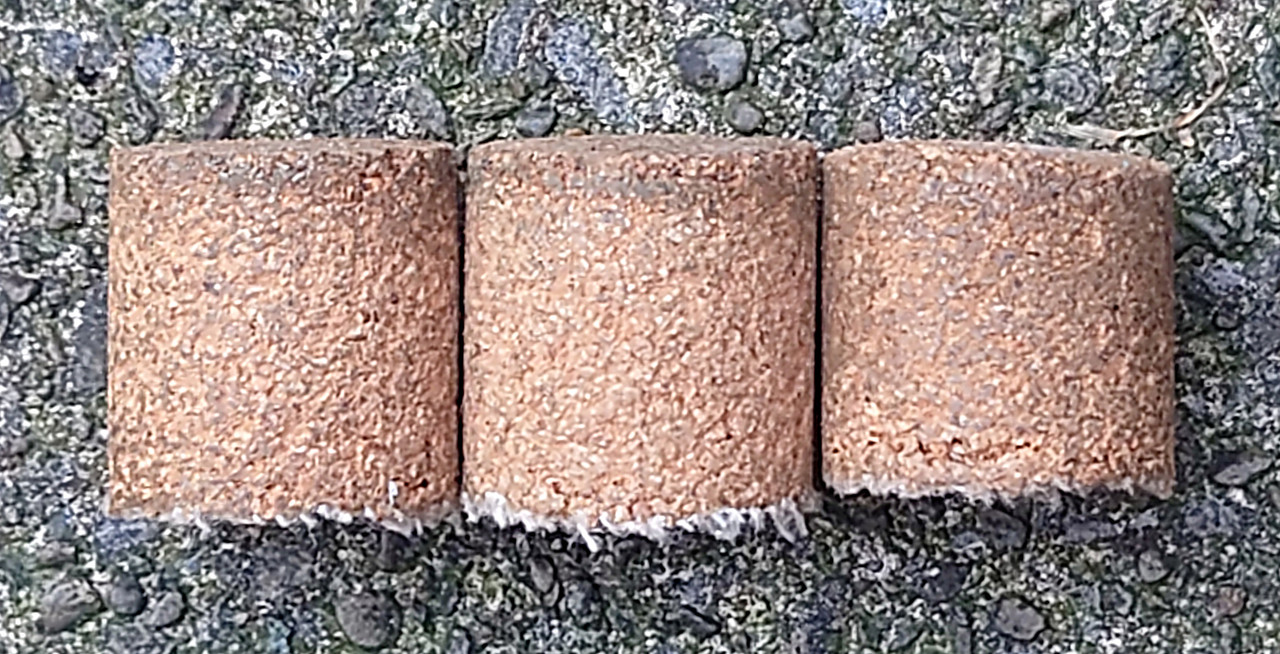
- Stopper corks (b)
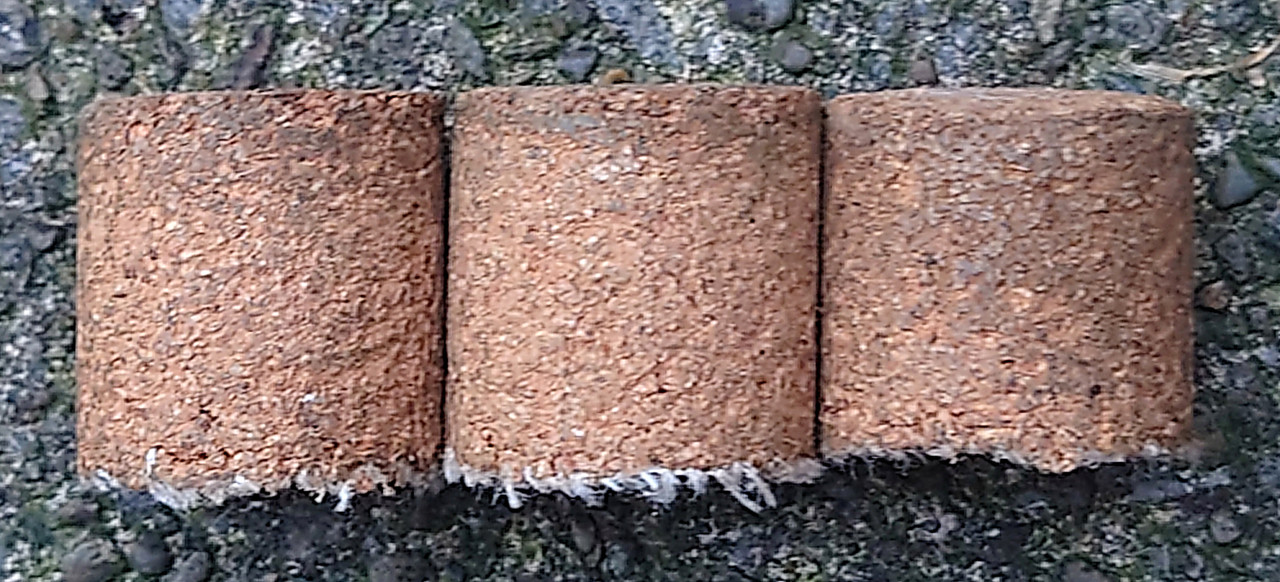
- Stopper corks (c) - faces
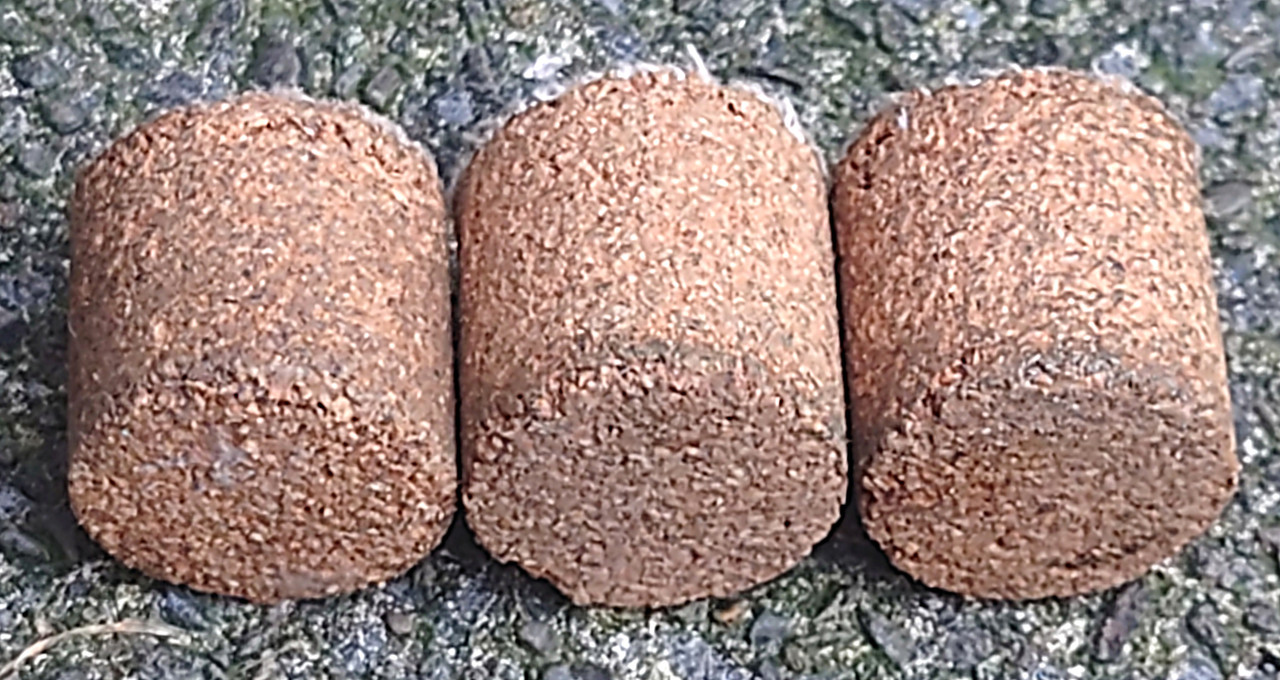
- Stopper corks (d) - rear faces
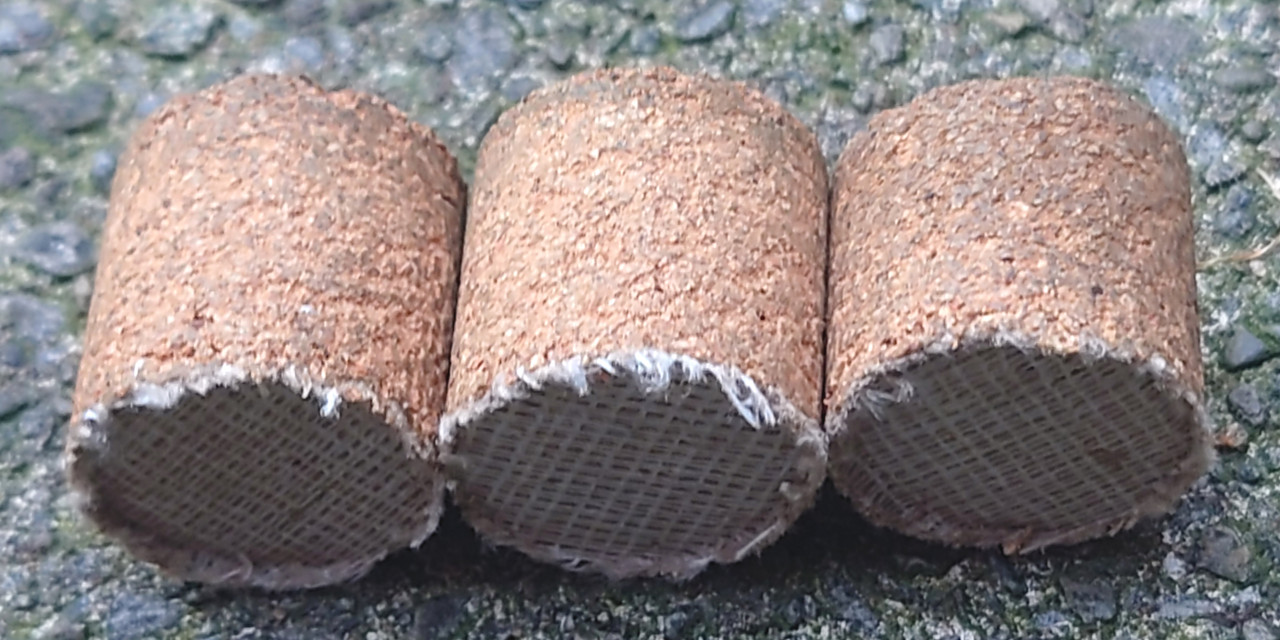
Again, I’d recommend using natural cork or alternatively making polymer stoppers with O-rings as a much better provision.
Tone-holes
On all three flutes the tone-holes (including the ones on the footjoints which aren’t fingered) have been quite deeply countersunk, almost scalloped. This has been done neatly, if not always completely accurately centred, and the finish is smooth and comfortable under the fingers, but is unsightly and in no way preferable to cleanly cut holes simply having their outward edges rounded slightly so as not to be too sharp for finger comfort. I don’t think the countersinking helps with sealing the holes with the fingers or has any other good reason to be done. As noted previously, all holes on the wooden flutes have been drilled in the flat grain of the joints - not a desirable practice.
- L-hand tone-holes
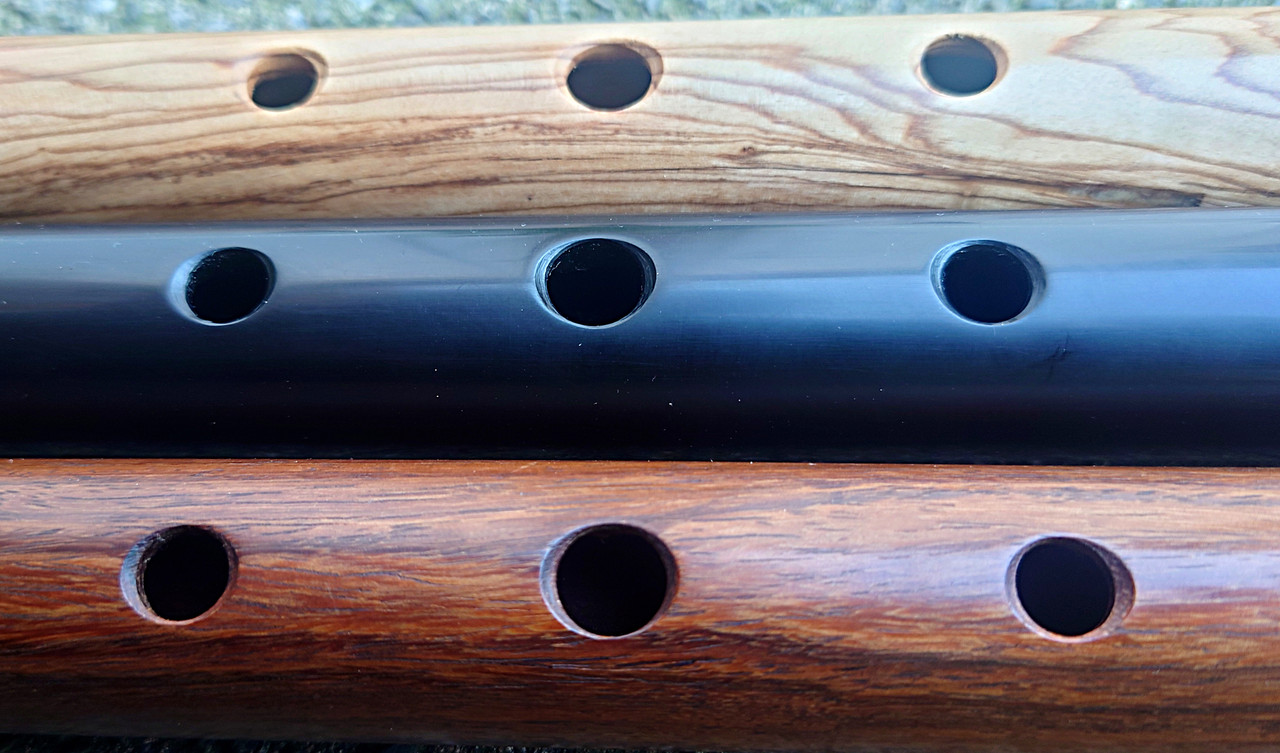
- R-hand tone-holes
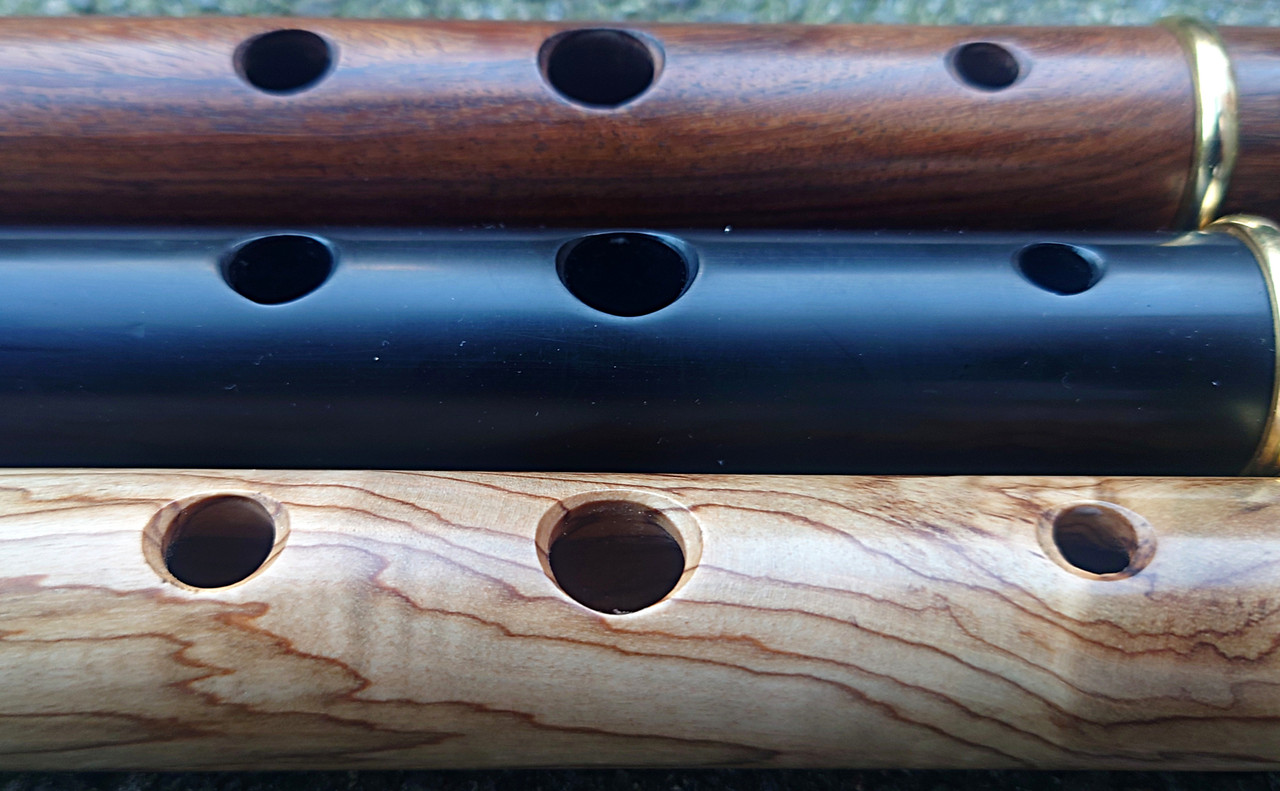
- Footjoint tone-holes
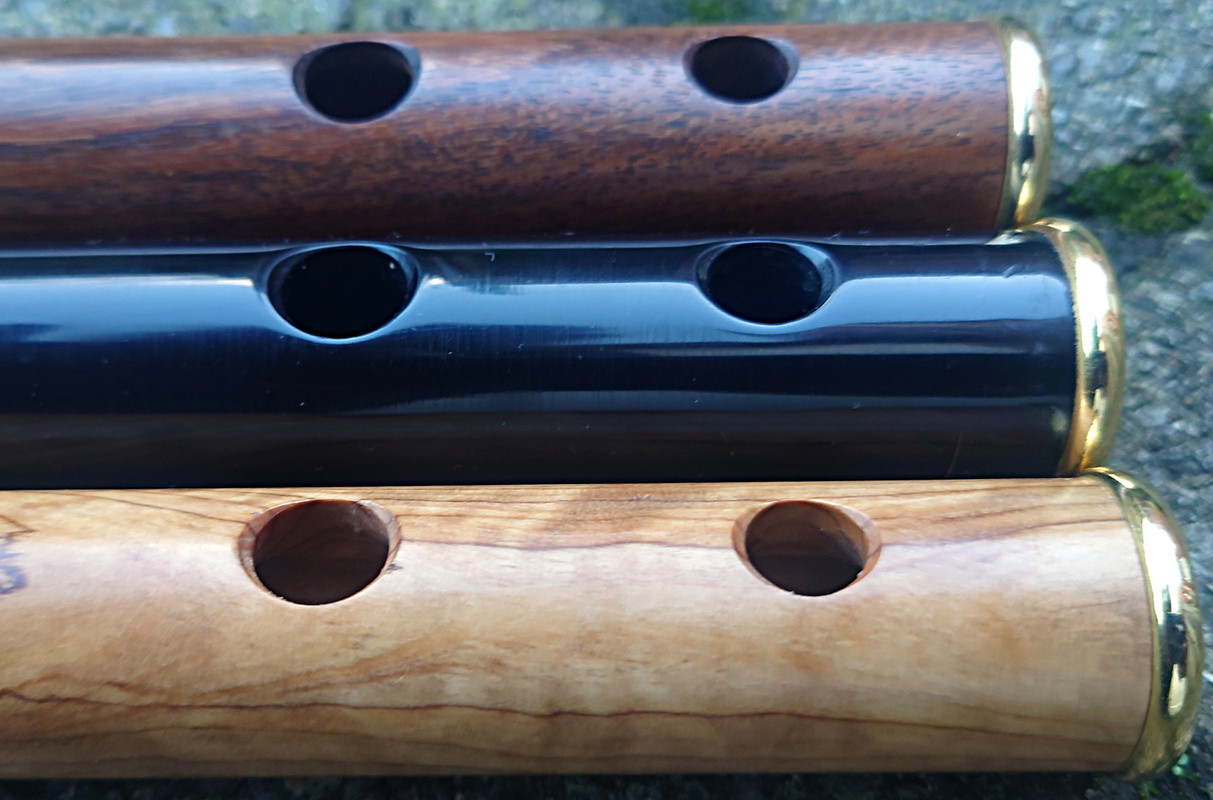
Inwardly, as they enter the bore, the tone-holes, including those on the footjoints, appear to have been hand undercut - quite neatly, I’m not sure whether with a bladed hand tool or a fraise, although the rims into the bore have not been smoothed/rounded and there are some rough/fluffy edges. Several tone-holes on each on the wooden flutes, have scruffy bits on their walls which ought to have been better finished (e.g. Images 24-25).
- R - Scruffy wall in tone-hole 2
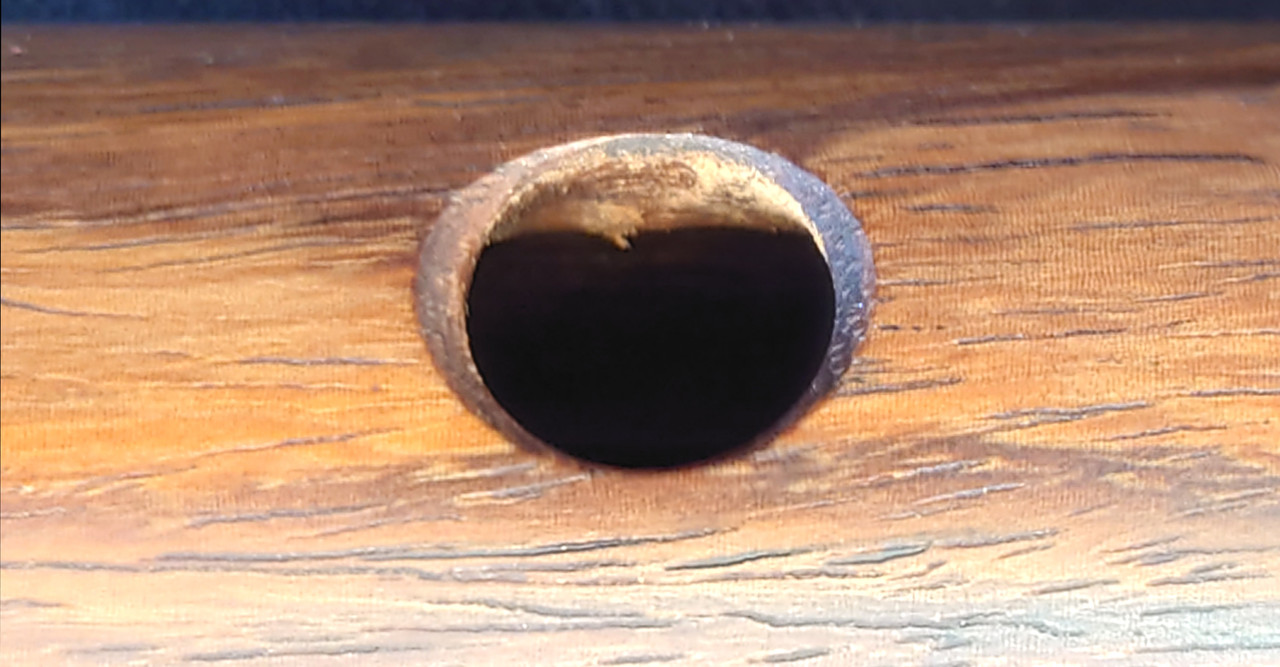
- O - Scruffy wall in tone-hole 5 (which is also off-line)
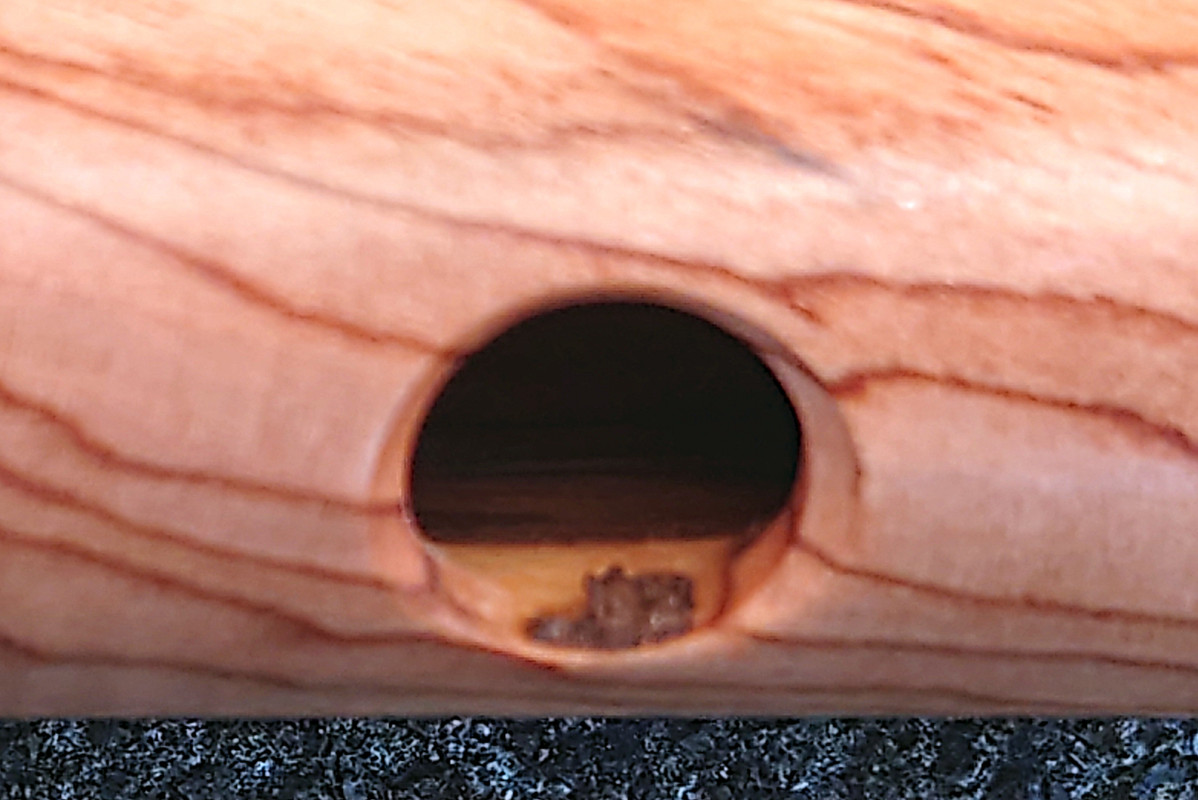
(That shown in Image 25 actually mostly flaked away by itself during play-testing!)
The tone-holes are fairly consistently placed longitudinally despite the slight discrepancies in joint lengths between the 3 examples. The spans, overall and for each hand, are somewhat longer than those of my original Boosey Pratten (Images 2 & 35 above), which may be an issue for some potential customers. In particular the distance between holes 5 & 6 at around 40mm might be challenging for some. There are some slight inconsistencies, too, as shown in the following table, and other discrepancies for individual holes are apparent (Images 1,2,6 above), but I haven’t measured them exhaustively.

However, the rotational alignment of the tone-holes relative to a spine-line along the body is less than perfect, so presumably not set out on an indexed machine tool or using a fixed template. On R the alignment is pretty close to spot on, but on O the 5th hole is a little off to the player’s side and the 6th to the audience side, making it difficult to seal them consistently with the R2 & R3 fingers in normal playing, leading to notes not speaking reliably. (For Video 2 I had to do a lot more takes to get an acceptable one with O because of missing sealing R2 &/or R3!) On P the three holes of each hand are more-or-less on the same spine-lines, but the R-hand holes are all slightly around to the audience side compared to the L-hand ones (Images 18-20). That didn’t cause me any playing difficulties, but it is the result of a lack of care in production and a symptom of poor quality control. These offsets are clearly not intentional ergonomic ones where normally only the 3rd hole for each hand would be offset towards the palm a little.
- R Body - tone-hole alignment … 19. O Body - tone-hole alignment … 20. P Body - tone-hole alignment
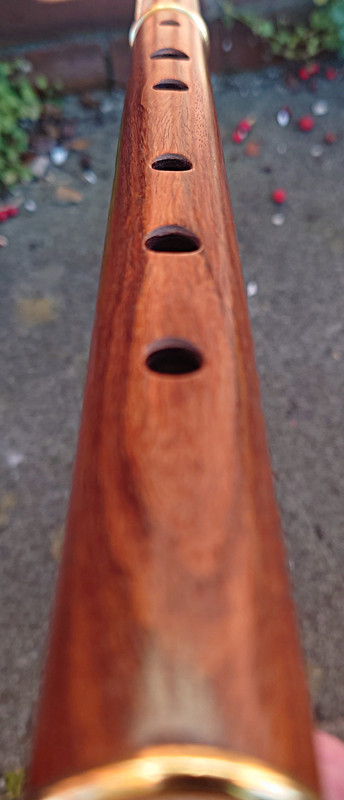
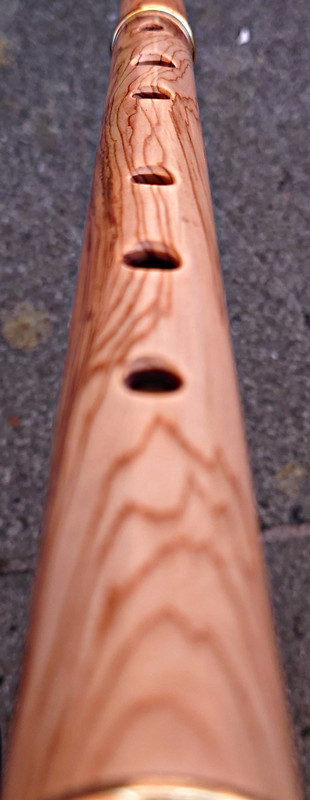
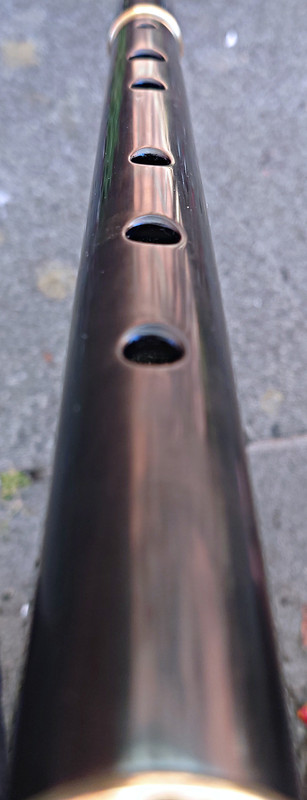
Embouchure holes
I’ll start by stating that these embouchure holes are far better than most I have encountered on flutes made in Pakistan and they play reasonably well, but. But. None of them is a perfectly shaped ellipse - all are visibly somewhat asymmetrical and all are somewhat askew of the long axis of the head (Images 12, above, and 13-15). Again, as previously noted, on the wooden ones they are inadvisably cut in the flat grain.
- R Embouchure hole - perpendicular view
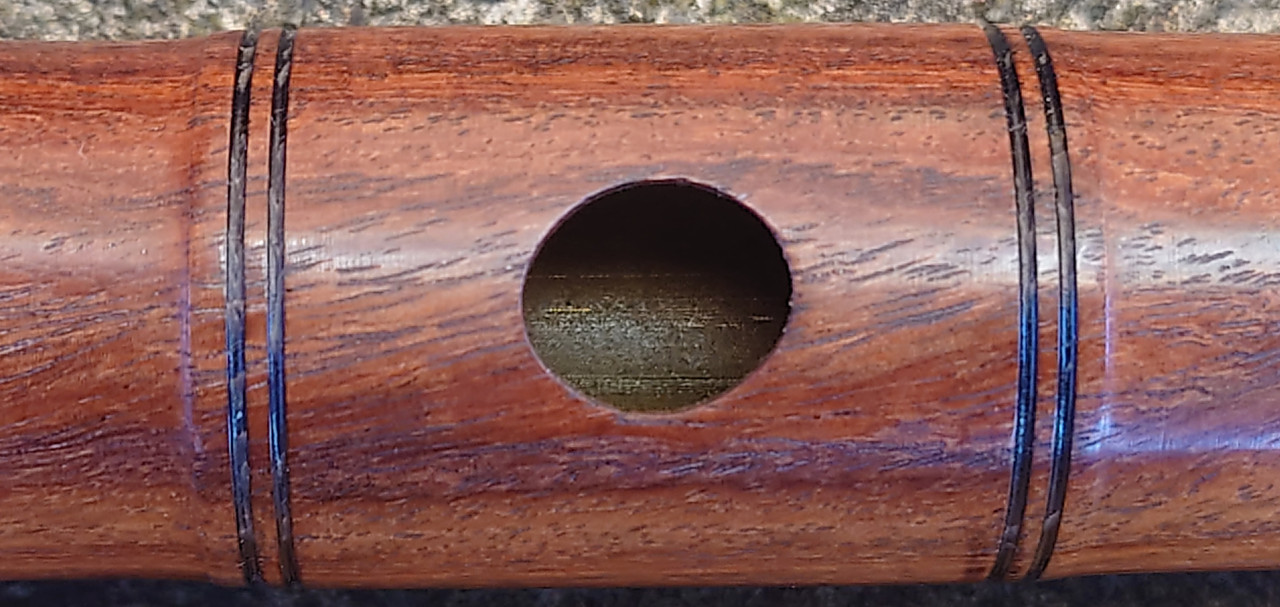
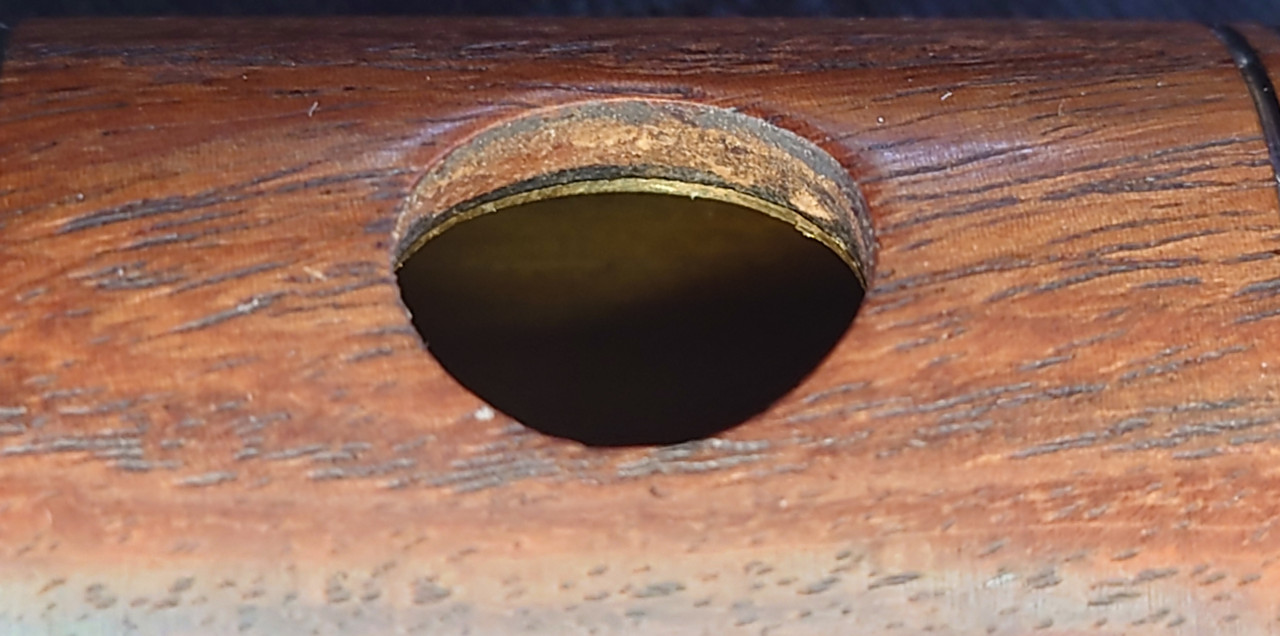
13b. R Embouchure hole - view to target wall - note sharp inward metal rim and the “sandwich” effect of being cut in the flat grain causing textural differences
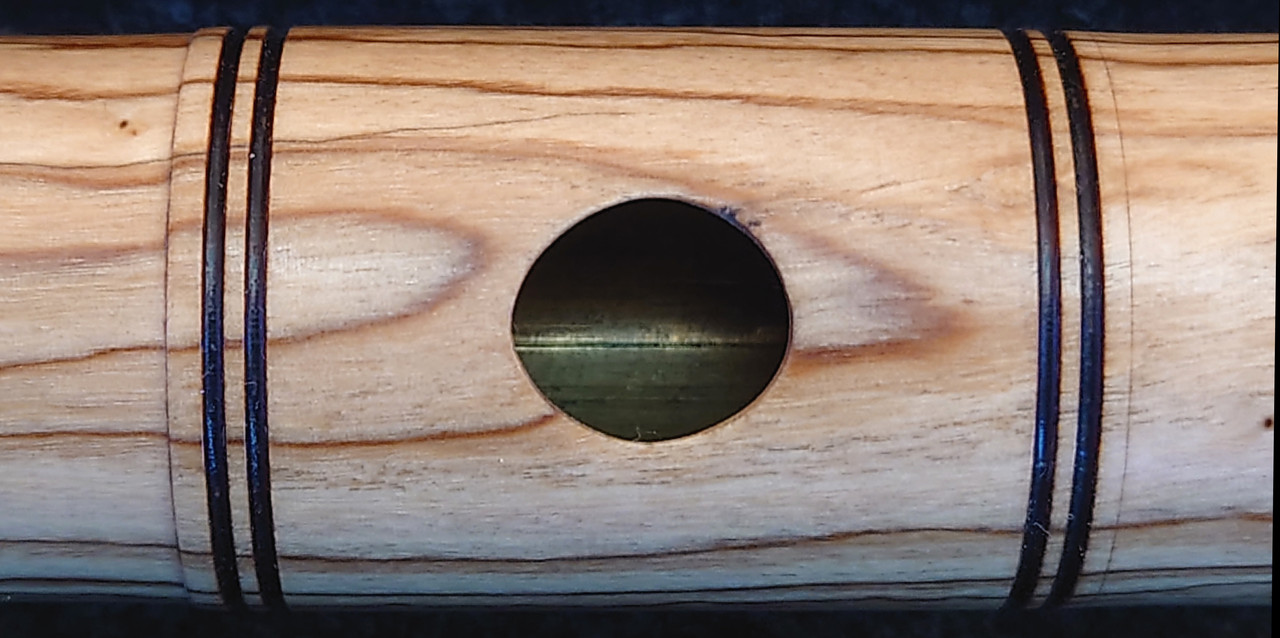
- O Embouchure hole - perpendicular view
14b. O Embouchure hole - view to target wall - note rough patch (lower right) due to grain irregularity because cut in flat grain
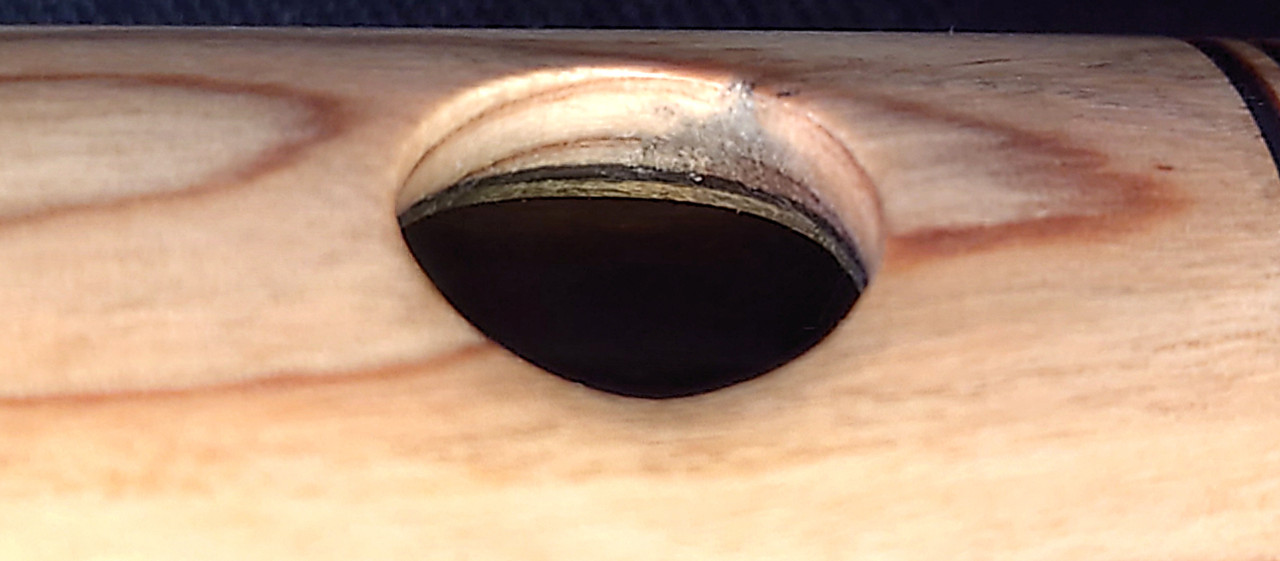
14c. O Embouchure hole - view to nearside wall - note rough patch (lower right) due to grain irregularity and rough, sharp metal rim
- P Embouchure hole - perpendicular view
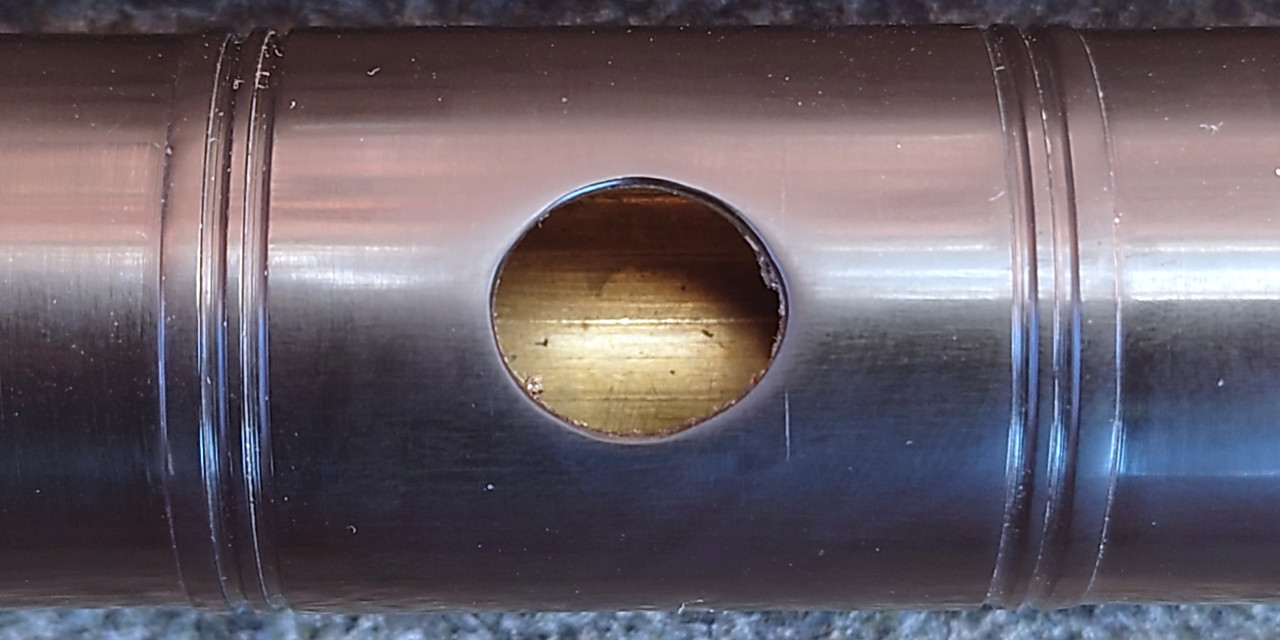
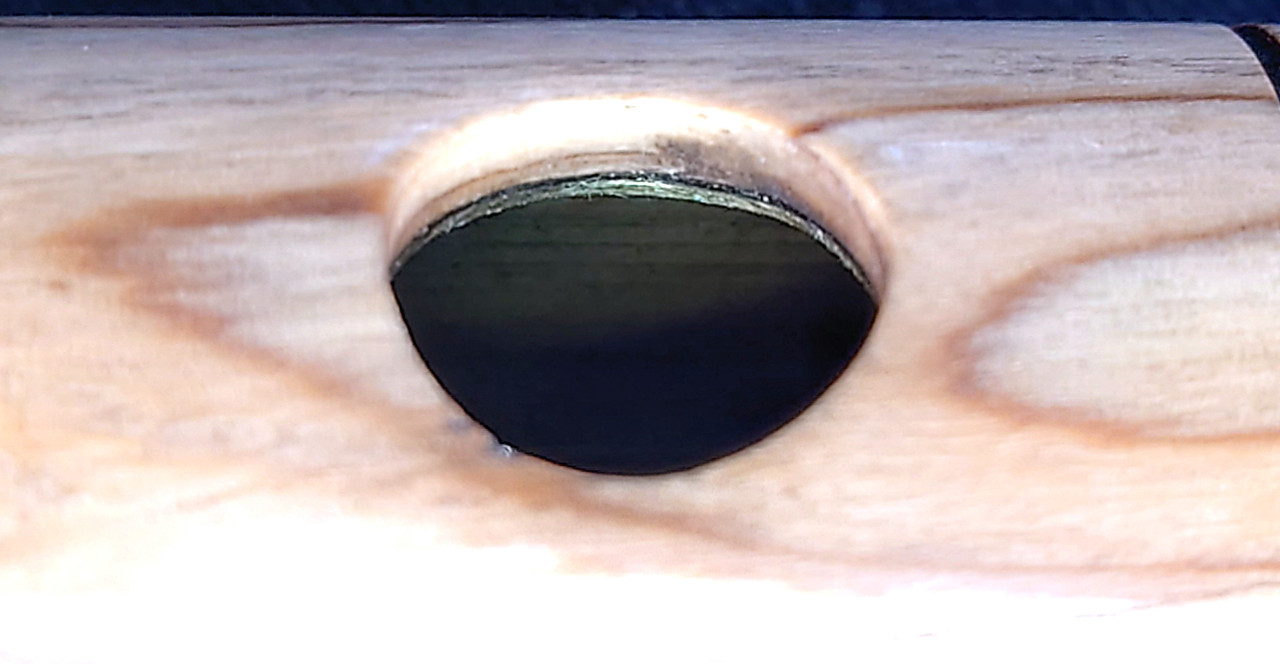
15b. P Embouchure hole - view to target wall (a) - uncleaned (as received)
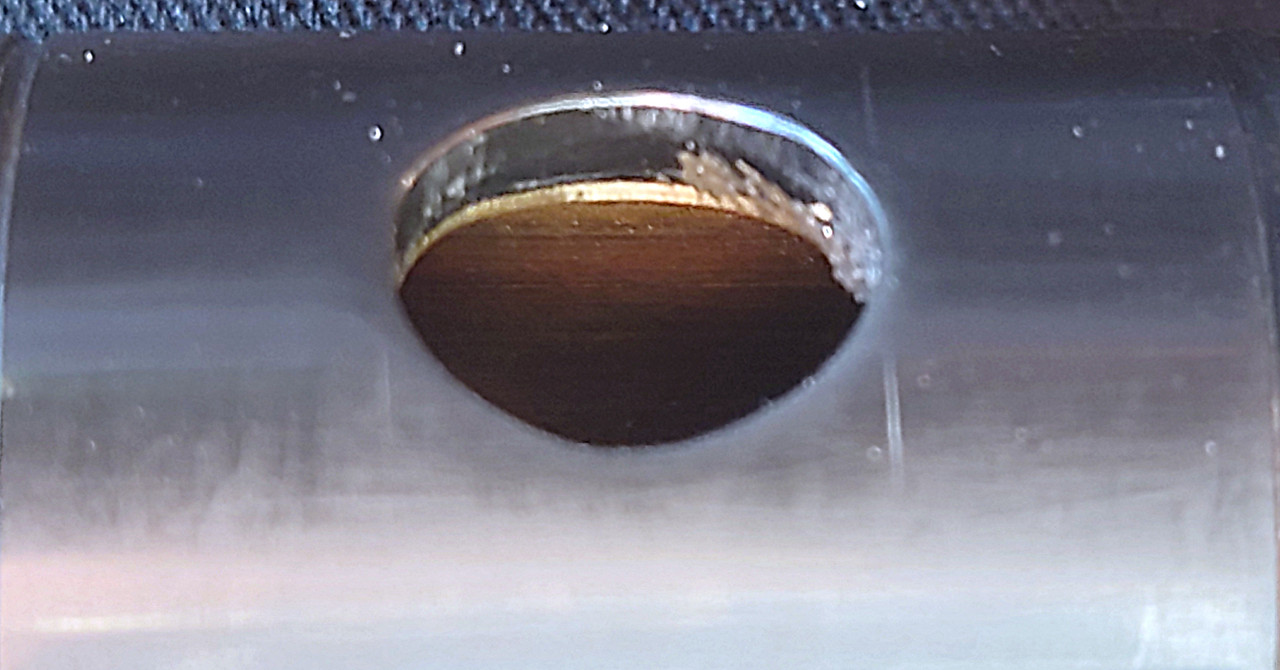
15c. P Embouchure hole - view to target wall (b) - uncleaned
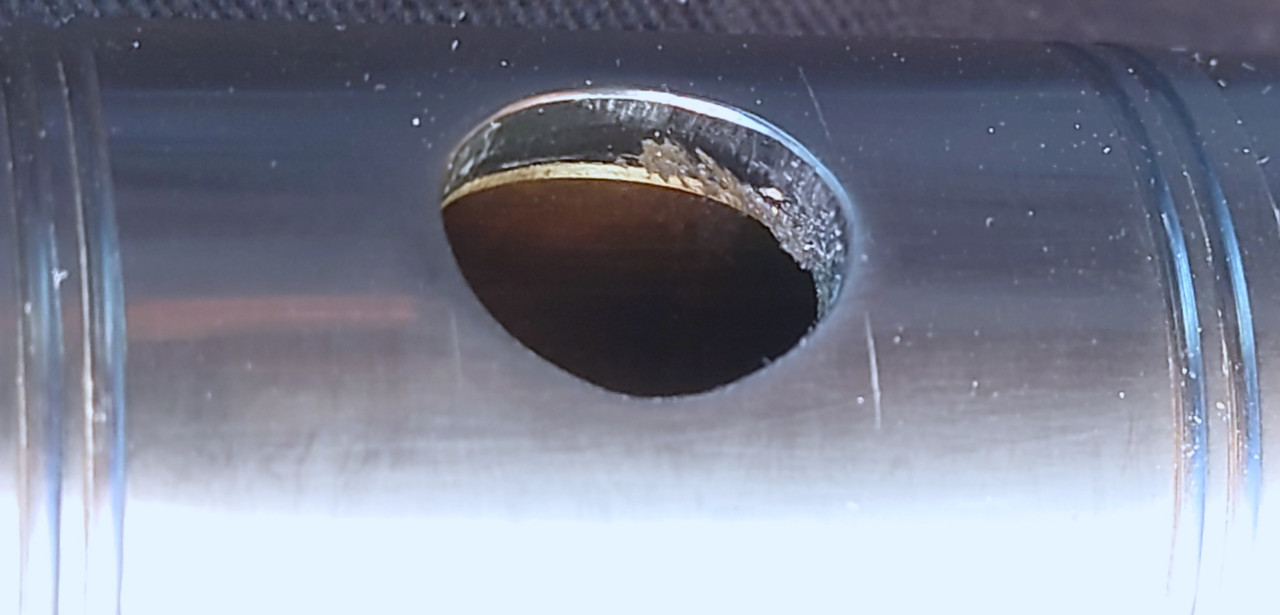
15d. P Embouchure hole - view to nearside wall - uncleaned
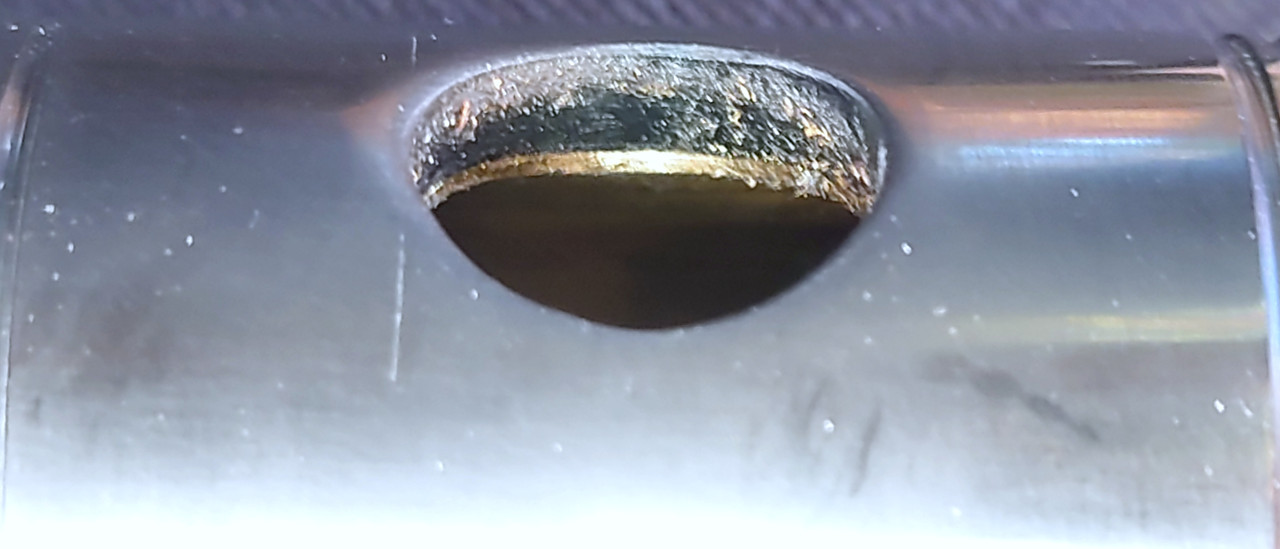
- P Embouchure hole - as-received gunk wiped out on fingertip!
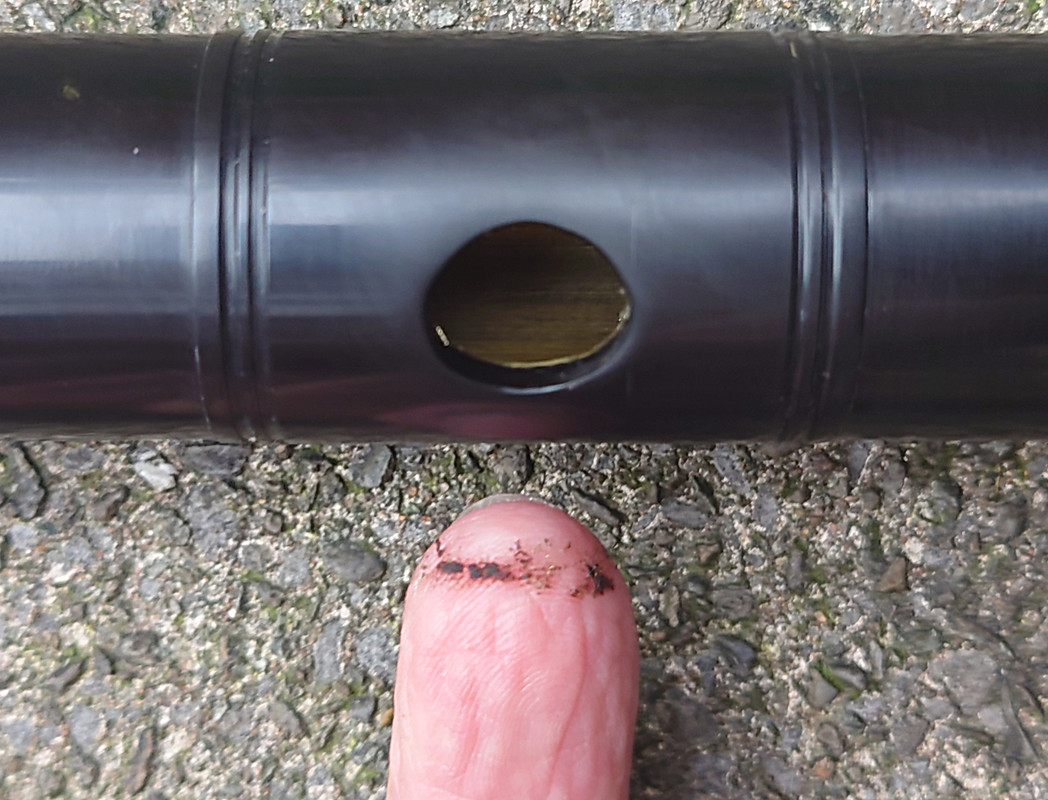
These irregularities do not intrinsically imply a significant detriment to performance, but they are tell-tales of inconsistent production. The sizes are also inconsistent and are at the larger end of the range found on typical high quality C19th English flutes, though not way oversize as so commonly the case with Pakistan-made flutes. P has the largest embouchure hole, 12.53x10.87mm at the surface, R is 12.41x10.75mm and O is 12.21x10.84. By way of comparison, possibly the very best antique embouchure I have ever encountered, on Rudall Carte & Co. #6695, made by Wylde (in 1875), is 12.07x10.24. My modern headjoint by Chris Wilkes is 11.55x10.38mm. Tiny dimensional variations matter very significantly with embouchure holes and, with mass-produced instruments, absolute consistency to a proven successful design is a paramount objective/requirement. The holes are moderately undercut, fairly tidily, though the walls of the wooden ones are less smooth than they could or should be (Images 13b, 14b & 15b above) and O has a grain fault in the target edge, partly because it is drilled in the table grain (Images 14b & 14c above). The external rims have been fairly nicely finished and are not too sharp, but the internal rims in the brass liners at the interface with the bore have been left sharp and a little rough (one even had a little drill swarf still attached!), not carefully finished and rounded. P arrived with what I initially though was un-cleaned-away adhesive on the walls (Images 15c & 15d above), but in fact it proved to be deposits of dusty grease which just wiped away (Image 16).
I’ll return here to the issue of the external diameters of the heads, as it affects the embouchure holes. Embouchure chimney depth (the difference between the bore diameter and the external diameter) is a factor in flute tone production. Like everything else about embouchures, a tiny difference can have a significant effect. (Up to a point a deeper hole gives a more resistant and potentially powerful response, favouring the lower notes, but too deep and tone quality, ease of tone production, accessibility of higher notes and ease of register shifts suffers. A shallower hole will, up to a point, give easier sound production, greater flexibility, but lack resistance and power.) For context, my original Boosey Pratten has a chimney depth of 4.125mm, the Rudall Carte by Wylde mentioned previously is 4.24mm. My modern Wilkes head is 4.1mm. (I am aware that there is a tendency among many modern makers to choose a slightly deeper embouchure chimney, so to make slightly fatter heads than the models of the C19th masters.) On the subject flutes, the turning of the exteriors of the heads is not very consistent, but they seem to be intended to be about 27.5mm (R in particular is noticeably waisted between the ends and the embouchure bulge). With a liner internal diameter of 19mm, that would give a chimney depth of 4.25mm, which one would think would be adequate without the bulges. The raised areas around the embouchure holes of these flutes are (again!), not consistent.O has an OD of 28mm, giving a chimney depth of 4.5mm; R is OD 28.3mm, giving a 4.65mm chimney; P is OD 27.7mm, giving a 4.35mm chimney. If there is a design-intended embouchure chimney depth (which I doubt), it is not being consistently achieved.
I’ve put the information above into a table (below) for easier comparison. The N-S length of the embouchure hole is the longitudinal dimension (along the length of the head), the W-E width is the lateral dimension (across the tube, the blowing direction) and the depth is half the difference between the head bore diameter and the external diameter at the embouchure hole. (I haven’t included the Boosey Pratten as the embouchure has been bushed/is not original, so only the chimney depth is original.)

From these measurements and observations I am quite certain that the embouchure platform/bulge is as unjustified technically as it is unsightly. I would advocate making the heads with a straight external profile with an OD to deliver whatever specific chimney depth is favoured, and I’d suggest 4.25mm would be a good target, so that OD of 27.5mm of the non-raised parts of the head tubes would be just fine, and could be made slightly fatter full length (without detriment to the overall looks) if a deeper chimney is desired - 28mm would give a chimney depth of 4.5mm. I would also very strongly suggest ensuring the holes are somewhat smaller, certainly no greater than 12mm N-S by 10.5mm W-E as the absolute maximums at the tube surface.
Bores
I am not equipped to measure bore dimensions in the conical bodies, so cannot make any comments on design or consistency of the bores. However, from visual inspection (including with a bore scope) the bores are clearly the worst aspect of these flutes in terms of finishing/production standards. They are rough, as bad as I’ve seen on other Pakistan-made flutes - so rough that the condensation from playing doesn’t flow out of them freely and they snag and accumulate any lint from a swab cloth! They do not seem to have been re-finished in any way after being reamed and one suspects the reamers aren’t kept properly sharp. P in particular is very rough, with obvious reamer chatter (Images 26-34 below & Video 3). All three also have scarring of the bore opposite the tone-holes, presumably from the cutting and/or finishing thereof and tools going in too far. Given the proven ability to finish the exteriors to a good standard, this is inexcusable. If the bores of these flutes were sanded and polished to the same standard as the exteriors and the internal edges of the embouchure and tone-holes were properly rounded off, it would make a very significant difference to quality and, almost certainly, improve the sound the flutes are capable of making.
- R Body bore (a) - some of what can be seen is the grain, but most of it is surface roughness
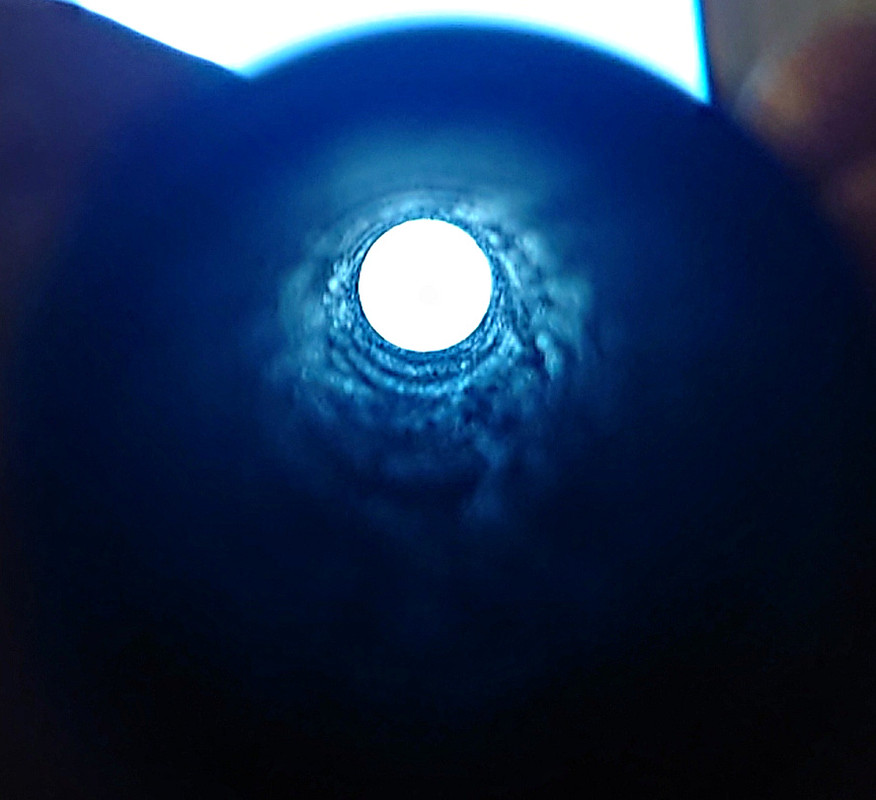
- R Body bore (b) - some of what can be seen is the grain, but most of it is surface roughness
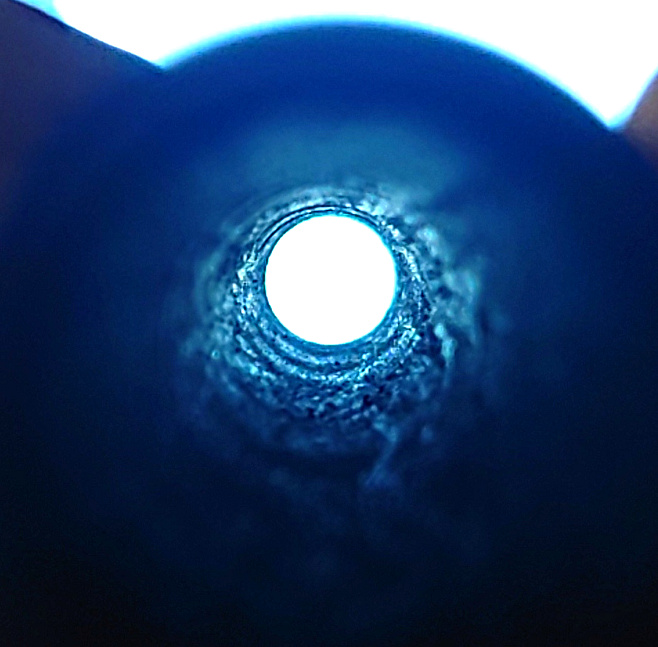
- O Body bore (a) - some of what can be seen is the grain, but most of it is surface roughness
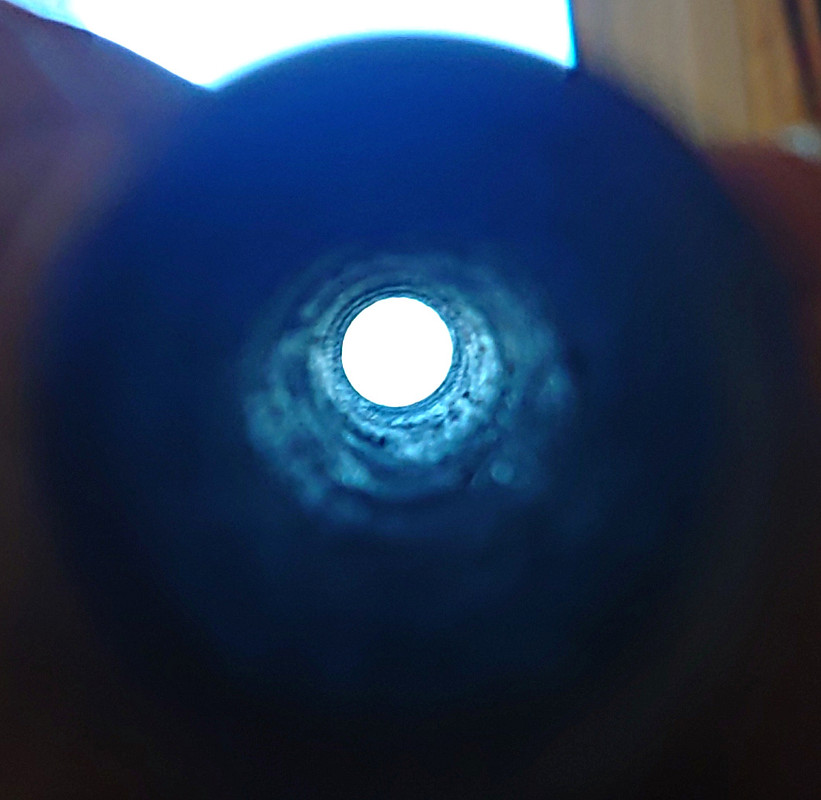
- O Body bore (b) - some of what can be seen is the grain, but most of it is surface roughness
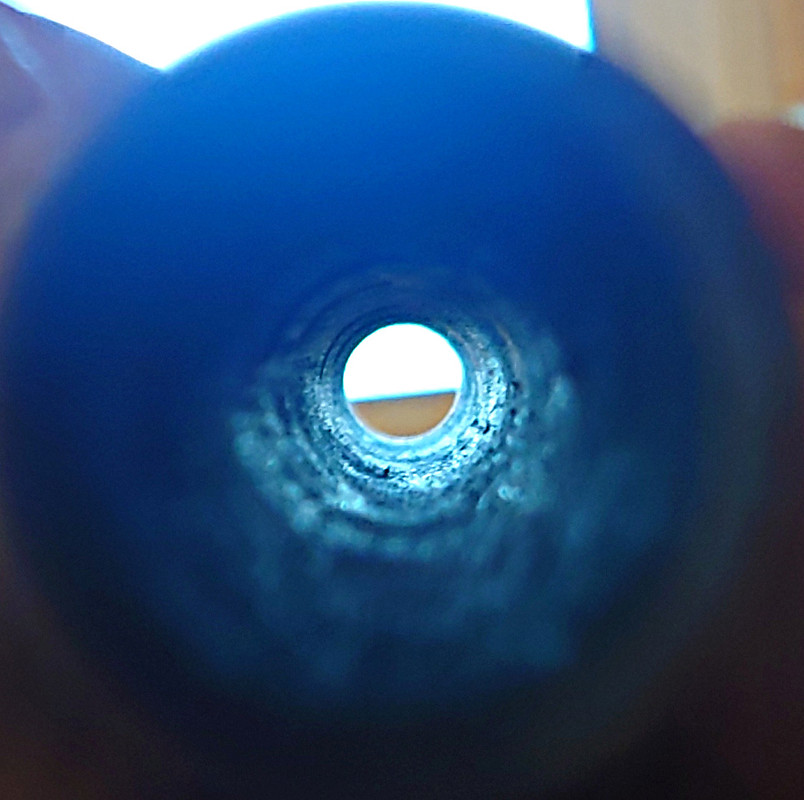
- P Body bore roughness (a) - no grain here! - note dark tool-scuffed circles opposite tone-holes

- P Body bore roughness (b) - note dark tool-scuffed circles opposite tone-holes
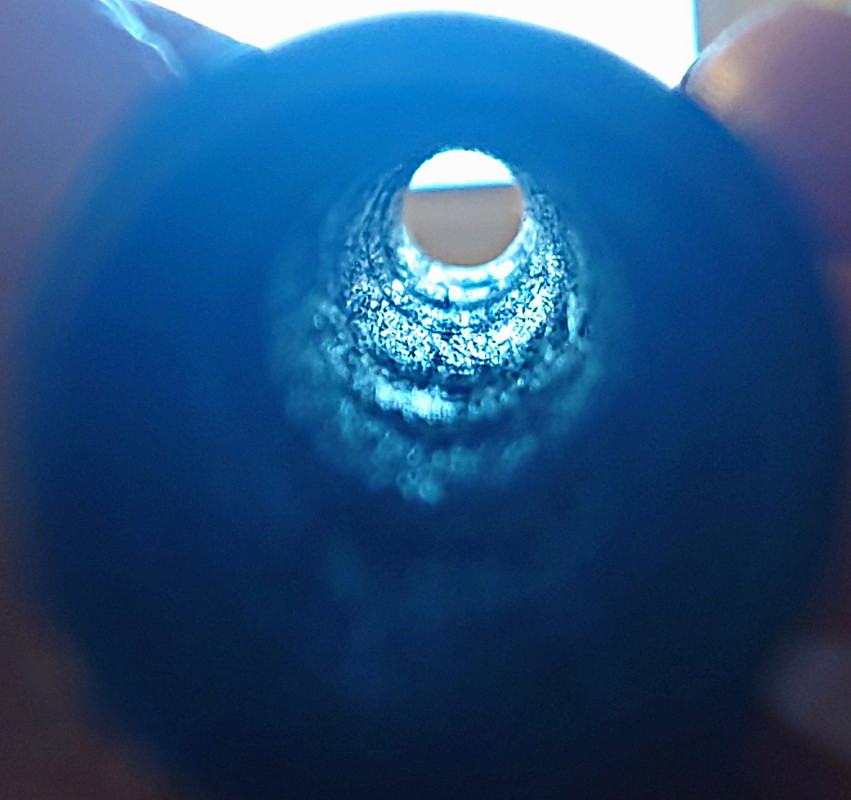
- P Body bore roughness (c)
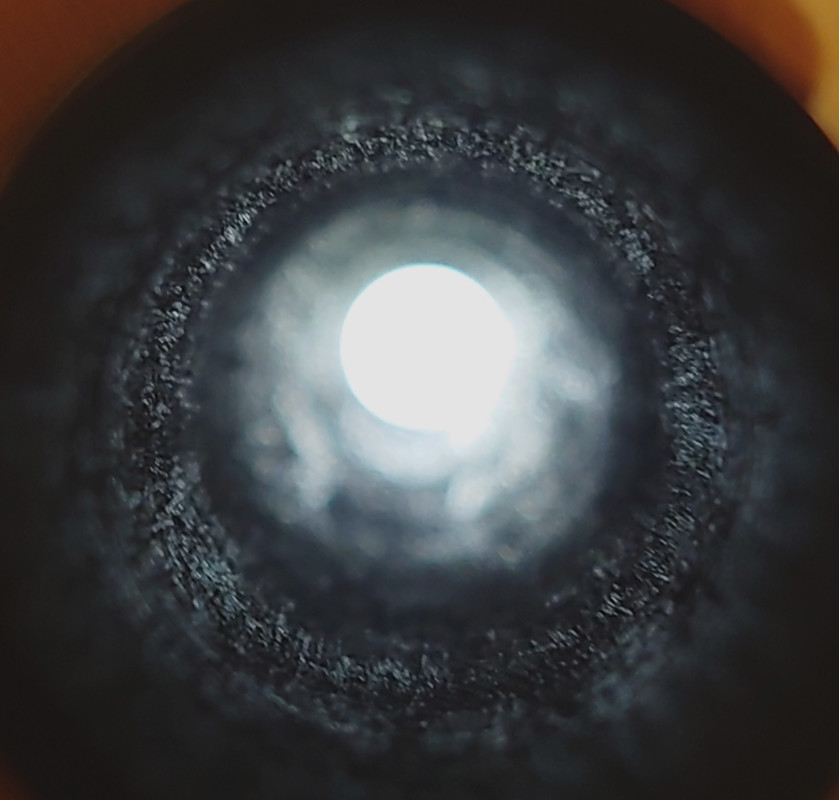
- P Body bore roughness (d)
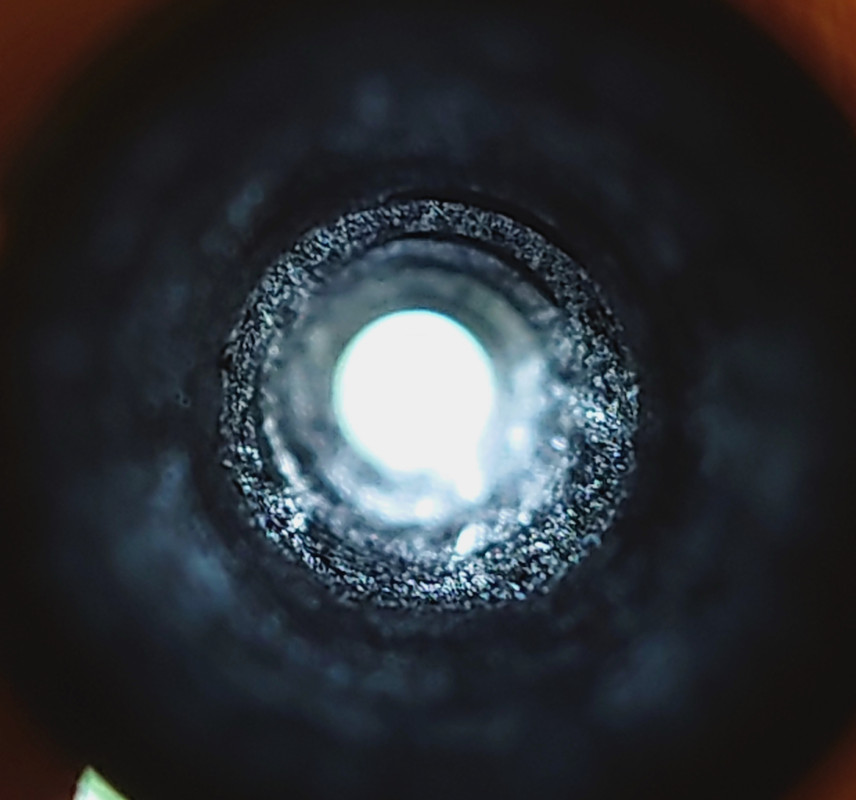
- P Foot bore roughness - reamer chatter marks obvious
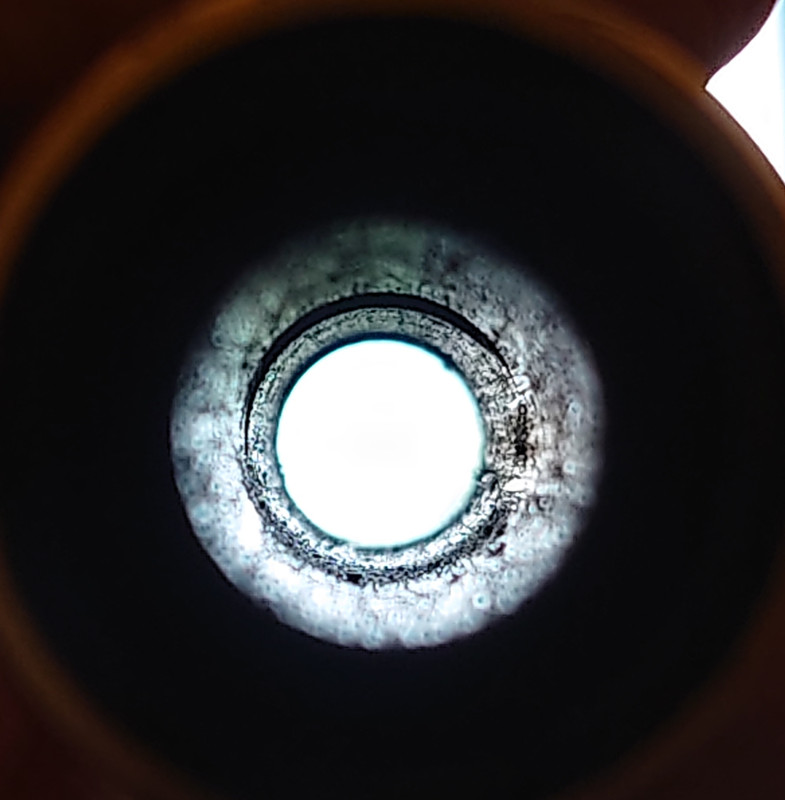
The design of these flutes includes a rather bizarre, extreme conical back-reaming of the foot end (Images 9-11 above). I’ve never seen the like before. I’ve no idea what it is intended or believed to achieve, given these are keyless flutes and that the lowest note (D) is vented by its own tone-hole on the foot and by the “dummy” C# hole. So far as I understand flute acoustics, this flare cannot affect the pitch or strength of any notes within the range this flute is expected to be used for. (In a flute where the tube end note is available, back-reaming the foot end certainly can achieve something for that end note in the 1st and 2nd registers, though I’ve never seen this extreme a flare, but on a keyless flute with a long, “dummy” C foot with D the lowest note, not so much.) It seems to be harmless but weirdly pointless, so far as I can tell and could be dropped from the design, removing an unnecessary production operation.
Musical
Sound
All three of these flutes play pretty acceptably, with decent scale intonation and quite a good strong tone with a pleasantly robust timbre, suited to Irish traditional style (see Video 2). They are balanced between the first and second registers and wide interval transitions are acceptably accessible. One could certainly take any of them to a session and play it and not be horribly let down or frustrated by it. Nor do I think a beginner with an undeveloped embouchure technique would find them unduly, hinderingly difficult or liable to hamper development of good habits or engender bad ones. The embouchure holes are not so much too big nor so badly cut as not to speak fairly well, but are less responsive and focussed than slightly smaller and better finished holes would be. They certainly aren’t as good as they easily could and should be. From a player’s perspective R seems to me to play the best, followed by O, and P (probably due to having the largest and shallowest embouchure hole plus the roughest bore) plays least well, with a tendency to some slight fluffiness in the sound, which is poor given that it is the most expensive. The P body works pretty much equally to the others tonally with either of the wooden heads swapped onto it.
Intonation
The scale intonation of all three is good (and consistent enough between the three despite slight dimensional discrepancies noted above) - pretty much as good as it gets for a keyless diatonic flute, and better than I’ve come across from some (admittedly lower end price-wise) modern “Western” makers. They play for me (in average ambient humidity and temperature) at A440 with the tuning slides open to the third graduation mark. The open C# fingering at the top of the 1st register is not significantly flat, so unsurprisingly the most common C natural cross-fingerings, oxo xxx and oxx ooo, both tend significantly sharp, but oxx xoo or oxx xox work well and may be chosen between to suit. At the top of the 2nd register the open C# is very flat (as expected), but the standard cross-fingering, oxx xoo, works well and again the usual options for C natural cross-fingerings are available to choose between, oxo ooo and oxo xxx being the best. The Es, always a relatively weak note on simple flutes because of necessary hole position/size compromises and especially where there’s no Eb key to vent) are pretty good (pitch, timbre and relative volume) and 3rd register D fingered oxx ooo is good - not always the case without an Eb key to vent. Almost none of the baroque cross-fingerings for chromatic notes work in the first two registers, as might be expected on such a large-holed flute; the 1st register Bb (xox xxx) is the only really usable one, plus maybe the G# xxo xxx (well lipped down), while the 2nd register equivalents don’t really work at all, so these really are principally diatonic instruments. The 3rd register diatonic scale is available with quite decent tone and intonation up to the high B, plus some of the chromatic notes, not that many folk who play this type of flute want to access the 3rd octave above D. There is the usual simple system conical flute tendency to trend sharp on 2nd register G and A, but it’s within normal expectations to be controlled by good embouchure technique. In all these respects there is consistency across the sample and there is nothing untoward requiring design alteration.
The main demo video (Video 1) includes exploration of the fingering possibilities and compares the sounds of the three sample flutes in simple 2 octave scales and arpeggios, including with some head swapping, and, at the end, bringing the two heads mentioned in the embouchure dimension comparisons above into the exercise, showing clearly what a difference a really well cut embouchure can make. Video 2 demonstrates the flutes playing a tune - Winnie Hayes’ Jig, first in E minor then in A minor as doing that makes use of a full 2 octaves. Whilst running the video one can jump too and fro between the flutes to compare their sound. For further comparison I added a take on R using the Wylde RC head previously mentioned and also takes on my original Boosey Pratten and on a modern keyless Pratten-based flute in Ebonite by Geoffrey Ellis. All takes were recorded in one sitting with the same recording set-up. Allowing for my own playing deficiencies, I have to say that, viewing the video myself, the Lakewood flutes perform creditably, though I think clearly less well than the other flutes shown.
Conclusions/Summary
These Lakewood flutes are a very significant improvement on anything I have previously seen from Pakistan and are fairly decently usable musical instruments as received. I cannot vouch for whether that would always be the case as this small sample may have received special attention for review purposes despite it being stipulated they should be from standard production. However, they are not entirely satisfactory and still have significant deficiencies of design, manufacturing techniques and standards and also quality control, especially the internal finishing and the embouchure cuts. They could very easily be made so much better, in ways which have been explained above, probably mostly without significantly increased production costs. Any necessary increase in production costs could be reflected in retail prices without harming market placement if the improvements are made and made consistently.
List of key recommendations (most important ones in bold italics but the others are all important/essential**)**
Get rid of ugly embouchure bulges and “decorative” grooves.
Make heads a little fatter full length to achieve required embouchure chimney depth if necessary.
Make embouchure holes smaller, with consistently accurate dimensions.
Make embouchure holes consistently perfectly elliptical.
Make sure embouchure walls are smooth and that inward hole edges are smoothed and rounded as well as outward ones.
Make better stoppers and ensure faces are cut straight and flat.
Make head/barrel proportions more normal (longer head, shorter barrel).
Make joint sockets deeper and tenons longer.
Make lapping beds on tenons longer and fit better quality cork sheet lappings more carefully.
Don’t waste money on gold-plated rings - the gold won’t last. Use solid silver or nickel-silver.
Make sure the rebates for the rings are accurately and neatly cut so the rings fit snugly and tidily.
Make sure all tone-holes are on the same axis line.
Drill all holes (including embouchures) in the side grain, not the table grain/V patterns.
Don’t countersink tone-holes, just slightly round off their edges (including into the bore).
Make sure all tone-hole walls are smooth.
Avoid reamer damage to bores (better or better cared-for reamers, better reamer technique?).
Finish bores properly - should be as smooth and glossy as the exteriors.
Get rid of the extreme back-reamed bore end cone.
Eradicate production inconsistencies of execution of design measurements - lengths, external diameters, socket diameters, tone-hole placements etc.
If I were a music shop or instrument dealer, I would not be ordering stock from this source unless the improvements suggested were put into effect. If I was advising a prospective player on acquiring a relatively low cost instrument, these would not yet be a recommendation, though I could imagine them becoming so with appropriate investment in quality and quality control by the maker.
(A full Word document of this review with the photos integrated is available to view or download here.)
Jem Hammond © 14:11:2024
