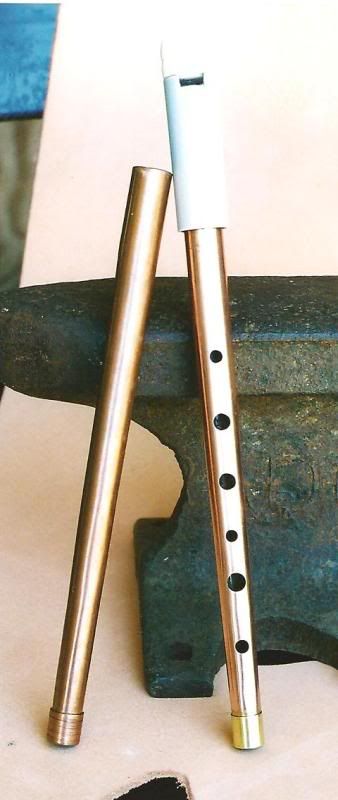
It’s clear, sweet, and well-balanced. Its not very loud. I wish I had a good mic so I could show you guys a recording. This is one of the best instruments I have ever made.
I need to figure out how to make a long tapered slit in the back side of the tube so I can taper the body. Or maybe try and “spin” the body to taper it. I think that will make it sound even better. Has anyone ever tried that?
Try a trick from the Uilleann crowd and insert a tapered reed from the bottom to mimic the effect of a narrowing bore.
If that works, you can try the effect of allowing a tapered depth of wax or eventually resin to harden along the bottom of the bore. If control the amount used and the slant of your tube carefully, you should be able to reproduce any taper effect exactly.
The ring on the bell end insures that the slit will not open. The slit does not go all the way to the other end, and is made air tight with an adhesive. It plays with a pure stable tone, and the PVC head slides making it tunable.
Wow, that’s a beautiful whistle!
Me not knowing anything at all concerning whistle construction, I can’t help you.
But that is gorgeous, congrats on making your favorite! and good luck with the rest…
I made a steel mandrel and a press jig. I dip it in oil and then press the mandrel into the tube with a 6 ton arbor press. I had to fiddle with the edge where the mandrel contacts the tubing. You have to get it just right for it to really work. I made a dozen of them before I finally got it dialed in. Aluminium bar just self-destructs.
Tommy, How did you slit the tube? Any special tools? This is more or less what I was thinking of doing. It should be easier than rolling the taper into the tube. I will prolly use silver solder to hold it together.
I use two wood V blocks to hold it in a vice. I have tried several tools to make the cut. A dremel motor with a thin wafer wheel is faster. But it is awkward to make a straight cut with it. A sheet metal shear is to large to fit into the tube. However a BX cable cutter with one side ground down will fit, and cut it. But leaves it deformed, and it must be reshaped with a hammer.
The tool that makes the neatest, and straight is a close quarter hacksaw blade holder. A blade with around 32 teeth per inch is better than a course blade. Make a blade about six inches long, and put it in the holder or wrap one end with tape to make it comfortable to hold. Point the teeth so it cuts when pulled.
Here is a video of a trombone being made. Several metal forming methods are illustrated during this video. The bell stem is made from sheet brass with a soldered seam. While early Copeland whistles were made from sheet stock, most Copeland whistles we are familiar with are made from seamless drawn tubing. So the part of the trombone video that is pertinent is from around 1:33 through 1:44. Don’t blink! Imagine starting with a simple cylindrical tube and drawing it down onto a mandrel multiple times. Check it out.