I doubt anyone has ever come up with that one before. But seriously, I just acquired my first whistle, a Clarke, and I’m wondering how much to worry about moisture changing the shape of my fipple and affecting the tuning or tone. It’s a piece of wood, right? So should I oil it? Varnish it? Leave it alone?
FYI, about those tacky gold diamonds on the Clarke, well, yes, they are tacky. But if you’re a new whistle player with mediocre eyesight, they do a great job of indicating where to put your fingers. Black holes on a black whistle can be hard to see.
Yes, it’s ok for you. But be mindful that it is illegal in several states to let someone else touch your fipple, especially in public.
The block on the Clarke is cedar, I believe. That wood was likely chosen because of its natural properties to guard against the effects of moisture. Some people do coat the block with oil or other solutions. You can search the archives for input on what people use. I leave them alone.
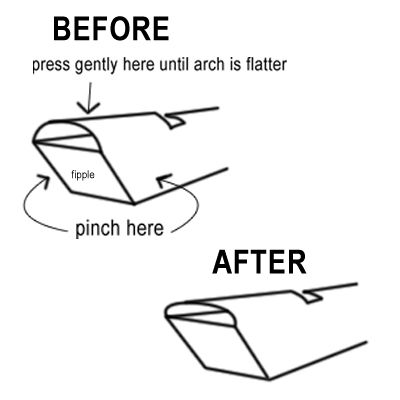
Clarke’s do get tweaked quite a bit. Here’s the basic tweak from the main C&F site.
As for the diamonds - here’s what I said to a similar recent post.
Otherwise, they wear off with sufficient playing or you can apply a paint remover.
Moderators: should this thread be merged with the one about pink whistles? Just asking.
As to cedar blocks, in the Realm of The Fipple Flute That Must Not Be Named (recorders), we do not put anything on a cedar block. Oiling or varnishing will prevent the block from absorbing moisture, which is the cedar block’s reason for being there. That said, I’ve grown to like plastic blocks in both whistles and recorders. With a plastic block, the moisture builds up faster than on a wood block but you can always clear the moisture by sucking or blowing it out. Coatings (duprunol, Jet-Dry, dishsoap) make the clearing easier but still necessary. A wood block will absorb the moisture, giving you a longer period of playing without clearing the windway but, when the block is saturated, the tone goes fuzzy and you’re out of business until it dries out. Admittedly, that can be a long enough to play a concert with a good quality wood instrument.
Maki, Thanks for the welcome and no need to apologize for the levity. I was actually trying to introduce a little myself with the subject head, but I think I overdid the subtlety. I could have asked if it was okay to oil my fipple, but that would not have helped much.
So I gather two things. First, I should call that little piece of wood a block. (Is that why a recorder in German is a Blockfloete?) Second, I shouldn’t touch it with anything but my tongue (and definitely not get it pierced). I have an ebony flute and I’m a little paranoid about the wood cracking due to moisture, so I thought I should get some advice about my whistle block. Now if I could get some advice about my mental block, that would be good, but this is a forum, not group therapy. Correct me if I’m wrong.
Feadoggie, I think by the time my fingers know where to find the holes (there’s no way to avoid this, is there? ) the diamonds will be worn off, so form and function will come together nicely.
Yes, exactly right. In fact, strictly speaking, the word “fipple” is a synonym for “block”, though in common usage it’s been extended to refer to the entire sound-producing apparatus: block, windway, window and labium/blade.
Nothing special about the summer… Whose summer, any way? And even, “What ‘summer’?”
As for fipples, I’ve even been know to tongue mine! But with fingers, it’s best not to try to force them into (whoever’s) apertures not intended for such insertion.


 I have an ebony flute and I’m a little paranoid about the wood cracking due to moisture, so I thought I should get some advice about my whistle block. Now if I could get some advice about my mental block, that would be good, but this is a forum, not group therapy. Correct me if I’m wrong.
