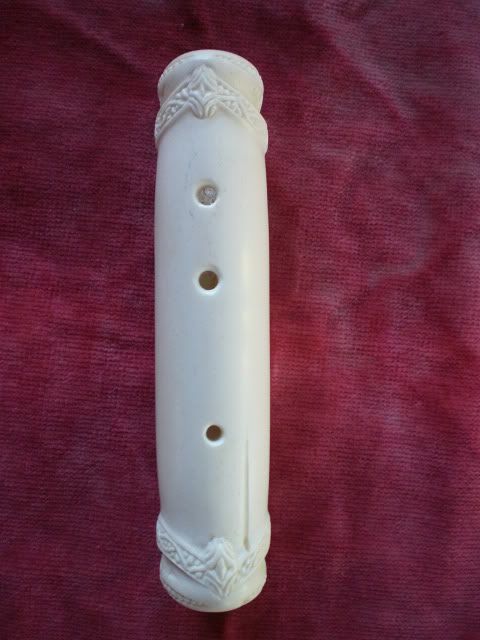
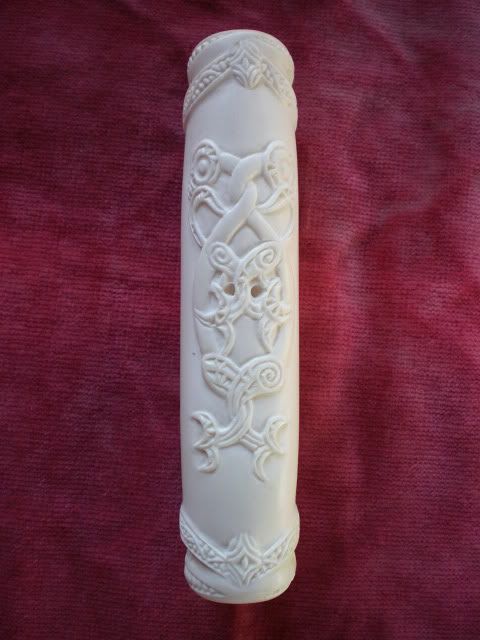
I have be playing around with Koauau an end blown flute with three holes. They are most awesome to play with, a beautiful sound, and easy to make.
One hand plays the three holes (obvious I know ) and the other hand, one uses a finger in the end to change the notes. The bit that confuses me is that as you put your finger in the end, the tone gets lower, not higher as you would expect (smaller volume=higher note). The lowest note possible is blocking the end completely (like blowing across a bottle) but I cannot understand the music theory behind making a lower note with a decrease in volume, as you put your finger in.
Help (in small words) would be appreciated
John
PS: [u]This PDF link[/u] has some instruction on making one, a great wee project to do with your kids/grandkids
I can’t speak for the physics behind it because I haven’t studied sound waves and such. I can tell you that I can drop a half step below the bottom note on a whistle by partly covering the end. This is also part of why french horn players put their hand in the bell of the horn. It lowers the tone. Hopefully someone with more knowledge can come and explain why rather than just saying it isn’t unique to you koauau.
The same technique is used in overtone flutes. The simplest overtone flutes have no finger holes. Modification of the note played is done mostly by breath control, but also by covering and half-covering the end of the flute.
I always thought the hole at the end of a flute is the same as any finger hole, just differently placed. Covering it has the same effect as covering a finger hole - lowering the sound.
Compare with an ocarina, where all holes are equally “end holes”, and covering them has the same effect.
Sealing off the “bell” end of the flute switches over the resonance to that of a closed end tube, the sound has to travel twice as far now since it can’t exit the bottom and thus halves in frequency (drops one octave).
Oh, I love those kind of flutes. It’s amazing that you actually get the same concept of flutes in different cultures. Any idea about where one can get like sheet music for traditional music?
As I have just said in a different thread , for some of the end blown flutes, like the Koauau are not played as songs in the western sense (as far as I understand) and are more of a reflection of the spiritual side of the player. Other flutes like the Kaval are more traditionally melodic and come in keys. Although, because the mouth plays such a major role in the tone produced (especially the shouter flutes) it is quite challenging to play in tune. Or maybe that is just me .
To find sheet music (and indeed how to make a variety of end blown flutes), Google is our friend
I’d call that a rustic scale, in my ignorance. I’d be inclined to build another one and shift the holes to suit myself. A long time ago I had a go on a floyara, although I didn’t know that was what it was called. Do you hum, to accompany yourself, like it says on Wiki? Wiki has a nice little diagram of the hole positions, but it doesn’t mention the bore, so I noticed. Anyway, good man for making one!
I finally got around to looking at your link and having a crack at making a koauau, of sorts.
I find it very difficult to get any kind of a note out of it. The instructions in the Aukland Museum PDF are a little terse. Looking at pictures of koauau on the internet does not provide as many clues as I hoped. One site mentions blowing across the edge of the pipe. I’ve blown across plenty of beer bottles and even a few transverse flutes, and got some kind of a note, but this thing is a puzzle.
It it like a quena, with a shaved edge making a whistle edge? My pipe is polypropylene, and about 5mm thick. The bore is about 18mm internally. I have shaved the edge, but there is not much improvement. Any suggestions?
It is played quite differently from just about any others. If any come close, it will be the Balkan kavals, but even they are quite different.
What you do is place the mouth side (no sharp edges, by the way) against the corner of your mouth (usually the rigt one. So the opening is from the corner to about the middle of your mouth. Now, you start blowing, but rather on the gentle side, into/out of the koauau. It’s more like breathing than blowing as in flutes. There is absolutely no need to blow hard, by the way. The lowest note often is not the easiest to get, the highest practically never is, so try the secon note at first. Vary the angle, but once again, do not try to blow hard. It will make it worse.
Good luck.
By the way, why I know it is because I both make them and can play them.
Aha! Thank you Yuri. I am beginning to get some sound now. Rounding the edge might help. The pictures of koauau showed them all with rounded edges. It is hard to know what is important.
I would have to say, my playing style is different, and I play it the same as my home made Kaval. Similar to Uri with the positioning of the instrument, but I almost whistle across one edge of the flute (or try whistling as you blow, until you get the Koauau making noises (you will know when)). Some people prefer sharp edges, some rounded, some flat.
The Koauau is one of many end blown flute which have been around for 35000 years in a variety of forms. My theory is that the flute traveled round with people as the migrated around the world, and the end blown flute was made of whatever materials and tools were available.
I make most of mine from Bamboo with an internal diameter of 30ish mm. I have even done a few with 6 holes in the Irish whistle style. Once you get the hang of blowing them, it is amazing what you can find to play (I really annoy my wife when I start playing the empty roll of kitchen paper )
Yes, it can be played like that, but mostly it was played the way I described. There are some who even play it quena-fashion. You can, it’s just that the traditional way you can vary the pitch and sound quality enormously by changing the mouth cavity. You can play (on some instruments, at least) as much as a fifth or so without changing any fingering, just on one position, but altering the mouth cavity. You can even sing, or at least hum into it.
I have been trying the method you describe, but I seem to get a clearer and stronger note with a pursed lips blow.
The smaller the Koauau the more you can bend the note. But even with the bigger ones the ability to alter the notes, makes it very hard to tune to a modern musical scale. I will freely admit that I have adapted the Koauau into something different to traditional, but I also try to spread the word about traditional Maori instruments. I usually carry a Koauau and sometimes a home turned Putorino with me to show people that are interested.
Just as an aside, instead of the traditional method of making Putorino (splitting and carving), I turn them on a lathe, cut them in half (across the middle) and turn out the inside. It gives me the ability to experiment with some of the dimensions a bit more.
The traditional playing style was not after clear, flute-like tones, neither was it particularly concerned with exact pitch. As noted above, traditional Maori music is not really comparable to European (or for that matter, Far Eastern, Indian, etc etc) music.
As an aside, 30mm inner bore feels far too wide, at least compared to what’s in museums. I make them with 15-20mm at most. Here’s an example, made from ostrich bone. (Yes, that’s not traditional, but for some obscure reason using human bone (the traditional choice) is frowned upon, can’t think why…)
The double hole at the back is for suspension, by the way.

 ) and the other hand, one uses a finger in the end to change the notes. The bit that confuses me
  is that as you put your finger in the end, the tone gets lower, not higher as you would expect (smaller volume=higher note). The lowest note possible is blocking the end completely (like blowing across a bottle) but I cannot understand the music theory behind making a lower note with a decrease in volume, as you put your finger in.
 )
)