I am 88 years old and I have been playing the Irish whistle for two years, almost everyday. There are so many of us that love the Irish whistle and have to be content with whistles in the key of D or C because of small hands or a limiting physical impairment. We would love to be able to play a low D whistle, but cannot. Yes there are some whistles being made with “close finger spacing”. They are either too expensive for the average player or the close spacing is not close enough. That was before the relatively new Howard Low D Close Spacing Whistle. It really is close spacing and should be playable for those of us who want a quality low D whistle at an affordable price. My right hand is missing my index finger. I have to use my pinky to cover the bottom hole on my various keyed whistles, which includes alto A and alto G (quite a stretch on both but doable). Howard’s whistle has given me the opportunity and ability to play a low D whistle. I am really happy with it
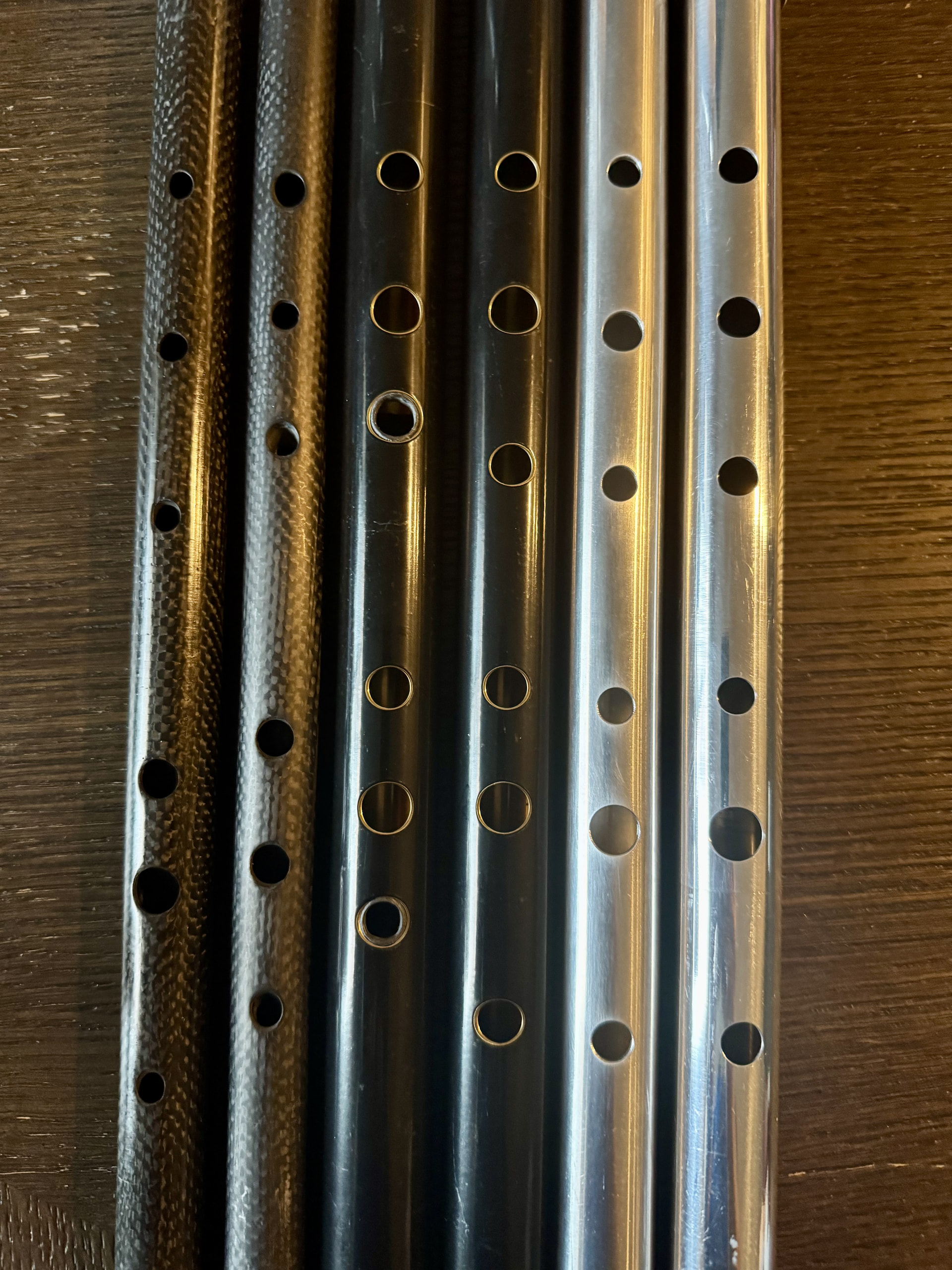
Folks might appreciate seeing the hole spacing of David O’Hagan’s new Howard Close-Spacing Low D compared with some other options.
From left to right in the photo:
Carbony Celtic Winds Low D (without close-spacing technology)
Carbony Celtic Winds Standard Bore Low D (with close spacing)
Howard Close-Spacing Low D
Howard Low D
mk Low D
Burke aluminum Viper Pro Low D
I’ve emailed back and forth with David O’Hagan, owner of Howard Whistles. David has continued Brian Howard’s ethos of making a genuinely affordable Low D whistle. David also put me in touch with Brian’s wife, and I’ve been corresponding with her. Brian is still alive, although for several reasons communicating by email or telephone is difficult for him now.
Bernard Overton pioneered the modern Low D, and Brian Howard was one of the important early makers who helped make the instrument available at a much more affordable price. David seems very conscious of continuing that legacy.
I also spoke with Rob Gándara, owner of Carbony Celtic Winds, about David’s new close-spacing whistle. Rob told me that he communicates with David regularly and is very happy to see this new whistle. He doesn’t really view it as competition for his Carbony Close-Spacing Low Ds because the instruments occupy very different price points. With a smile, Rob said he was actually surprised it had taken this long for someone else to produce another serious close-spacing alternative to his Standard Bore and Big Bore designs.
What really struck me when I put these whistles side by side is how far David has taken the idea.
This isn’t simply a conventional Low D with the holes moved a little closer together. Look at the tone-hole placement compared with the other whistles. The spacing approaches the hand position familiar to someone used to covering the holes of a High D with the pads of the fingers.
Having had the opportunity (thanks to John!) of playing the close-spaced Howard and close-spaced Carbony back-to-back I think the Carbony is a much better player.
It’s also more expensive, but in this case you get what you pay for.
(I didn’t really care for either Howard, regular-spaced or close-spaced.)
For pancelticpiper: I respect your opinion; however, I respectfully disagree with it. You state that "(I didn’t really care for either Howard, regular-spaced or close-spaced.) I believe you are missing the whole point. If you are able to play the regular Howard low D whistle, why would you be using a close spacing whistle? It was designed for those of us with either small hands or a physical disability. Howard gives us the opportunity to play a low D whistle that we wouldn’t ordinarily have. I do envy your ability to play a standard low whistles.
I love mine.
Not having to stretch/ being able to play in comfort means I’m able to concentrate on learning the tune and improving my technique rather than having the extra hurdle of pain from playing.
It’s not the best of the best in terms of sound, from what I’ve read, but is very accessible!
Sound is subjective. If you like the sound of your Howard close spacing whistle, then the sound is great. Who cares what other people say in terms of sound. I love mine and what I hear when I play is what I expect a low D whistle to sound like.
For sure that’s what makes this all so interesting: each player has a unique set of playing characteristics that are important to them.
In my video, before giving rankings of the whistles, I list the performance aspects I value with the reasons I value them.
It follows that a person with different priorities will rank the whistles accordingly.
And!! My sample size of each Howard was 1. Due to whistles being hand-made things they will vary and a larger sample size is required to make statistically meaningful statements.
The close-hole Howard I sampled had nice tone and tuning in the low octave, but High A and High B had audible hissing and were quite loud. Most importantly for me, G, A, and B in the 2nd octave were very sharp. As I outlined in my introduction really good tuning was my #1 requirement.
Just one more data point here on the Howard (regular spacing) low D.
Mine has quite a nice tone (whatever that means … I think its quite nice), and the tuning is pretty good across the board, except for the high B, which is quite sharp. How sharp depends on how you blow it, but for me it varies between 10 and 25 cents sharp. When I look at the whistle, this is kind of what I expect. The second tone hole down, which vents B, is huge (12.4 mm), and is the largest one on the whistle. And the whistle is made from thin walled brass, so the chimney height is almost non-existent. So this is a really huge tone hole acoustically.
I only have one data point, but I get the impression that there may be variation in the tone hole sizing that results from the difficulty of keeping it precise in such a thin walled body. But it would be easy to fix with a piece of black electrician’s tape, which would blend well with the black body.
I got this whistle by accident in a batch of used whistles from Goodwill. I didn’t expect to like it, but its actually quite good. My other low D is an MK Kelpie which is also quite good, but quite different in tone and acoustic design, with its thicker walled aluminum, smaller tone holes, smaller bore, and lower tuning in the second octave which needs a bit more push to bring it in tune. So, two quite different whistles with different tonal qualities that would likely appeal to different people in different ways.
Having only two years experience playing the Irish whistle, low D included, I have come to realize that there is no perfect whistle. Granted, higher end whistles have fewer problems, but do have problems. I have multiple whistle in five brands. Each whistle is individual and all present some challenges. There may be issues in the low or high register. Changing registers may present some problems. Individual notes may either be sharp or flat. Etc. Etc.
I do not believe it is the intent of the Howard close spacing low D whistle to fulfill the needs of a purist. As I have stated before, that whistle is for those of us who want to play a low D whistle, but for whatever reason, cannot. It certainly fills that niche market.