How to hold a whistle when playing C#

I’ve been playing some low whistle/flute for a little while now, but there is one little thing I’m wondering about. When playing C# on a whistle(D whistle, no holes covered), how to you secure it properly? I usually use a combination of my right pinky and thumbs. Still in fast tunes I always seem to mess up when it comes to this note. My fingers seem to fall out of position after I’ve lifted them all to play C# note.

This is not really an issue when I’m playing flute, since the weight of the flute is resting on my thumbs.

Any ideas?

I always bite down really hard when I get to that note. Holding on by the skin of my teeth as it were.

Alternatively have a read of this recent thread for a discussion on a very similar topic and IIRC anchoring a C#.

third finger of your right hand

Thanks. The other thread about anchoring a C# was very informative!

Oooh no. Biting a whistle isn’t good technique. May I humbly recommend the Australian position? Then gravity becomes your friend - use the force, don’t fight it.

In the old days many players kept the ring finger of the lower hand on for G, A, B, Cnat, and C#, their “basic fingering” being

xxx xxx
xxx xxo
xxx xoo
xxx oox
xxo oox
xoo oox
oxx oox
ooo oox

The D Generation whistle, which was the only D whistle available, played just fine using this approach.

Nowadays all sorts of neo-whistles and low whistles etc etc with bigger bores and different voicing etc are around, some of which don’t like the fingering
xoo oox
on high B.

To me, the idea that all the holes below topmost open hole for a given note must be kept open appears to be a notion borrowed from orchestral instrument fingering charts, which Mel Bay etc has followed. Folk instruments often don’t work that way.

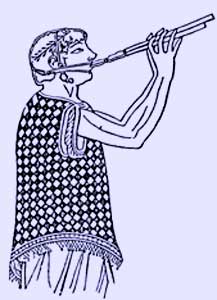
Might be a good excuse to reintroduce the phorbeia.

I’ve recently hired a curvy blonde to hold it for me when I play c#. She has had to learn all the tunes to know exactly when to grab it. She is also required to feed me grapes between tunes.

I’m trying to imagine what your Help Wanted ad looked like. :stuck_out_tongue:

i’m curious… i use my pinky finger to stabilize the whistle, but i’m interested in when to leave down fingers to speed up phrasing…

but what i wanted to ask about was i’ve seen players (i think maybe in that Vinnie Kilduff Bb video going around?) seem to add a vibrato to long notes by flicking down fingers at the bottom. i guess for example, if the song ends on a g, flicking the e (b2) and/or d (b3) fingers up and down while playing the g. i was trying it recently… it seemed to work?

but if that’s true, then it must be the case that leaving fingers down affects the tone? or is it somehow the flicking of the fingers that makes it work?

or did i dream the whole thing…

cheers,
eric

I often use fingerings similar to what pancelticwhatshisname (whatever happened to perfectly useful and sturdy names like Bob) shows above, except sometimes I anchor with the next-to-the-bottom finger rather than the bottom one, which works well in tunes that go bouncing back and forth between B and E, for example. Depending on what whistle you use, there are a number of spots where you can leave more fingers down than the fingering charts might suggest.
Of course, I caveat this with the fact that I am not an expert whistler, and what works for me may cause another whistler to recoil in shock and horror. :slight_smile:

all righty!!! we could do with a bit of shock and horror!!!


let’s not forget the pictures

Dream on, O whistler …

You have the perfect experimental device at hand for empirically testing your questions and hypotheses: your whistle.

In other words: try it. :slight_smile:

Remember that anchoring is really for the upper notes. If you’re doing a finger vibrato on E or F# or even G, you’re going to be waving those bottom fingers. Which is kind of hard if they’re planted.

Play a G on your whistle with xxxooo and xxxoox. Any difference? How about if you vibrate the B3 finger? You’ll figure it out.

I doubt it.

The closer the “covering” finger is to the note you mean to be playing, yes, it will flatten that note in some degree or another, that degree in part depending on the whistle. All you have to do is try it and listen for yourself to what happens to notes when you have other fingers down in different places, singly or in combination, and how that difference changes in either octave.

So for example, we have xxo ooo for A. If you cover thusly, xxo oxo, you’re probably going to have little if any noticeable flattening although it may change in the 2nd 8ve. Certainly you should have no discernible flattening of the note with xxo oox. BUT: if you do xxo xoo, your A will be flattened somewhat, and usually moreso in the 2nd 8ve. Try xxo xxo, and the effect is more pronounced yet, and on to xxo xxx. Depending on the whistle, the heavier coverings like xxo xxx may make for a poor tone.

And so, yes, if you have xxo ooo and rapidly alternate between it and xxo xoo, you’re going to have a finger vibrato.

These are just examples of possibilities. I say try it for yourself and see what you find.

Uh, yeah…what MTGuru said. :slight_smile:

Of course, the shorter the note, the less time there is for people to notice that it is slightly out of tune. Thus, a fingering that wouldn’t work for a sustained note in an air, could work on a passing note in a jig or reel. At least, it works for me… Sometimes, when the notes are flying, the best possible fingering isn’t the quickest possible fingering, and so we compromise.

Yes sorry for the rather silly screen name. I would change it if I knew how. It seemed appropriate at the time, as I was on a Holy Quest to obtain and play the bagpipes of every so-called “Celtic” land…

Anyhow my name is Richard…

Back to the fingerings, the fingerings I gave, where the ring finger of the lower hand is kept on the whistle for G, A, B, Cnat, and C#, is how all the players I observed happened to play when I was learning back in the 70’s. This helps make many passages easier, keeps the whistle anchored, and is in accord with the fingerings of the uilleann pipes (which is where this fingering approach may have originated).

In observing the “real Irish guys” play back then, and slavishly copying them, it dawned on me one day that the fingering approach, rather than being like the “open” fingerings of orchestral instruments, was more like the partially open fingerings of bagpipes, and in some ways like the chord shapes of the guitar.

Because with the fingering xoo oox you can move the lower index and middle fingers as one unit, and the upper middle and ring fingers as a second unit, and by moving only these two units play figures involving G Major chords with great speed and clarity. I call it the “G shape”.

The “D shape” as I call it is xxo xoo and many passages in reels, jigs, etc are played leaving that lower-hand index finger on, greatly decreasing the number of digits which have to be moved about, and thus increasing speed and clarity.

As I’ve said these “false” fingerings work just fine on the old D Generations, the only D whistle available back then, but often don’t work well on 21st century neo-whistles. Sad that traditional technique must be sacrificed due to the incursion of “improved” instruments.

Good stuff, Richard, and thanks for posting it.
(And that bit about the name was just slagging, no harm meant!)