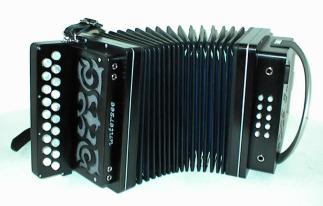
.. that since the 1950s the overwhelming majority of Irish players with half-step boxes play “from the inside out”, i.e. mainly on the inner row.
This being so, why do we have to put up with boxes whose design reflects a time when the fashion was to play from the outside in? By this I mean a design where the outer row, which gets so much less use, has one button more than the inner.
For example, if you play C#/D, and you want to be able to get a low G, you have to have a 23-button box.
But you could have a 21-button box if the 11-button row was on the inside and the 10-button row on the outside - allowing for a more compact format. And cutting down on the completely useless notes that you have at the bottom and particularly the top end of the outer row.
Now I know Saltarelle make boxes with a longer inner row, but these are 25-button monsters.
The thought came to me last night, admiring the wonderfully compact design of a 21-button Cairdin mini and thinking, nice, but I couldn’t live without a low G.
I can’t see any practical or technical reason why the rows couldn’t be “reversed” - can anyone?
Steve
Well you’d still have that button with what I’m talking about. Your D row would be exactly the same as on your 23-button box.
To bring you down to 21 buttons, you’d lose two buttons from the outer row - the lowest one (in pitch - i.e. nearest your chin), which is C#/F#, and the highest one (nearest your knee), which is g#/d#. I’d bet you don’t use those very often.
I use Fs/Cs, my lowest button on the inside row for cuts and rolls on the button right above, wich is D/B. The accordion is kinda sinking into my left leg, when i try to reach the lowest button on the outside row to cut a note, then my leg is in the way, can’t get my pinky there, but it’s not a problem, i don’t use that button. That’s why i prefer the 23 button type.
Seems to me probably
A) Still more quint-tuned boxes get sold worldwide than Irish boxes and
B) B/C players have all the low notes they need.
So manufacturers don’t have much incentive to offer a specific model to accomodate C#/D players. You could always get a custom button layout or get somebody like VanderAa to build a special box for you.
Hey, part of the fun of one-row playing is figuring out creative solutions to the missing notes.
You’re both right, i only realise that just now. When i ordered my last box, the maker said “if you like 21 buttons, i’ll move the Fs/Cs button to the outside”. That’s what got me confused. Still 23 buttons is handy for funny keys, it’s fully chromatic, in theory anyway.
I was discussing this recently with friends - or at least, with regard to ways of cutting down on box manufacture costs.
Most Morris tunes (e.g. the 100 Cotswold Morris tunes covered by Dave Mallinson’s Cotswold Morris books) can be played using just 14 of the 23 keys on a D/G - so why not produce a “Morris” intro-level box, where the innards (reeds, keys & buttons) are left out for the notes which just aren’t used? The same outside shell could be kept, to save the cost of producing a different one.
What box manufacturers will do all depends on the market, i suppose.
A lot of the three-rows being sold today are made without the basses, because the Mexican and Colombian players never use them. Another thing you see now are “2-tone” three rows with two sets of reeds (GCF and FBbEb) so one can switch back and forth without having to carry around two boxes.
Most standard 3 rows have 31 buttons but some are being made with 34 to suit the Mexican players. Then there are some people who customize stock Hohners to add the three extra buttons.
There are makers in Ireland such as Cairdin and Kincora who cater almost exclusively to the Irish market. And plenty of Italian and French makers who sell enough boxes to Irish players to make it worthwhile rejigging their production machines, if players woke up to the fact that the present configuration is a wee bit daft.
Rh, if it’s true that B/C players have plenty of low notes on a 21-button box, then they should be able get everything they need with a mere 19, with a 10-button inner row and 9-button outer row. You could make a wonderfully compact box with that arrangement!
I was beginning to wonder, lixnaw - it sounded as though you were saying you needed a redundant button on the outer row to bury in your leg, which struck me as a bit odd.
Cairdin and Kincora are pretty much one-man shops, aren’t they? So they’d probably make you whatever you want; Louisiana builders will do 9-button one-rows for Cajun music, and Quebec builders will do 11 buttons, so i wouldn’t think it to be a huge deal for a small builder to make an inside-out keyboard. Likely wouldn’t come cheap though.
As to the continental makers, i still wonder about the %age of Irish-tuned boxes vs others they sell. Saltarelle has been more responsive to the ITM market than most (with the Shamrock, Connemara, etc), but then it looks to me like they have the biggest market share. I’m sure you can get a message to Georges Roux, why not pitch him your idea?
Rh, if it’s true that B/C players have plenty of low notes on a 21-button box, then they should be able get everything they need with a mere 19, with a 10-button inner row and 9-button outer row. You could make a wonderfully compact box with that arrangement!
You still see some antique 19-button boxes in the hands of players – Dave Hennessy comes to mind, and of course Derrane’s famous Baldoni was a 19-button D/C#.
BTW, I’m thinking that at one time i saw the Dancemaster C#/D had a longer inside row, but it doesn’t look that way on viewing their website now; they changed the design last year, though.
Jim Coogan who runs the website “The box office” plays a D/C#.
It would be interesting to get his perspective on the advantages of playing on the outside row.
Hey, didn’t those Dancemaster boxes use to be set up in a 21-button configuration, but with the whole scale shifted up a button, i.e. with D on the fourth button? So that you’d have fewer high notes but more low ones? I don’t know – it might have been another brand I’m thinking of, but whatever it was it seemed like a pretty cool solution to the problem.
You’re right, and Frans van der Aa has made boxes like this - look at the one lying on its back in the photo below.
Also, on Han Speek’s page, there are no less than three different boxes by van der Aa with the same button layout. (Three? A case of “AAAOAD”, it would seem!)
But I still don’t understand why this isn’t an option offered by factories who supply significant numbers of boxes, including B/C models, to the Irish market.


 It’s all right for me, just as long it stays with that one redundant button.