Holifield Low D whistle tour

Well the only low whistle I have in the house is a Cheiftain that’s been modified by my
fathers friend it has a slight narrowing of the wind way and is about 20 years old.

Here is a hasty comparison clip.

I tried to just play quick without thinking which whistle was which and leave it that.

https://www.youtube.com/watch?v=6iUZRCfBCLU

That’s a really interesting clip, thanks for posting :thumbsup:

What’s happened to the tour reviews, after Dun’s excellent YouTube films I am keen to hear more about this fine whistle, surely it’s with the second if not third person by now?

And Norm if you’re reading this, are you planning or can you make a non tuneable low D, if yes how much would they come out at?

(PM if you’d prefer, thanks) :thumbsup:

I’m second on the list but it only arrived with me last Saturday. I hope to be able to report on over the weekend.

For in six days the LORD made heaven and earth, the sea, and all that is in them

But in EIGHT days Mikethebook only hopes he can manage to review a whistle :confused:

Way to go Mike :thumbsup:

Norm’s instructions were that we should each have the whistle for seven to ten days!!! Eight days isn’t excessive. Have a little patience!!

To review a whistle :laughing:

The Holifield Low D is one of the most beautifully made whistles I’ve come across, aesthetically very pleasing to the eye including the lovely logo but also engineered with a level of perfectionism that reminds me of Marc Lofgren’s excellent whistles; there is nothing here to indicate it is made by hand, not that there is anything wrong with such signs. But beauty alone is not going to win any fans or orders.

Laying it alongside my Goldie, I was surprised to see the similarity in hole sizes and separation. So my hands went straight to the holes without problem and the “stretch” is easy. They are very comfortable holes though not rounded like on the Goldie.

When it came to playing it, I was far from disappointed. In fact it is one of the best and easiest to play Low D whistles I’ve encountered. The word “balanced” springs to mind. To begin with, it possesses a very solid bell note . . . but one that you can’t really lean into. The upside of that is that second and third octaves are ridiculously easy to play. Not that you would want to play such high notes (unless you’re trying to rid your house of mice) but third octave A is a piece of cake. In practical terms it means that there isn’t the normal difficulty and extra push needed in playing second octave A & B you get with so many whistles.

The whistle is equally balanced in terms of back pressure and air requirements. Both are what I would call moderate, optimum levels. Tone is nice, solid, a little breathy and complex. And the whistle feels very responsive. Dunnp has already addressed tuning so I don’t need to say any more. To be honest, I can’t fault the whistle in any way.

I hope he won’t mind me repeating them, but in his instructions to reviewers, Norm asks owners of the likes of Goldies and MKs to bear in the mind the relative cost when comparing the Holifield with them. This is a perfectly reasonable and understandable request . . . but I’m not totally sure it’s necessary. Disregarding the price of the Holifield, I think it is perfectly able to stand on its own two feet alongside intermediate priced Low D whistles like the Lambe and Hamilton and maybe even against the likes of MK and Goldie. In fact, since they are very similar designs I would like to see someone compare the Holifield with the MK . I’ve only ever played the MK Low F.

So you get a LOT of whistle for your money with the Holifield Low D. Plus, if you prefer aluminium to plastic and can afford a little more than the Dixon tapered bore Low D, the Holifield would make a great first Low D . . . or second . . . or final Low D when it comes to that.

So . . . if its that good, will I be ordering one? The answer, at least for now, is no. It is an incredible Low D for playing ITM but, in the last year or so, I have gradually moved away from ITM towards slow inspirational music that is more challenging in terms of breath control and requirements . . . . and moved from my initial soft blowing Goldie to a medium blowing Goldie that, with higher backpressure, requires much less actual air than the Holifield. I would have been interested to try Norm’s earlier design which, I think, had more backpressure, though clogged more easily. Rounded holes (which I think Norm would probably provide on request) and a thin beak with a flat airway are also personal preferences. I also prefer the the tone of the Goldie. I’ve played a Goldie Low D as my main whistle since I began four years ago and built up a great relationship with Colin who understands my needs and requirements. That in itself is priceless, so it would take a lot for me to change to a different make. But none of these thoughts constitute any criticism of the Holifield.

Well done, Norm!! It is an amazing whistle.

I’ll get it off to Kinlochleven today. You should get it tomorrow, Peter.

Thanks Mike a very comprehensive and detailed review, it was interesting to see it alongside the Goldie as well to compare hole spacings :thumbsup:

Is the tubing similar wall thickness to the Goldie, how does it compare weight wise?

Any comments on the tuning slide, is it just metal against metal (lubricated of course) or does it have a liner of a different material? I’m not a fan of tuning slides to be honest, I’m wondering if Norm is planning a non tuneable version?

Bit confused by this Mike

If it’s everything you state on your review I should imagine you can play any genre of music you choose with it?

Sorry, it wasn’t as comprehensive as I thought and the whistle is now in the mail.

The whistles are similar in diameter but I didn’t compare the wall thicknesses or weight. I suspect the Holifield is marginally lighter and likewise perhaps the wall thickness slightly less than on the Goldie but it felt substantial. I didn’t think to investigate the tuning slide so maybe Peter can comment on that when he gets the whistle.

Yes, you’re right it would be great for any type of music but it is generally ITM that most people on C&F play. My mention of it was in comparison to the Davy Spillane type of music that I prefer to focus on now . . . which is not strictly ITM.

hello All. I must reply to the question about a non tuneable version of my low D. I have no plans to produce one at the moment. I just wanted to put that to rest here and now. I would also like to let everyone know that due to the pressure of work, having just started a new job I may be forced into just making low D’s for the immediate future at least. I would rather produce one thing well and at least leave myself time to play myself as well as do all the other stuff that life throws up at one. I will probably update my website accordingly in the near future.
If anyone is interested The Music room at Cleckheaton have a couple in stock and a little shop called The Musicbox in Oxford also has one, the other is the one on tour. After that I will have to make some more. I hope the afore mentioned does not break any forum rules, apologies if it does.
Best to everyone.
Norm H.

Yep, got it today. But please give me a few days for the review, folks!

Well, I’m done with testing the whistle, my video review is up at https://youtu.be/IsGFTivQErM and the whistle’s now on its way to Tarleton, Lancashire. Keeping it brief here because most of what I’ve got to say probably comes across clearer when you can see and hear it, but typing a few quick notes to summarise and supplement the video.

The Holifield (top) alongside my Bracker with custom hole layout (bottom):

And taken apart to show the metal-to-metal tuning slide:

As stated on the video, it’s beautifully made, has all the notes and plays in tune, but the sound just doesn’t do it for me. It’s soft-focussed, breathy and full of air noise, and simply can’t be coerced into producing the kind of tighter, edgier, chirpier sound I prefer. It’s also not air-efficient and probably takes every bit as much air as my Bracker without rewarding me with the Bracker’s big, bold sound. In short, it reminds me more strongly of the Chieftain V3 I no longer have than anything else, though with better tuning and more reliable upper register.

The tubing is of heavier gauge than my Bracker, allowing a very nice (and accurately machined) metal-to-metal tuning side to be fashioned within its wall thickness. So you should get very little disruption of the bore from tuning it, though I don’t find external tuning slides like Hans Bracker’s an issue this way (especially with lighter tube) in well-designed and set-up whistles when I don’t expect to move them much if it all.

Might add (because I didn’t say in the video) that I experienced no clogging issues whatsoever despite obvious condensation dripping from the window, and the whistle was supplied in a nice soft pouch similar to the ones that came with the original Bernard Overtons.

While Norm has asked us to bear the price in mind when comparing to other whistles, I’m not sure I can. So long as it’s not obscenely expensive, I either want it or I don’t, and I’m afraid this just wouldn’t tempt me as currently voiced if I couldn’t afford another £65 for the Bracker because I just didn’t find it fun to play. If it could be voiced more for my preferences (sure Norm has the skills, but guessing it’s voiced for his) it might, but not as is. If you like the sound and response (where I also felt that grace notes could ‘pop’ more), it’s got to be a good buy, but I don’t and would surely be considering an MK Kelpie if I really needed a low D at this kind of price.

For the interested, I cover the holes the same way on my Bracker, which is to say end joints for all fingers except B1 and B2, where I use the middle joints.

From left: Alba, Chieftain V3, Chieftain V4, MK, Holifield.

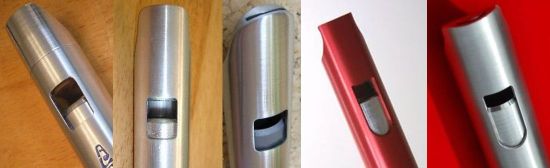
All share a similar design IE; rounded windway, blade insert, all have ‘noisy’ tones, to a lesser or greater degree (before someone jumps in to defend a favoured whistle, hi Richard :thumbsup: ) So as it appears this design generally seems to produce a whistle with some turbulence in the tone, will Norm being able to alter the voicing to any degree?

That said, Burke whistles that have a similar mouthpiece, blade design as the above are known to have a particularly bland, pure tone?

Well, that’s a matter of personal opinion. Isn’t it?

Bland? I don’t find that to be the case at all. I find it rather musical.

Tone is a fairly subjective and personal matter. It’s all relative.

And the Burke design isn’t at all similar to an Alba, V3/V4 or MK, IMO.

YMMV.

Feadoggie

PS: Peter, I enjoyed your playing of the harmonic series. Informative review. :thumbsup:

Nothing wrong with noise in the sound. I’m certainly not looking for ‘pure’, but there’s noise and noise, and you also need definition. People keep saying Norm’s whistle looks like an MK and I’ve heard the same about the V3s, but the MK has definition that Norm’s and the V3 lack. So of course you can get definition (or whatever else you like) with rounded windways and blade inserts because it’s all as much to do with dimensions and proportions as anything else.

Pity I didn’t hit them all straight off and once only, but not worth remaking it for that and at least they kept going up without dips! :slight_smile:

If you go to the 'Search function above (something I know you hold in high esteem) and search for Burke + Bland you’ll find quite a number of hits, so it’s not an uncommon observation.

With regards to the mouthpiece and blade alone (I know Burke’s have their unique or is that needlessly contrived tuning slide?) have a look at the pictures, all six whistles have a rounded windway, all six whistles have an insert forming the blade, a marked similarity in design I’d say?