History of Cell Phones

Help me with a little project. I’m working on a talk and I want to make the point that we have all, collectively, convinced ourselves that cell phones are necessary. I want to illustrate that by coming up with a year–and it doesn’t have to be precise–that we would agree that personal cell phone ownership by adults, even in the developed world, was rather rare. Then I want to pick another year in which it would be fair to say that teenagers carrying around their own phones would be very rare. I’m thinking I might use 1992 or so for the first year and 2002 for the second year.

What do you think?

For the UK, I’d have thought that 1992 was fine for the first of those two dates, but that 2002 would be late for the second one. I think you’d have to go back to at least 1999 for that, if not before. I got my kids phones in 2000, and we had held off for at least 2 years, during all of which time it was obvious that all of their friends (really, all, and that’s not just my kids telling me this ) had mobile phones. So that would make the teenager thing back to, say, 1995? Not later than 1996 for the UK, at any rate.

Now, I haven’t cheated and Googled this. I’m off to do that now. :slight_smile:

I’ve just looked at this graph, and I reckon I wasn’t far off.

But, wow! 97% coverage now. As in, there are 97 subscriptions per 100 people. And I’ve seen these statistics somewhere else before. I’m pretty sure that 100 inhabitants includes every man, woman and child, including babies.

Yeah, Ben, I was looking at the same chart. What’s confusing about it, though, is the term “inhabitants.” I would interpret that as literally all ages, all human beings. Surely it doesn’t mean that there are 97 mobile phones for every adult, infant, elderly person…

I assume you mean in the States, specifically, because
Europe and, interestingly, the developing world might
actually lead us by a few years in ubiquitousness.

I think your first year is pretty early (and therefore trivially
correct) for the US. I graduated High School in '93 and
they were still banning beepers because they thought
drug dealers used them. No mention of cell phones yet
in school policy. Teachers still had to be paged on the
intercom if a call came in for them because, with one
exception I know of, none had cell phones in class. I
knew a few adults who had “bag phones” in their cars
in the early 90’s.

My wife did her Vet School rotations in 2000-2001 and
they made everyone carry a beeper when they were on
call. I noticed that it wasn’t as easy to buy one as it
used to be. We commented that they soon will probably
just make everyone have cell phones instead.

So, I think the year it was rare for a US adult to own a
cell phone could be as late as 1995 or '96.

I didn’t know enough teenagers at the time to comment
reliably on that subject, but I’d be willing to bet that teen
adoption follows surprisingly close on the heels of mass
adult adoption. So 2000-2002 wouldn’t surprise me.


so 97 out’a 100 are subscribers

I’m not sure if this is of much use but a large number of employees nationwide from local to federal governments had issued cell phones(not private individual phones) back in the late '80s, those monstrous Motorola MicroTACs.

adults 1992 pretty good I recollect, but, children… 2002 IMHO is a little late. I think Colombine H.S. is the defining moment when every parent realized cellphone for child is necessary (kinda benchmarked it) http://en.wikipedia.org/wiki/Columbine_High_School_massacre

Yes, I think that’s exactly what it means. I remember two things - because they are memory only, I wouldn’t count them as facts, but even so, they may be illustrative: a few years ago, Norway had 130% mobile phone use, i.e there were 130 subscriptions per 100 inhabitants, men, women and children; and the average mobile phone user has something like two and a half subscriptions.

Does that help?

See my previous post, Denny. I don;t think that’s what it means.

I have to say, the use of the word “subscriber” does muddy the waters somewhat. I think what they mean is “subscriptions per 100 inhabitants” which is a different thing entirely. I wonder if we can get at the source data?

[EDITED TO ADD] Ah “source: own work”. So any misuse of English or misunderstanding of the logic is down to the Wikipedia contributor. If I was a contributor, I would strongly question that data, simply because of the use of the word “subscriber”.

sorry Ben, I’s jess reading the heading :really:
Is the author British, have an aversion to “per capita”, wha?

“subscriber” allows you to use a reasonably accurate number from the companies selling access to air time.

Many people with corporate accounts will also have private accounts. I’d expect drug dealers and pimps to skew the numbers a bit also.

I had thought of all those disposables that are for sale. How do they affect the stats?

Well, I don’t agree that Columbine means that a cell phone for every child is necessary, but I understand your point.

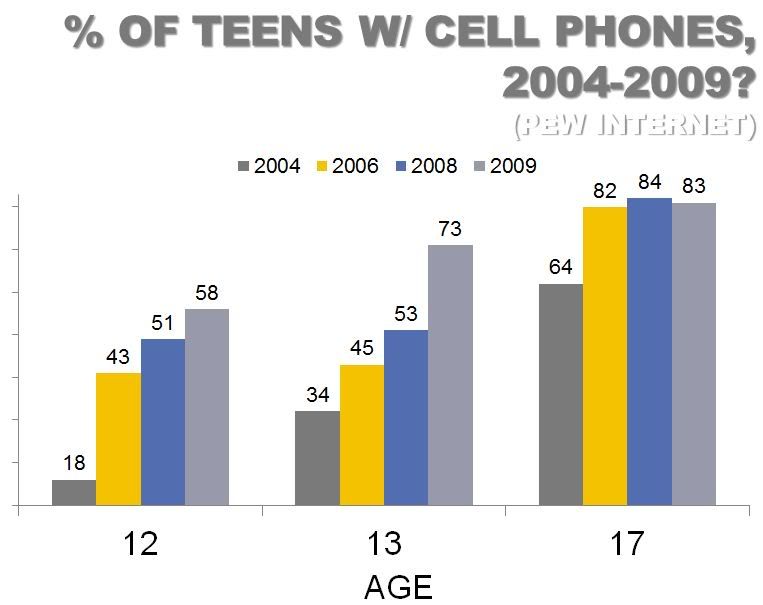
I’m not sure the date is late, though. Our oldest daughter got her first cell only when she went to college, and that was in 2000. We didn’t think (nor did our daughter claim!) that we were far behind the rest of middle-class America. Most of her peers did not yet have cells. So, I don’t think most high school students had them by 2002 and certainly still very few middle-school or elementary school students had them. The latter, especially, has already happened since the mid-2000s, and that’s when we start to get reliable data.

I don’t think that can be true of the UK, even if it’s true of the States. When we got them for our boys, then aged 11, 13 and 15, in 2000, we were definitely at least a couple of years behind where almost all of their friends were.

might want to consider cell tower/availability in GB/EU/US

we’re spread out more, costs more to implement and takes longer

Dale, I don’t know if you’ve looked at this site yet but it could add some data to your thinking.

http://pewresearch.org/pubs/1315/teens-use-of-cell-phones

It does remind me of this little ditty though.

Feadoggie

Maybe I should’ve said that Columbine HS (1999 or so) was the defining moment cellphone provider’s used as a “marketing tool” to justify the “gotta hav’em” and it may have taken alittle while for everyone to “buy in” to the idea. The cell companies used “safety” as the reason for parents & children to be connected 24/7. But…

The cellphone provider’s brilliance in everyone’s hav’in’em (humans=connected=safety) has lead to further “marketing profits” from cross media interactivity, i.e., TV: American Idol (all others too) call-in on cell to vote… brilliant! Those aren’t free-calls, maybe within a callin’ plan, but, not free. Even the local TV newscasts have implemented the cellphone call-in and “tell us what you think” WTNH (and that may have started way back with cooking recipes on the News). I won’t even mention video games from cellphone, MS, FB, or Twit. Connectedness: data-gathering for numbers/people/customers=profits, all interactively somehow staying connected to the point of “safety"addiction”. (like the whistle)

What I’d like to see included with every cellphone nanomoment/interactivity is the “failure rate” whether equipment, dropout, or interference. The cellprovider’s oughta talk about fix’en failures, other industries would never get away with it. Automobiles that didn’t work 30-40% of the time and we’d all be walkin’ healthy.

Ok. Thanks.

A few data points from my own personal experience.

In 1990 I began renting (yes, renting) cell phones for my business for occasional situational needs. These were suitcase-type phones weighing around 20 lbs, not the kind of thing the average person would carry. Pagers were the norm for personal mobile contact.

By 1994, the top management of my company carried cell phones, so I bought my first - an Audiovox, then a Motorola MicroTAC. All still analog, of course. And definitely a prestige thing. Teen use would have been rare except among the wealthy.

In 1997 came the Qualcomm Q Phone, my first digital (CDMA), with basic texting and internet capability. Coverage was spotty, even though San Diego’s infrastructure was better than most, thanks to being the home of Qualcomm and CDMA.

In fact, I think adoption closely tracked the build-out of 2G infrastructure in local areas, and the state of the hodge-podge of the four competing systems: analog, CDMA (Verizon), PCS (Sprint), and GSM (Cingular/ATT).

The Europeans were way ahead of the US in this, thanks to the early adoption of the GSM standard. A memorable moment came in 1998 when I was attending the CeBIT show in Hannover. I was waiting for a stall in the men’s room. And from behind the closed doors of the 20 or so stalls, all you could hear was people talking and phones ringing (the Nokia song!). I’d guess that 90% of attendees had phones, far higher than I’d have expected in the US at that time. And companies like Orange Mobile were really pushing mobile phones as a universal appliance, not just for elites.

By 2000, I remember discussing the phenomenon of texting with my European friends, and the (still mostly European) problem of kids being obsessed with texting. Over here, the phone companies were just beginning to really push texting as the big thing in their TV advertising, targeted partly at kids, and “family plans”, as the business market became saturated.

If I had to pick a pivotal year for the teen cell phone phenom in the US, it would probably be 2000. And the trajectory of subsequent TV advertising reinforced that by focusing heavily on texting, integrated music features, and video. Since then, with the exception of certain aspects of smart phones (e.g. the business focus of Blackberry), my impression is that teen and youth phone use has driven adult patterns, not vice versa. Hook them early, stoke peer pressure, and you have a market for life.

Today I don’t own a cell phone. Early adopter, early un-adopter. I’m way ahead of the curve. :slight_smile:

I agree completely… year, hook, and sinker!

I do own a cellphone today (late adopter on a whim), but, monthly calls RARELY exceeds a dozen, maybe a “baker’s”

p.s. my observation of the movie industry saw the “fast food” establishments as marketing “channels of distribution” targeting the children, put a few movie character toys in there and a parent couldn’t drive past without stopping to P/U the weekly collectible with the kids screaming so loud. Hook’em young and ya gotta customer fer life (well said). But, that has all carried over to the cellphones. Kinda makes ya wonder who’s running the house, dad, mom, kid? It is the kid quite often.