Hello all, seeking opinion on the little discoloration I see inside the embouchure of my rosewood flute.
Is it possible to test if it is mold, or just discoloration due to playing?
FYI, the outside of the embouchure does have a minor color fade where the air stream goes, hence I a not sure if it’s just the grain around that part or more. Also, I used a cotton swab to poke around that area and nothing moved.
I have attached a few pictures here. In case it does look like it, what should I do?
Thanks in advance!
Pics:


I’m thinking if it didn’t move when poked, it isn’t mould. (Note our different spellings for mold!)
I’m wondering if it is a calcium salt. Perhaps calcium carbonate, a.k.a. limestone or marble! It seems humans can exhale, or perhaps expel calcium salts, some more than others.
Every now and then a recorder player will show up at my door, whimpering that their recorder seems to have gone stuffy and weak. (And when you start out as quiet as a recorder, you can’t afford to lose much more performance!)
And when I go investigating, and tap the block out, I often find buildups of calcium deposits in the windway. Calcium. Good for bones. Not so good for woodwinds.
Try applying some white vinegar via a cotton bud to the build-up. See these instructions from the American Recorder Society. You need to re-interpret it for flute rather than recorder:
__
Remove calcium from the beak: This is much easier than you think. Lay a strip of folded tissue paper across the beak where calcium has accumulated. Wet it with white vinegar. Keep it moist and in place for five minutes, up to 30 minutes if the accumulation is heavy. The vinegar will dissolve the calcium. Wash the area with mild soap and water. Use a terry or microfiber cloth to wipe off any remaining residue. Prevent it from developing again by wiping your beak with a damp cloth after playing it. You can rinse the beak under running tap water too.
Wash the exterior of the instrument. We recommend using a microfiber or terry cloth for this since they don’t damage wood. Feel free to add some mild dish soap if needed. Rinse when done. Avoid getting string joints wet if possible. Cork joints aren’t a problem. Keep leather keypads dry too.
Here is the image from the American Recorder Society. You can see their concern is largely more external appearance. But I have found build-up inside the windway which I believe is enough to mess with the flow.
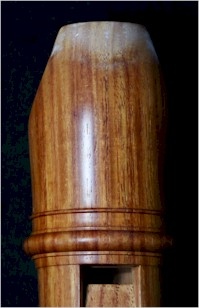
I know we get concerned about mixing flutes with water, but keep in mind the inside of flutes are wet all the time you are playing. So, if you do the white vinegar thing, don’t worry about rinsing the flute head with water. Just do it, and dry it off and air it.
Let us know how you get on!
Thanks Terry, and Bob for the detailed answers! Somewhat relieved it’s not as huge as it appeared to me. I will give those remedies a try abd get back.
It’s possible that the discoloration inside your rosewood flute’s embouchure could be mold or just natural discoloration from use. To test for mold, you can lightly moisten a cotton swab with water and gently swab the area. If the discoloration transfers to the swab, it might be mold. To clean it, you can use a mixture of mild soap and water on a soft cloth, being careful not to saturate the wood.
Ah ha! If it’s calcium salts, it would explain the crud on the inside of my flute embouchure that I have to clean away every so often. Mold isn’t usually white so I wondered about that.
Here’s a closeup of what it looks like on my blackwood flute, and it’s only ever on the far side of the embouchure. It disappears if I wipe it away with a Q-Tip and some bore oil, but I’ll try vinegar next time. Might clear it away faster.

Certainly worth getting rid of, Conical. Scale is unlikely to present a smooth face to the vacillating air column.
Notice how it doesn’t form near the edge itself, but further down and to the sides. I imagine that’s because near the edge and the centre, the jet doesn’t allow the moisture to linger.
Hmmm, I wonder if the stuff they sell to de-scale coffee makers has anything to offer in removing this? I just looked at the jar of “Restore Espresso Machine De-scaler” we have here. It lists the ingredients as Citric Acid, >60% and Tartaric Acid 1-10%. It also warns about getting it in your eyes!
I had wondered about Citric Acid, in the form of Lemon Juice earlier, but didn’t mention it, as I thought Calcium Citrate mightn’t be as soluble as Calcium Acetate. But if it worked, it has the benefit of smelling better than vinegar!
Note, I’m assuming, at least for the moment, that we are looking at Calcium Carbonate.
Do let us know what worked and what didn’t, and what differences in performance you were able to discern before and after.
Okay, I tried cleaning the white crud with a Q-Tip cotton swab soaked in distilled white vinegar, and it came off instantly. Much easier than the last time I cleaned it with a Q-Tip soaked in bore oil, which needed some rubbing to get it off. I’d say that probably confirms the diagnosis of calcium salts.
Just for grins I tried blowing a few notes before cleaning and then afterwards, and I couldn’t hear any difference in tone. Not exactly a scientific ABX listening test, but the white crud was a very thin layer on the surface of the embouchure cut, so apparently it didn’t affect the tone at all.
To reduce calcium buildup in future, maybe I should gargle with vinegar before playing. 
Good if you couldn’t tell the difference, it presumably means the scale hadn’t built up to sufficient depth to mess with the jet. It will be interesting to see how long before it returns. But at least you know what to do then!
Once the scale has been removed, it would probably be good to rinse off any remaining vinegar, then re-oil the inside of the embouchure hole and let it dry/soak in.