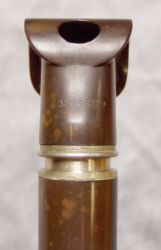
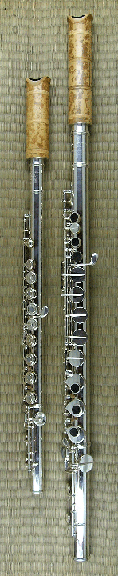
That’s exactly what it’s for. This picture from that site shows the
fipple head on a concert flute (which is often called a Boehm flute).

That’s exactly what it’s for. This picture from that site shows the
fipple head on a concert flute (which is often called a Boehm flute).
I’m sorry, what do you mean by that?
I did not know that the boehm flute was the same as the concert flute  and oh I talked to Doc Jones, he said he sold it to a whistle maker (Gary Humphrey) who wanted to try and make his own version of it.
Some peoepl call boehm flutes concert, and some “irish” flutes. Same goes for the term “classical”. Both are true for each. Boehm is the most exact term for the modern flute, I think.
So, does anyone know if Gary is making these things (or something similar)?
taffy pull: Heat the PVC and pull one end. Maybe with the right technique, it could be pulled into a conical shape. (I doubt it)
chlorine gas: PVC is toxic when heated
…john
another variation on the theme.
http://www.saxpics.com/the_gallery/slideandodd/kohlert-fluteophone/i-1_B_L.JPG
http://www.saxpics.com/the_gallery/slideandodd/kohlert-fluteophone/i-2_B_L.JPG
http://www.saxpics.com/the_gallery/slideandodd/kohlert-fluteophone/i-3_B_L.JPG
The gist is that both Simple System and Boehm orchestral flutes can correctly be called “Concert Flutes” as the term was originally a C19th one defining the pitch/tonality of the instrument and its normal usage - i.e. the standard D flute used in the orchestra (C in modern classical terminology) - as contrasted with other flutes in other tonalities for other purposes, e.g. high and low Bb, F and Eb Band Flutes (and Eb piccolos) made chiefly for use in military bands. This distinction didn’t really exist before the C19th, so “Concert Flute” was not at the time applied to the Baroque traverso or its Classical successors although they were indeed D flutes. Note that variations in the standard performing pitch (A=440, 450 or whatever) are not the issue here, but the nominal home scale of the instrument. D = orchestral use (flute or piccolo), Eb/F/Bb = band use - hence NOT “concert”. So a Boehm flute in Eb (Db) cannot correctly be called a “Concert Flute”. Nor, probably, should the modern keyless versions of the Simple System D flute as commonly used in ITM, since they are not suitable for orchestral use!
However, as in Ireland it is still common to refer to Simple System D flutes as “Concert Flutes” generically, the usage would seem to be moving on and including the modern undressed version. The issue is of course complicated by the general disuse of Simple System flutes in orchestras since the 1920s so that to many people the Boehm is the only “Concert Flute”.
Heigh-ho! The joys of jargon and special terminology! Love it or hate it, it evolves to aid communication and ends up hindering it because of both the ignorance (not their fault) of the uninitiated and the remorseless tendency of language and usage to develop and shift.
Well, I usually charge people for advertising my site but I’ll give you a pass as it’s your first offense.
Doc
Well, needless to say, things O’Riordan and silver had swarmed on you, and I thought it would be OK…
R
Someone is making cheaters? That defeats the way a fife should play, it would mess up it’s sound making it shrill and harsh, the tuning would be off, dynamics would be destroyed… …why?
Someone is making cheaters? That defeats the way a fife should play, it would mess up it’s sound making it shrill and harsh, the tuning would be off, dynamics would be destroyed… …why?
Sorry to offend anyone, I am by no means soliciting these!  Just thought this is what people were talking about for ‘simplifying’ the flute.
At the NAMM show a couple years ago there was a guy with a tiny booth selling his verticle flute headjoint invention. Rather than a long curving thing, this was like having a two-inch long bit of the headjoint, bearing the embouchure plate, soldered perpendicularly onto the remainder of the headjoint, sort of a “T” thing. He was pitching it at marching bands so that they wouldn’t have the current trouble, when doing tight marching manoeuvres, of the flutes sticking out to the side.
Sorry, I guess I went over the top with that post, I was actually surprised that Be a Fifer! was making and selling cheaters. I didn’t think there would be enough demand, but the justification seems sound.
However, I am also contacted by people with dentures, dental braces or no teeth at all! Although I still have most of my teeth, I can understand the problem. Some messages deal with emphysema, asthma, and other lung or breathing problems.
Oh and since the thread has drifted slightly from fipples, there is also the shakuhachi head but it probally would not make the flute easier to play.
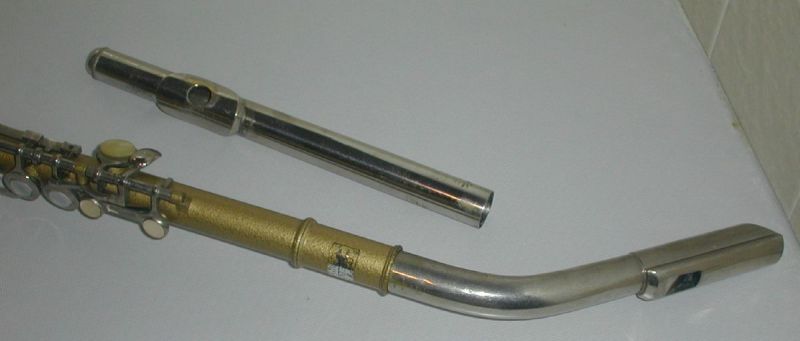
Re: cheaters, here’s a fine example currently on ebay…

Lots more pics on the listing - Item number: 300148422980.
Oooooooooooooh…
try doin’ that with wood 
Of course, if you really want an upright flute with a transverse type mouthpiece, the answer is the Giorgi flute - or at least, apply his head design to a head to fit on a Boehm or simple system body. It wouldn’t actually be a million miles away from those shakuhachi heads shown above, but a lot more elegant and effective than those swan neck type jobbies - cheaper and easier to make too, I’d have thought. Probably what the guy with the T-piece was aiming at. It does have some different acoustic properties and effects though - see the article from which this picture is borrowed:- Oldflutes link