I thought it might be interesting to discuss the flutes made by these two top end modern makers. To my mind at least, they seem to remain closer to the original antique instruments than some other makers.
What do other members think?
I think that is true beyond doubt, Uni Flute. There may well be makers other than Mike and Chris who do the same, I probably wouldn’t know. (We don’t see all that many flutes by other makers down here!) The occasional Sam Murray flute, perhaps? His might fall into the same category?
What interests me is the reaction of different flute players to such flutes (or to the originals themselves). Some people just love them, and can do great stuff with them. Some people are less enthusiastic. Some people really struggle.
Now, it might be tempting to conclude that it’s all about ability. The great players do great, the mediocre ones get by, the poor ones struggle. But it’s definitely not that simple. Flute teachers would probably be able to comment, but we makers see it too.
I wouldn’t be the first maker who has sold a flute to someone who previously owned the kind of flute we’re talking about but who struggled mightily. And I wouldn’t be the only maker much relieved when said new customer came back soon after, thanking him or her profusely for making a flute they can not only play, but really enjoy and play well. Whew, my work isn’t wasted. This person can play flute. It was the flute holding them back. Whatever its merits, it didn’t suit them, or they didn’t suit it. Maybe even both?
So, what is the mystery missing ingredient if it isn’t ability? Why do some old flutes (and new copies of old flutes) defy some players, yet engage others? (We could argue that the engaged were masochists, but that would be as facile an answer as “lack of ability” would be for the disappointed.) We have touched on this in these columns over the years, but I’m not convinced yet we have an answer. I’ll try to move the conversation forward. Please help!
I reckon that tuning is the main technical issue that separates old flutes and their copies from newly designed/reworked flutes. (I’d be really happy to be corrected here, if others feel they can identify issues other than tuning.) Period flutes and close copies relate to a period when pitch was rising from the baroque (A= 410 or so) towards low pitch (A = 430). Consequently, the body scaling is significantly longer than that which suits A = 440, and so, if the top end of the flute is tuned for A = 440, the low notes are unacceptably flat (like 50 cents or so). Ghastly!
When confronted with (period) English flutes like that back in the 50’s, 60’s and 70’s, Irish players found a solution. Push the low notes so hard that almost all of the energy went into the better-tuned second and higher harmonics, effectively bringing the pitch up to acceptable, while, at the same time, rendering the tone of the low notes (which, because of the poor harmonic relationship, was thin, waffly, burbly, unfocussed) dramatically more edgy and focused. I suspect that players of modern copies of such flutes are employing the same embouchure approach. The successful players certainly achieve the characteristic hard-edged low note tone.
And so, coming out of all of this, this is my thesis. People who get off on period flutes from first-half 19th century England or close copies thereof have a particular skill - they can successfully push energy in the low notes into the upper harmonics. That is not the same skill as playing the flute, it’s an additional skill, and it seems only some players command it. Or enough of it.
Interestingly, a well-tuned flute doesn’t prevent using the same approach to harden the tone of low notes, though it can be argued that a flute with slightly flat low notes encourages this hardening approach. But a badly-tuned flute demands it. And not everyone can do it.
It’s a bold thesis isn’t it. But, hey, come up with a better one that fits the known facts!
Firstly, I do not believe that Wilke’s flute are that close to the originals, as for Grinter’s flutes I have never tried one so I won’t speak about them.
Chris had one of Andrew Kirby’s box wood original Rudall, all the keys made with pewter plugs, a shark skin patch for the left thumb and, it was and it is to this day the best original Rudall I had ever tried (if any one reading this has it, lucky you!). So when I ordered a Rudall from Chris, I asked him for something that was like that Rudall, and when I got it, I played both, and they were a wee bit a like, but very very different in tuning and in many other ways, which I can not recall precisely. I think Chris’s flutes in their making are as far from the originals as any other decent modern makers. It is even clearer when you mesure the bores and compare them to the original ones…
The closest to original Rudall I have played was a Cameron Rudall. Maybe people think Chris’s work is close to the originals because of the craftmanship on the outside (keys etc.)
As far as hard to play, I have yet to meet some one who can play flute, who can not play my Rudall. So is it hard to play, absolutely not, if you know how to blow, if you don’t, then I do not really see what there is to argue about…It is all about tight embouchure, you have it, you can play any flute, you do not have it, then you need to play a far more forgiving instrument. I have tried quite a few of those, and most of the ones I played are fine, they play easily right away, but, that (to me that is) is all they do, you do not get a really fabulous player, the kind that you try and feel sorry to return.
But then again maybe I say that because I am used to one kind of embouchure. But please find me a player who sounds great on one of those “easy” flutes and can not play a “hard” flute…
Terry, that is a pretty good thesis to be starting with, and definitely worth further discussion. I would say you’ve done a lot to push the curtain in terms of development and a contemporary approach to flute making  I think your analysis of the Irish style of flute playing being born out of sheer necessity, dealing with instruments with sometimes poor intonation quite revealing and astute. Consequently, it could be said that Irish flute playing could have sounded very different in terms of tone and style without them.
Nicolas86, thank you for sharing your experience and comparisons between an Original Rudall, and one of Chris’ own flutes. It is the first time I have heard someone say anything to the contrary about the closeness of Chris’ own flutes and the originals. I am not surprised to hear that Rod Cameron’s Rudall copy is the closest you have found to an antique Rudall, bearing in mind that he primarily focuses on instruments for Early and Historically Informed Music, whose customers can feel that even shrinkage in the bore of a venerable Boxwood original should be faithfully replicated. Out of interest, do you know if Chris decided to base one of his production Rudall models on the Boxwood flute owned by the late Andrew Kirby, or was your request a one off specialist commission ?
I agree with you that a lot of professional level players can play just about anything put before them, but I myself have on a couple of occasions seen competent players of modern flutes try an antique, only to return it rather quickly and resume playing on their modern instrument. Perhaps some of those who have played exclusively on modern instruments may find antique flutes to be unnecessarily challenging?
I would like to second what Nicolas86 said, except I would say it about my Grinter flute and I have not played a Wilkes.
My Grinter has very good A=440 tuning, better than antiques I’ve played, and in line with A=440 tuning from other
top modern maker’s. I find it easy to play and I would guess that even if Grinter started out copying an original, what I
have is likely the result of significant refinement towards a tuning target that several modern makers share.
I do agree with Terry though that the main difference between antique flutes (in general) and modern flutes is tuning, but
I would put my Grinter (and Murray) flute in the modern flutes category.
I think embouchure cut and bore profile have very significant impacts on the voice of a flute, and I think embouchure cut
in particular has the biggest impact on ease of play, especially for beginners. My best guess is that makers such as Wilkes
and Grinter and Murray, who all make beautiful sounding flutes, strive for a bore profile and embouchure cut that gives their
flutes a voice with a (desirable) traditional characteristic, but with A=440 tuning and lots of volume for modern session
playing.
Yes Terry, I am one who struggled with several different flutes until I got my 5 keyed 5088 with the semicircular embouchure from you 10 years ago. I really took to it and it has remained my primary flute to this day. It plays really easily, has the great tone some call reedy, and is in perfect tune. Thanks for that one! Over the ensuing years I bought two original Rudalls. No.s 3415 with an extra Wilkes head and No. 6530. They feel a little bit fatter and are harder to play although I can usually do pretty good on them now. But of all the flutes I have owned, including a Wilkes, I would say your 5088 model feels the most like an original Rudall. I know you make several models and I have played two others, but the 5088 is the one that really works for me.
Lots of interesting perspectives there, but I wonder if we should just check back with Uni Flute to make sure I haven’t perpetrated a massive thread heist. Is this discussion more or less covering the kind of ground you had in mind, Uni Flute?
On a more physical matter (not that acoustics isn’t physics!), can I invite owners of Grinter and Wilkes flutes (or flutes by other makers for that matter!) to pop a key off and report back what the tip of the key spring bears upon? I’m imagining you’ll find one of three options:
- bare wood, probably with a shiny spot where the tip of the spring bears against it
- a metal slip plate set into or attached to the bottom of the slot, or
- a thin blued-steel spring screwed to the bottom of the slot as we see in this Rudall & Rose (No 519):
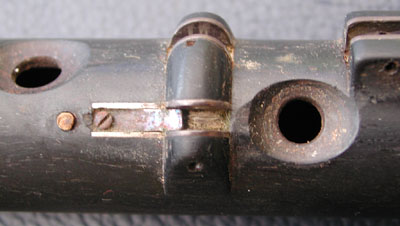
I can’t speak to the Wilkes, though I did for awhile own a Grinter, but I want to say
that IMO, probably ignorant, Glenn Watson flutes and Bryan Byrne flutes
are quite Rudally, perhaps more so than the Grinter.
Are you counting coil springs, like Hammy uses?
I have a modern 8-key Rudall-type by Tom Aebi. A recent secondhand purchase, maybe 10 or 15 years old. That key in the photo above on this flute has a visible screw head and metal strip under the lever. I suspect it’s a spring, but I didn’t want to remove the key while I’m still doing other fine-tuning and getting used to the flute.
There is one area where I wish this weren’t such a close 19th Century copy, and that’s the pewter plugs on the C# and C foot keys. Maybe that made sense at one time in the past, but in hindsight I’d rather have a better modern cup and pad than something this fussy to get sealing well.
FWIW, the “McGee C# to Eb” measurement is 150.8mm, so based on the scale info on your web site, it’s been tweaked for A440 compared to the original Rudall this was probably modeled on. Good intonation in both octaves, just a wee bit flat on the low D but not that hard to blow it up.
I wasn’t planning too, but yeah, let’s make it a wider survey of springing approaches. (Woah, I might regret this!)
Indeed, I’ll add another I’ve recently come across. So now we’re up to:
-
a single-leaf spring attached under keytouch, with its tip bearing on:
1.a) - bare wood, probably with a shiny spot where the tip of the spring bears against it
1.b) - a metal slip plate set into or attached to the bottom of the slot,
1.c) - a thin blued-steel spring screwed to the bottom of the slot, or
1.d) - something else? -
a single-leaf spring screwed to the bottom of the pad end of the key shaft and bearing on wood under the touch end, or
-
coil springs,
-
needle springs (post mounted keys), or
-
some other form of springing?
Although Grinter and Wilkes were the makers that first came to mind, adding other makers into the mix could prove very interesting.
So for closeness to the original antique Rudalls, the following names have also been mentioned; Cameron, Byrne and Watson.
As a side note, Hammy Hamilton may not be the first maker to utilise coiled springs on his keywork, check out the flutes of Frederick Godfroy.
Paddler
I’m interested that you find your Grinter has “very good A 440 tuning”, as I’ve recently had one down here for repair and found it had very wild tuning indeed. Low D more than 60 cents flat of low B. Indeed, the owner was whimpering that he keeps getting told off by fiddle players and concertina players for playing out of tune!
Now, there could be a myriad reasons why we have had such dramatically differing experiences.
Perhaps this particular flute is an early one (I don’t know if that’s likely. I’m not even sure when Michael started making.). I don’t believe Michael puts serial numbers on his flutes, does he? If so where, and I’ll get the owner to look. Is yours early or more recent?
Perhaps Michael switched designs at some point? What do you get as your c#-Eb length? The flute I was looking at was dramatically longer than mine, 256mm compared with 245mm. More like the 19th century originals.
Perhaps you are really good at the “special mouth trick” for pushing energy into the upper (and often better-tuned) octaves? I’m pretty good at it, and use it routinely to harden my tone, but I’m probably not as skilled as one who needs to use it routinely to correct tuning. It would be interesting to test the intonation using a more “naïve” embouchure (e.g. blowing less firmly and directly at the “edge”), or having someone else test it to see if you are applying special skills.
On the particular flute I was fixing, I found the response didn’t let me do the “special mouth trick” until I pulled the stopper out a long way (circa 23mm). I suspect that this brought the upper partials down closer to the fundamental. The owner was delighted with the improvement from this partial workaround, although he’s still wondering what he should do in the long term.
The “special mouth trick” I’m referring to is offsetting the jet back from the “edge” by a mm or two, by blowing a finely focused jet downwards towards the bottom of the embouchure hole, rather than aiming it at the edge. The offset disadvantages the efficiency of the fundamental, and pushes its energy into the upper harmonics. If the fundamental is the only flat partial, it means that the pitch is now determined (at least mostly) by the tuning of the harmonics.
I haven’t taken the key off but the Bb key on my 1990 Wilkes cocus wood 8 key has 1.b) - a metal slip plate (with a screw) set into the bottom of the slot.
Ooh, tricky, Gromit.
If it has the screw, it could either be the slip plate (1.b) or the double-springing (1.c). Can we convince you to pull the pin?
I’m not sure how old my Grinter is. I bought it from a member here in 2015. I think it is pretty new though.
It is a keyless D flute with rudall-style separate left and right hand body sections and a separate foot. It also
came with additional body sections to play in C, using the same head and foot. It has a long foot.
It plays in tune with itself at A=440, almost perfectly for me, with the tuning slide extended about 4 mm at
a 70 degree room temp. The low B and D are very well aligned with that slide extension, and the tuning is very
close to that of my Olwell when played back to back in the same environmental conditions, and the tuning on
that is the best I’ve ever seen. Both are as close to “perfect” as any player would need them to be, in my opinion.
So, given that the flute is keyless I can’t address your spring question or the C#-Eb measurement. However,
the C# to D measurement (center of hole that vents C# to center of top foot hole that vents D) is about 289 mm,
if that is of any use.
I really like how this flute plays, so I profiled the bore and was surprised to find that it was almost identical (at
least within the margin of error for measurement, reamer reproduction, and finishing) to that of my Olwell. In
other words, you could make a decent replica of either instrument using the same reamer. The two flutes have
subtly different embouchure cuts and a slightly different tone hole matrix, and that makes them distinct from
each other. But I think the similar bore is telling, in the sense that the Olwell is supposedly a “Pratten”, and the
Grinter is supposedly a “Rudall”. From my perspective, though, they both look, feel, and play, like highly optimized
modern flutes. They are really GREAT flutes, but they are quite distinct from antique Prattens and Rudalls that
I’ve experienced. This is why I tend to recoil a bit when I see discussions that try to categorize modern flutes as
either Pratten or Rudall, when they are not intending to replicate a particular Pratten or Rudall antique.
So, I don’t know if Grinter uses different reamers for his keyless and keyed flutes, or if he has evolved his reamer
design over time. I strongly suspect that he has many different reamers. I already do, and I’m only just starting
out in flute making and have not yet tried to sell a single instrument.
Maybe the keyed flute you are working on is an early one that was a direct copy of an original antique, complete
with its tuning anomalies. Maybe this was a convenient starting point for a new maker back in the day, or maybe
the intention was to deliberately create an accurate replica, and the flute is not one of his early ones at all.
Which is representative of his work? Well, they both are, I guess. My feeling is that makers like Grinter, Wilkes, etc
are extremely talented flute makers who are capable of making just about any flute they want. They can copy originals,
and they have evolved their own designs over time, through a laborious iterative process, and by learning from each
other and past masters. They can tweak particular instruments in many different ways, as top flute makers seem to
have done throughout history. Flutes from a specific modern maker differ from each other over time, as do flutes
from specific historic makers. Your study of the evolution of Rudalls is a great example of this.
This is why I think we need to be careful about making overly general statements about the characteristics of flutes
from specific makers, and then making inferences about a maker’s capabilities. Its better to collect experiences with
specific instruments and qualify them with as much background information as we have, which I guess is what we are
doing here.
Oh, and my flute has Grinter’s maker’s mark on every section, but I have not found a serial number anywhere.
Drifting a bit, but there seems to be a tendency to lump one-piece bodies as Prattens (damn spell-check keeps trying to change that to pre-teens) and two piece bodies as Rudalls. As Paddler hints, and I strongly concur, it would be nice to get away from this somehow.
Best wishes.
Steve
I have a Wilkes made in 2000 with medium sized holes. I’m not sure on which Rudall flute Chris has based the Wilkes I have. The embouchure hole is the same shape as the embouchure holes on three Rudall flutes made in 1842, 1844 and 1891-2. All three Rudall flutes have been repadded, are airtight, and are easy to play I find, after playing them on a regular basis. As discussed in an earlier thread, I find the Wilkes easy to play too after becoming accustomed to the Rudall embouchure.
I think the Wilkes I have sounds similar to the Rudall flutes, maybe a tad louder. No special tricks needed to play the Wilkes or the Rudalls. It’s just to have the patience to become familiar with your instrument, just to blow, spend time. We all have different mouth shapes, also different teeth configurations, or perhaps missing molars, over- or underbite. There are lots of facial variables, that can have positive or negative issues, that also have to be taken into consideration irrespective of whoever you’re trying to play a Victorian or modern timber flute.
I think the Wilkes I have is very close to the Rudall & Rose and Rudall Carte & Co. flutes I play.
Interesting discussion, there is definitely a categorisation system in place for Irish flutes which equates to; one piece body = Pratten, two piece body = Rudall. As Terry has shown, one of the most prominent and perhaps the most prolific makers Rudall & Rose appeared to produce flutes with a broad range of variations. Paddler’s observations regarding the similarity of bores between a Grinter and an Olwell flute are important, I have even heard it said that modern copies of Prattens and Rudalls are indeed so similar, that the number of middle joints ( one or two) is the only true difference between many of them, unlike the originals.
So perhaps it may be appropriate to refocus the discussion, say, which makers of Irish flutes do we feel stay truest to the original instruments? So far, the names; Bryan Byrne, Rod Cameron, and Glen Watson have been mentioned in this respect. It would be interesting to see if other members concur with the names mentioned above, or feel other maker’s names should be included in this category. Could the keyed Grinter that Terry worked on with the broad intonation be considered a contender as well?
Out of interest, I have read that Grinter has produced two noticeable flute designs, and that his earlier instruments were based on a Wylde, can anyone confirm this?
I have a Wilkes, made in 1992. It´s a second hand flute, I own it since 2001 and I was told that this flute was an exact copy of a particular Rudall and Rose flute. I always thought that but I don´t know it this is completely true. I think that most of the makers start copying some original flute and continue his career developing and modifying the starter design to reach what customers and makers consider a better flute-
In my particular case at the begining I did struggle a lot with the tunning, because the foot notes were very flat to me. The foot joint was rebored and after that I felt that the flute was perfect in tune since then, at leat to my feeling and embouchure.
I have tried a few Wilkes made years later than the mine. They presented different tone holes and bore size than the one I own. All of them were terrific flutes. I know Chris has been changing the design along the years. But, after all, I prefer the mine one. It suits me better. May be it´s me.
Regards,
S.