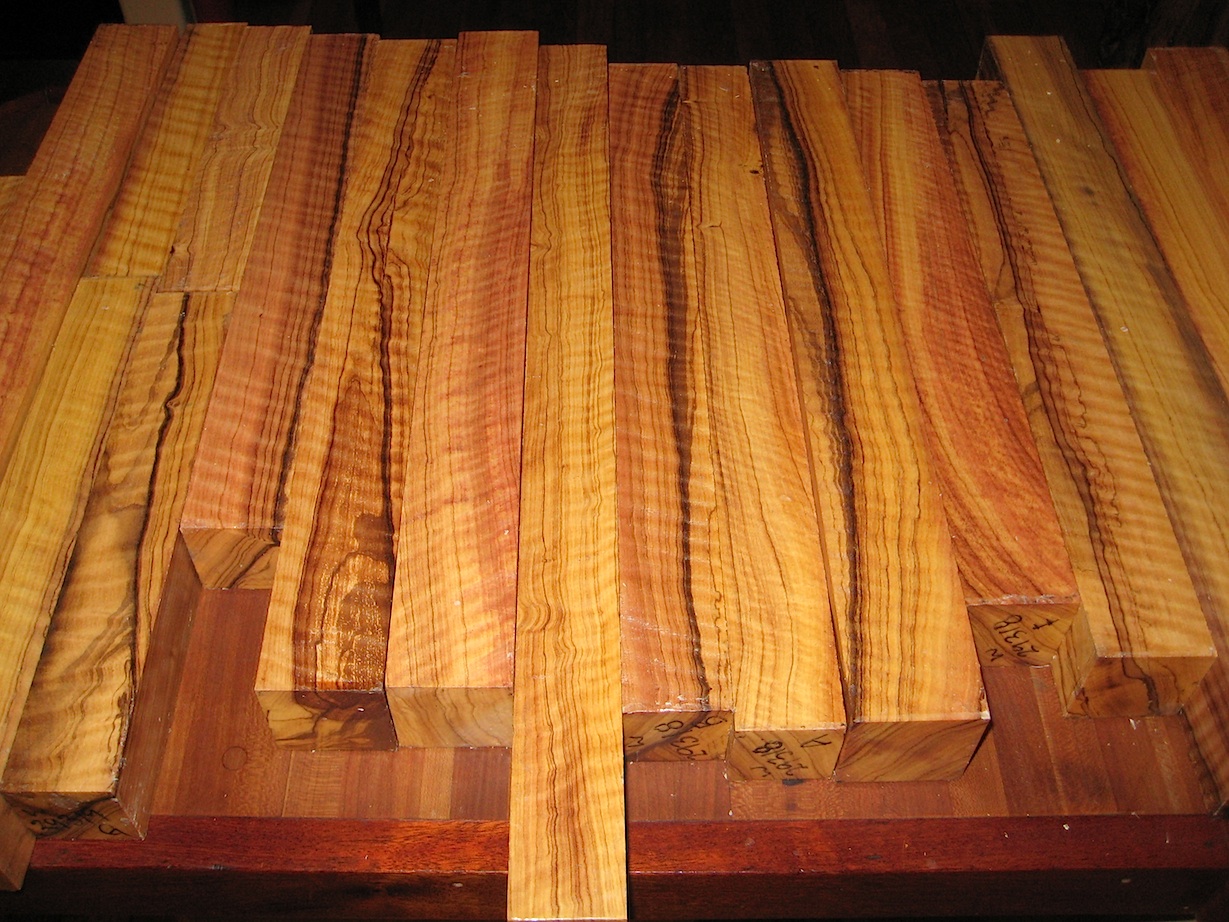
I am finishing up a flute today out of some beautiful curly South African Olive wood. This wood is harder and heavier than the California Olive wood that I have worked in the past, and its very stable. Nice stuff and I want to make flutes out of this wood. So yesterday I grabbed some more while passing through Portland on the way back from an event in Berkeley. I will be using these pieces on my flutes with rings and slides - but not on my inexpensive Folk Flutes. The quantity is too limited and I want to save this wood for my higher end instruments. I have enough for 8 or 9 flutes here I think.
Am tempted also to make a Galician Gaita for myself out of this instead!
Well I already own 3 gaitas and several extra chanters. One gaita can be played in Bb, A or G with different chanters and swapping out drone reeds. My others are in C and D. I plan to build one in E later this winter - but it will be out of boxwood. And being that I am both maker and consumer, I’ll probably use the gnarly stuff with all the defects.
If anyone is curious what olive wood flutes sound like, check out this link. Guy Bertrand of the French traditional group Lo Jai is playing the olive wood flute I gave him back in about 1986. Enjoy!
Well I just finished the first flute out of wood from the same batch, started in the summer. Its always a little hazardous to take an order for a flute for a wood one hasn’t tried, as the working and tonal qualities are unknown. However, I had had enough experience with regular European Olive grown in California and Italy to give a good guess and take the risk. The wood was denser and harder, and less porous compared with European Olive which would theoretically make it an excellent flute wood.
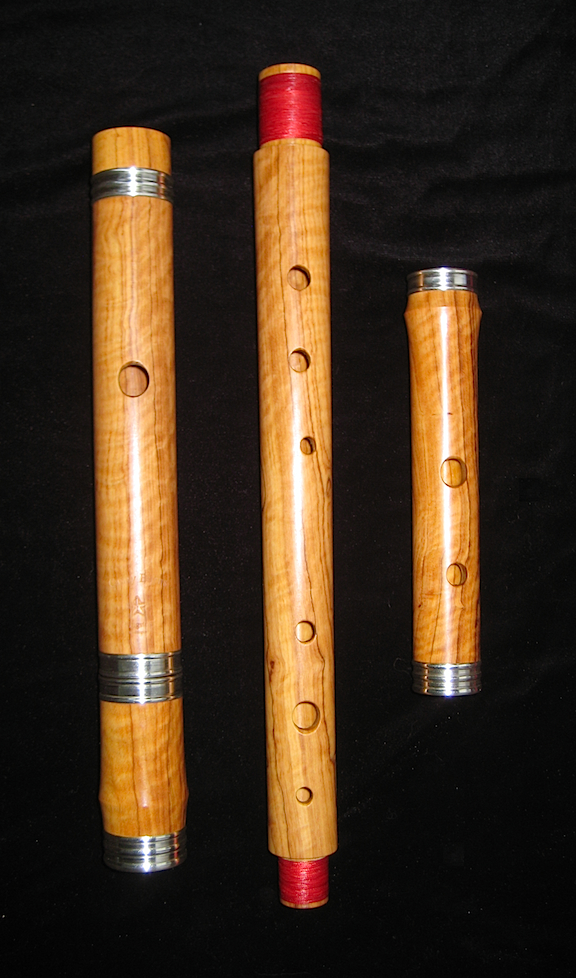
So I just tuned and voiced, and finished one in my small handed configuration, with tuning slide and bands, with an extended foot with two vent holes per my client’s request. What I observed while fitting the rings and turning the tenons (I did the last step just this morning) is that the wood is very stable, and only warped out of true at most .5mm on the 310mm long middle joint, after being turned in this shape for about 45 days. Blackwood is about the same. I would consider it very stable.
Tonally the flute has the quickness and ease of tone production as Boxwood, with a similar tonal spectra full of overtones (this is how I describe “warmth”). However, its power is about the same as Blackwood and Mopane. These observations were before the bore got sanded and oiled, which always improves it further. South African Olive is a fantastic flute wood!
I’ll get pictures of this flute posted up over the weekend. Its off to England in tomorrow’s post.
Yes it does. It makes the whole workshop smell like something wonderful is being cooked. Its perhaps like the smell of really fresh olive oil multiplied by 100.
On my way to a Galician music and chestnut harvest party in Berkeley last Sunday I stopped at Terra Savia in Hopland, CA (see http://www.terrasavia.com) and they sold me some organic oil of theirs that was less than a week since pressed. Poured it right out of the 1000 liter storage container into 375ml bottles, with a hand written label. Delicious stuff. Comparing the smell of this oil with the olive wood, they seem distantly related. Lilac blossoms and lilac wood are the same way (Lilac is in the same botanical group).
One can tell that there is oil in this wood. It would be interesting to press it and see what comes out.