I actually feel the same way! 
I had a class with a man from South Africa one time. He says the reason cheetahs are endangered is not only because their pelts are attractive to poachers, but also because they have no natural enemies. They can outrun anything except, unfortunately, bullets. Also, he says they often regard humans with curiosity rather than caution and will sometimes “act like big kittycats” and approach without hesitation.
Bobcats are actually making a resurgence in New England, for what it’s worth. As are coyotes (which I read are really more closely related to the supposed-extinct red wolf, at least in these parts) and moose. It’s really strange and wonderful that these animals are “coming back” to these parts, even if you do have to be more careful driving at night, and about letting pets roam after dark. There are even black bear in my town, and moose have been seen less than a block away from my house, which is pretty much in the suburbs. Very cool. This has all been happening in the last 10 years or so.
I read somewhere the story of the white-tailed deer in New England. Apparently their numbers had been pretty much decimated, if not exterminated, except for a small population on Long Island. It’s thought that they crossed Long Island Sound near Old Lyme, CT, and began the repopulation there. As a result, that area is where a concentration of Lyme disease was first described, hence its name (Lyme disease is carried by deer ticks).
I had a dog for many years who was part Carolina dog. His mother was a feral dog, and his father was the farm labrador retriever. He was a cool dog who rarely barked. He tended to stick around when I would walk him off-leash, always revolving in a prescribed radius from me. He could travel for miles with me on horseback before he was a year old. They guy lived to be 16 with no physical problems whatsoever, before succumbing to cancer.
http://www.carolinadogs.org/
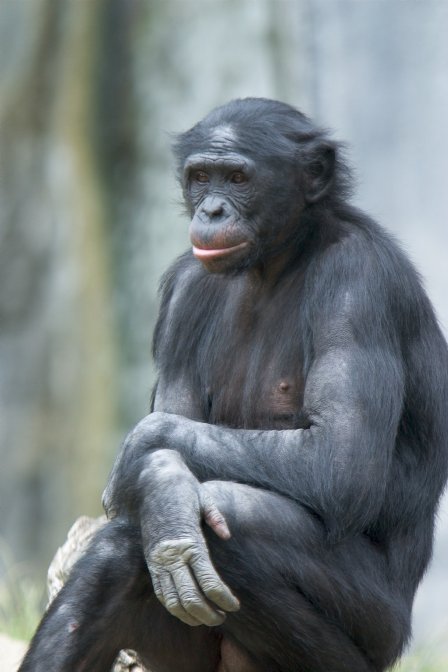
On a semi-unrelated note, I had the chance to see bonobos at the Seattle zoo when I lived there, some time ago. My hubby and I had been through the primate house, including the orangutan (who was living in miserable conditions, I hope they have changed that by now), and there were these two strange-looking “chimpanzees” in one of the outdoor enclosures. It turned out that they were bonobos. I found out later that this is a separate species of chimpanzee that lives in a different region from the standard chimpanzee. These animals were definitely different. They looked into my eyes and there was a sense of humanity to them that I couldn’t even ascribe to a regular chimpanzee. It was really very disturbing, almost like looking into the eyes of a man in jail. I won’t ever forget them, and it bothers me every time I think of them living there, more than the other apes in the facility. I’ve seen footage of bonobos on TV, but what I encountered at that zoo was an experience that can’t translate on film. The only difference between me and them was that I was on the outside of the cage, and they were inside.
Robin

The reason alligators (which are to be found in extreme southeast Oklahoma, btw) are listed as endangered is to keep hunters from shooting American crocodiles by mistake.
I too have experienced the sight of previously scarcely seen animals in my area of the Appalachians.
Where we live deer were very rarely seen until the last few years. Now they are practically vermin to this mostly farming community.
Great Blue Herons, all kinds of hawks, and I saw my first wild Bald Eagle just last year, these were seldom seen around here until recently.
And coyotes? Unfortunately they are now all over. This is not good for farming in any way, shape or form.
We’ve always had the occasional black bear, bob cats and “painters”. I even saw a black one about 30 years ago! We’ve seen others, but they are of the tan color.
Bonobo…

I find it amusing that I saw this thread just after finding this website:
http://www.humandescent.com/index2.shtml
And a week after going to the Shepaug Reservoir in CT to eagle watch. I’ve seen quite a few bald eagles, both free flying over our cabin in Maine, and in the clinic where I work (unfortunately the most recent was a glorious adult male who died of heart failure two weeks ago). Here again we have one main culprit: DDT.
The Carolina Parakeet (one of the conures, if I recall) wasn’t the only parrot native to the US, but it was the only one with a population entirely within the US. The Thick-Billed parrot was native to the American Southwest, and attempts have been made to reintroduce it there. Amusingly, there are a few thriving populations of non-native parrots, including the conures of Telegraph Hill, San Francisco and my own local Quaker (Monk) colonies. I’m torn between “non-native species- BAD” and “wild parrots in my backyard: WONDERFUL”. The ‘bad’ side is of course winning, but I can’t support the idea of destroying the colonies either.
At any rate: location: suburbia CT - weather at 10:00: snowing (again!) - birds at the feeders right now: pair of cardinals, 5 juncos, song sparrow, white-throated sparrow, three house sparrows, one very fluffed mourning dove, two chickadees, a tufted titmouse and a nuthatch.
Oh yes…and speaking of the link…has anyone else read Norstralia by Cordwainer Smith? (spelling may be wrong)
Apparently colonies of Quaker parrots are living all over the US.
Speaking of animals formerly found native in the USA, but not exclusively so, here’s one that would be a little nerve rattling if it made a comeback: the jaguar. There are a few, now, in the southwestern USA. They were once found in this region, even having been attributed with the downfall of the Mississippian civilization based at Spiro Mounds.
One of the great ironies of life for environmentalists and animal lovers, this. You can’t consistently be a full on envoronmentalist and a full on animal welfare egalitarian. Moral theories of animal rights all tell us we should value all animals equally. Environmental concerns tell us we should privilege native species over exotics.
It’s terrribly hard to fault the arguments of the animal rights people. But when you see cane toads on the rampage across northern Australia driving one after another native species of frog and toad into extinction, I simply can’t care much what happens to the toad or what is done to stop it, short of torture. I think I’m definitely on the side of environmental preservation here, but I don’t know how I can figure out how to give appropriate value to animals if I can’t follow the egalitarian ethics that seem appropriate for humans.
My environmental ethics classes were discussing this very conundrum this week. On a brighter note, not only am I seeing native parakeets in my garden but, amongst the numerous other species, native (I think) owls.
I agree.
And I’ve often wished I lived in Australia just so I could see budgies in the wild. 
Interesting link, Tyghress.
And yes, I have read “Norstralia” (Norstrilia?) and every other story of his I could get my hands on. Have you read “The Ballad of Lost C’Mell” or “The Game of Rat and Dragon”? (I think that both of these are most easily found in the collection “The Instrumentality of Mankind”). The major characters from “C’Mell” play supporting roles in “Norstrilia”, though the stories are fairly independent otherwise.
“Underpeople” (a working underclass created by genetically manipulating animals into roughly human form) are a major element in his writing, both as a source of ethical conflict (“what does it mean to be human?”) and a means of slipping such questions past our mental blinders (most of his best writing came in the two decades following WW2 - at the time he wrote his stories, many states still had - and enforced - anti-miscegnation laws).
I heartily recommend Cordwainer Smith to anyone who hasn’t read him - carefully crafted, humane but unsentimental, and somewhat surreal. (All qualities that could be used to describe R. A. Lafferty, too - though the feel of their writing is very different.)
How so? I thought that the concensus these days that the Mound Builder civilisations were decimated by the epidemics that followed the first European explorers (cf Jared Diamond’s “Guns, Germs, and Steel”).
I’d be curious to hear the reasoning behind this theory - not dismissing it out of hand, but I’d be curious to see the basis of their claim. Especially since the Mayans developed their civilisation in an area that still has jaguars today, and there are similar large cats (leopards and tigers) native to southern and eastern Asia.
I agree that it would be nerve rattling to have them be a major presence today - they’re much more formidable than cougars. For those who aren’t familiar with them, jaguars are a large cat resembling a burly leopard or a small tiger (with leopard-like spots rather than stripes). Much larger and more aggressive than cougars. I seem to recall that jaguars are actually fairly closely related to leopards and other Old World big cats, while cougars are actually the largest member of the small cat family (and are more closely related to house cats than jaguars).
It is not, to my knowledge a current theory, rather, it was blamed, by the people themselves, for the fall of the leadership at the Spiro site.
Just recently, when I was walking near my house, I heard the unmistakeable sound of sandhill cranes. The loud honking causes you to look upward. I live on a migration path, so I am accustomed to the migration of the cranes. I don’t know why, but the cranes always circle over where I live. It is like they have momentarily lost their bearings. I know that they can’t hear me, but I tell them to go ahead to Pulaski to the north, which is their usual stopping-off-place.
I hope that we have the collective wisdom to protect essential natural habitats, so that all creatures have the opportunity to live out their lives on this beautiful planet.