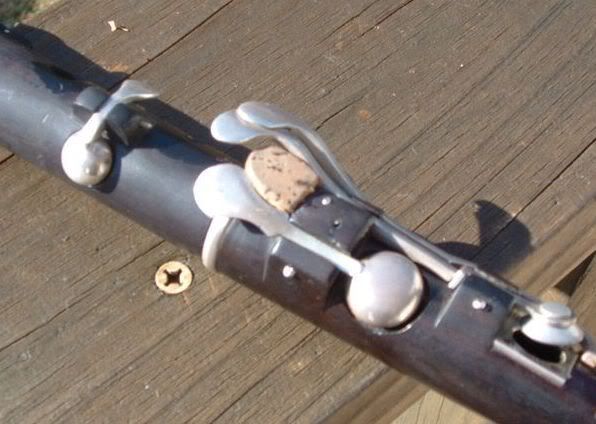
I’m one of the number who tend to roll the footjoint away.
Partly this is because I use my rt pinky to brace the
flute and I find placing it on the E flat key unstable.
This is because the key moves. Wood is more solid.
This is one of the reasons I do not want an
8-keyed flute.
But it seems to me there must be a way to comfortably use the key
to stabilize the flute, as I suppose it was often so used in orchestral
flutes in the 19th century. And I reckon some of you
know how. Any suggestions?
Hey Jim,
I often position my pinky down the touch toward the key pivot (reducing the leverage against the key spring).
Or try venting the Eb-key for all notes except D’s. I really like the way a vented Eb-key strengthens the E’s.
Baroque flutes tend to have very light touches on the Eb key, so I’ve found these techniques a big help.
Incidently, I have a 7-hole fife that needs to be played in a dainty manner (with your pinky in the air). I’ve learned to set my pinky above the 7th. (rotated towards the audience) when I need to help hold the fife for a C#.
Exactly. This is what virtually all period fingering charts show and the makers expected. When pressed down (i.e. open) it doesn’t move and is quite stable. It remains the norm on Bohm system flutes and all Bohm players learn the necessary fingering alternations/sequences.
Thanks to all, and apologies to Rob for forgetting his wonderful
cork invention.