Hi-- just saw Mary Coogan accompanying Joanie Madden and think I’d like to add dropped D tuning to my repertoire. I don’t currently play guitar for Celtic music (mandolin and whistle mainly) but used to play a lot of folk guitar and am pretty decent.
Any hints or pointers on how to incorporate this tuning?
BTW–figuring out how to tune the guitar is not an issue, but if you put “dropped D” into YouTube, you’ll find a LOT of videos on how to do this simple, self evident thing
I use it, but sparingly. I don’t find much use for it except for when I’m playing something in D tuning. And I’ll only use it then if I really feel the need to have that low root in the bass …usually I’m happy to use the F# 3rd and not tune down.
If you really want to have some fun, play around in DADGAD tuning.
I use it a lot, but only for fingerpicking /picking tunes in D and D minor. for backing I go straight back to standard as this is where I am comfortable. I dont use Dadgad , its a completely different system and Id rather put the energy in learning the tunes. I use open chords, D, G with the d on the B string added, A/A7. Am G, that kind of thing, intently listening for the changes which can come hard and fast as well as key changes. So thats my advice; keep it simple root chords occasional inversions, no substitution or a touch only and Follow The Tune.
I play almost exclusively in Dropped-D for Irish backup. Will post or PM when I’m awake. 
It’s really a great tuning once you get comfortable in it. When I first started using it, I thought it was fairly limiting, but I got a chance to sit down for 30 minutes or so with the guitarist for the McDades one night some years back after a show and he showed me how he plays tunes in F in DADGAD tuning. My eyes were opened.
i suggest you to try to find mad for trad cd rom guitar tutorial, where tutor was john doyle. it is worth money… on that cd rom on concertina was niall vallely…
personally, when i am not play flute, i play dadgag guitar ,because i like a lot that tunning, which gives a richness in sound …
marin
You mean he puts a capo on the 3rd fret?
Eskin used to have a bunch of dropD videos
which I found helpful, but I’m having a hard
time finding them now.
Sorry, I should have been clearer. No capo. He was playing in F in DADGAD without the use of a capo.
I like Drop D tuning, but it can be overdone. I think someone mentioned that earlier. I play a lot of finger style in Drop D because of that drone sound, and alternate bass picking.
I’ve seen some people use two guitars to go back and forth, but it only takes 15 seconds to drop to D, and another 15 to retune to E. Most crowds will wait that long, especially when you have some little story to keep them occupied.
Here is a picture of my new Martin D 28 which just happens to be sitting on the stand right now
Tuned to Open D
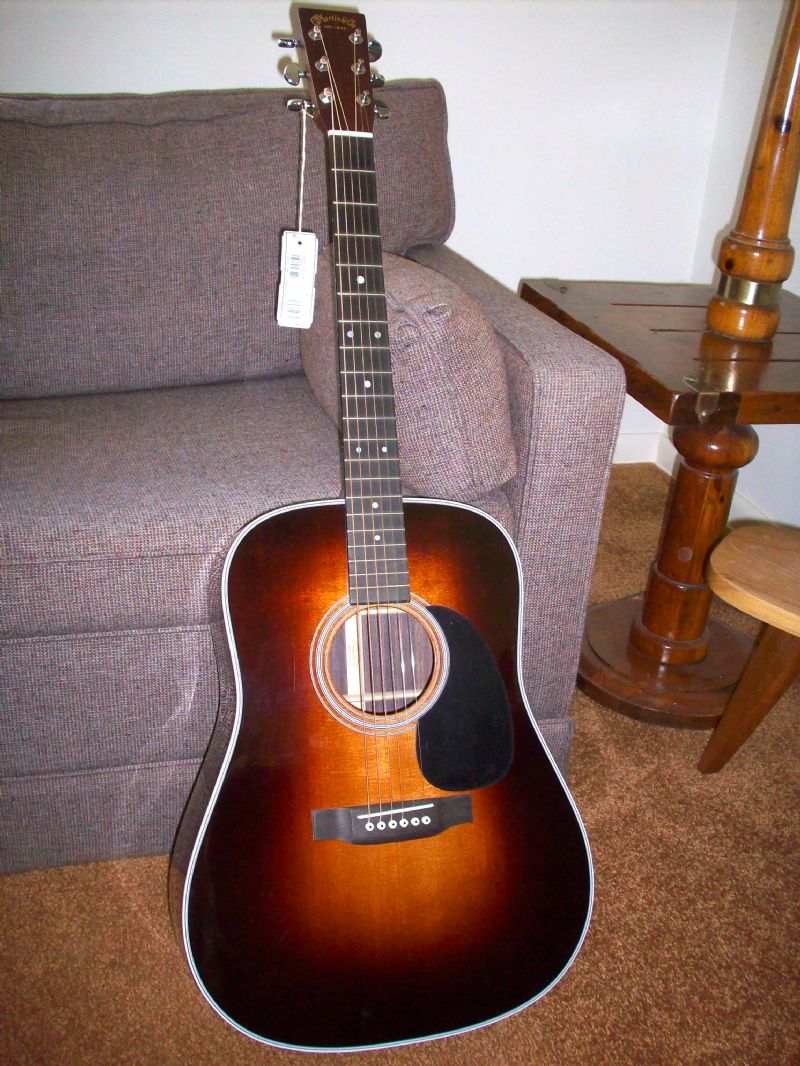
Hey Greg, nice guitar. Pretty sunburst on that D-28 too! Hope it sounds as good as it looks, and it should. Always liked the Martin D sound, especially after they mature a bit and get played in. Good luck with it, and as always, enjoy! Makes a nice stage presentation too, if you don’t mind taking it on the road.
Have a blast!
Greg, congratulations on the new Martin. 
Well, I’m not quite sure what you could mean by “overdone”. Fortunately, there’s no law of guitar tuning. There are some, like myself, who play almost exclusively in Dropped-D (for IRTrad). Others may play exclusively in DADGAD, or “Finn McGinty”, or something else. It’s all just playing guitar. Maybe I play too much guitar (!), but that has nothing to do with tuning. From my POV, I might say that playing in standard EADGBE tuning is overdone. 
But it’s not quite that simple. Tuning to Dropped-D may involve retuning the entire instrument for maximum consonance of Just fifths or fourths or other intervals for your preferred chording. Whereas for other non-modal musics I may just settle for ET (e.g. with a tuner) for more flexibility. If you’re tuning to Dropped-D as a complete system, and not just to give you an extended bottom note, it’s almost guaranteed that just dropping the 6th string to match the 4th is not going to give you the best result.
That said, I’ve considered installing a Hipshot tuner on the 6th string. This is basically similar in concept to a Keith banjo tuner. You set up two preset stops for E and D, then switch between them with the flick of a lever. It’s not ideal, but convenient if you do a lot of changing between the two on the fly,
I don’t think you are going to be happy with a Hipshot tuner MT, not if the above explanation is any indication of your tuning standards. If you do install one, I’ll be curious to know how you like it.
You’re probably right, Greg. Plus, I’m reluctant to make modifications to my Martin. But still, the Hipshot is a cool toy. And who doesn’t love a cool toy?
I use a hipshot D tuner. It is awesome, assuming you need to retune your 6th string between E & D. I change tunings a fair bit, so it’s perfect for me. You don’t have to make any modifications on the instrument, it is made so you can use the existing screw holes. Just pull out the old tuner & drop in the hipshot.
You can only use it on the low string because of the mechanism. and when you change strings, it takes a bit of messing around & retuning to get both the E & D in tune, but once you do, I’ve found it to be very reliable.
http://store.hipshotproducts.com/cart.php?m=product_detail&p=87
as far as the issues of tempering the whole instrument: I find that changing the low string alone doesn’t really mess up the whole of the instrument. Of course you can spend hours tweaking, but getting a guitar “in tune” is such a compromise anyway. If I’m happy with it in standard & I flick the lever, I’m generally happy with it in dropped d. This does assume the instrument is set up well with a good nut, etc.
I hope this wasn’t mentioned already, as I just skimmed this thread, but ..
John Doyle has an instructional video for playing Irish accompaniment on the guitar and I think on the video he uses exclusively dropped D. I used to own the video (lent it out…now its gone??) but it is a great video and has some great box playing by John Williams.
Thanks for your report on the Hipshot, matt. Very interesting!
I’ve played with John once, and he can and does use several different tunings (he also plays a mean guitar-zouki). But yes, Dropped-D is definitely his signature sound.
He also tends to use a very heavy D string - actually a bronze D from an acoustic bass set. Of course, that requires a custom nut, saddle and neck setup. I’ve tried a slightly heavier sting, but find I’m satisfied with a standard .053 on my instrument.
Yes, the Madfortrad video is unfortunately no longer in print. But copies can be had on eBay etc.
Yes, John uses a very heavy gauge string for the bottom D. I’ve heard it’s a .072. I’ve used a .59 from a squareneck resonator set for dropped D tuning which works.
Oh, the Hipshot tuners are made in two formats: one to replace Rotomatic style and another to replace Schaller enclosed tuners. If you have Waverly or other style tuners on your guitar then you may have to drill a new hole when you install them.
Feadoggie
I don’t care much for drop D but I do love open D.. That is DADF#AD, and I drop the F# to F for minor key and blues stuff. I keep one guitar always tuned to open D. The nice thing about open tuning is I can just play nothing without fretting . Three finger rolls up and down the strings and its musical… Brake away from the tyranny of standard tuning… Bob.
Then you must be a slide man too. A fan of Blind Willie Johnson? Robert Johnson? Lyndon John…ok, that’s enough. Am I right?
Yes, open D and it’s sibling open E are great tunings. And frequently are used as the basis for slide guitar - both bottleneck and lap Steel styles. I keep my Weissenborn tuned in open D as well as a Spider bridge resonator. The Rolling Stones were just another bar band before open D came into their music. I could say more.
But drop D is quite useful as well.
I couldn’t agree more except I might prefer to break away, actually.
Feadoggie
One could just as well say: “Break away from the tyranny of open tunings!” 
I’ve known people to become mesmerized by the resonance of open tunings, and forget that you’re supposed to play the instrument, not the other way around. The “Hey, I can noodle anything and it sounds good” syndrome is just another kind of trap. Which is not to say that open tunings can’t be done very well and obviously have their place.
The key question is: For what?
Especially if you’re playing fingerstyle, open tunings can be great, offering up patterns and harmonies that you might not otherwise exploit.
But for percussive Irish backup guitar, where you’re playing the instrument as a sort of hybrid drum-and-chord thingy … well, there are reasons that Dropped-D, Standard, or DADGAD tend to be tunings of choice.
I tend to switch to Standard for hornpipes, for easier access to stride patterns and Dom7 voicings. And just listen to Andy Cutting for examples of what can be done with Standard tuning for rhythmic backup.