The other problem with extra holes covered by the thumbs is that when you want to use those notes you have to remove support of the instrument at that point and make up for it some other way. So, it is doubly problematic from an ergonomic standpoint. In imposes severe restrictions on the placement of your support points even when you are not using the note, and then it forces you to remove a support point when you are using the note. That is pretty bad.
You keep telling me that it isn’t a problem as if you think I haven’t actually tried it. Well, I’m telling you that it is a problem, both in theory and in practice. I’ve given some indisputable reasons for why it is a problem. Often, with ergonomic problems like this, you don’t pay the price until much later, when you either encounter limits in your ability to push your technique beyond a certain point, or worse, you develop overuse injuries. It is worth paying close, and individualized, attention to ergonomics.
With closed standing F keys, you don’t have to learn to use both of them. You can learn just one if you like, or you can choose to not use them at all and just play as if it was a keyless instrument. So there is much more flexibility in how a player transitions to such an instrument.
And yes, Boehm did rework the design of the 8-key flute, making all kinds of changes, but very few people choose to use a Boehm flute for ITM despite ready availability of inexpensive Boehm flutes. Many reasons influence our choice of instruments, and the Boehm flute is not considered an improvement over the traditional conical bore 8-key flute by the vast majority of ITM players. And again, yes, most of us have tried, but just find that it doesn’t suite the purpose as well.
Not sure why my opinion would be relevant on this, but I personally like as large a bore as possible, and with a fairly large windway. I want to run out of breath frequently, because I find that it helps with phrasing. I also find that larger bore whistles tend to be better at varying their dynamics (but this could be purely coincidental based on the particular whistles I own).
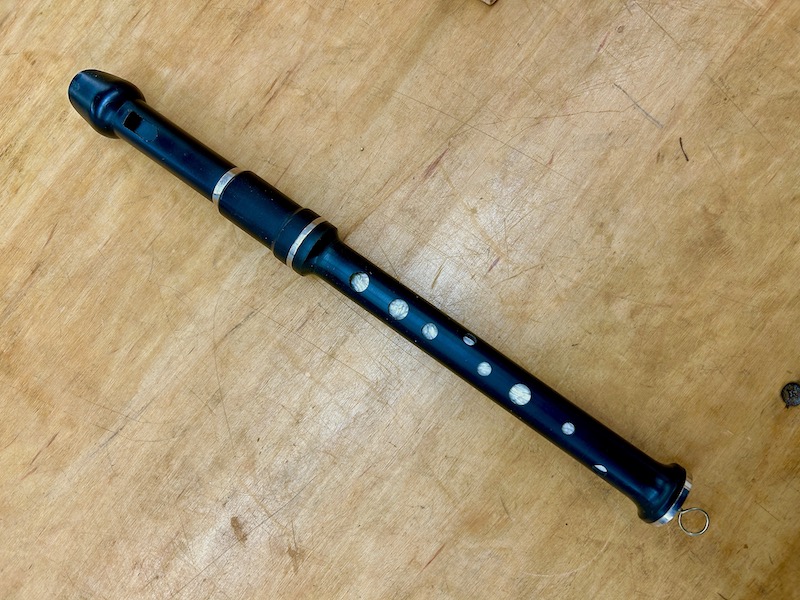
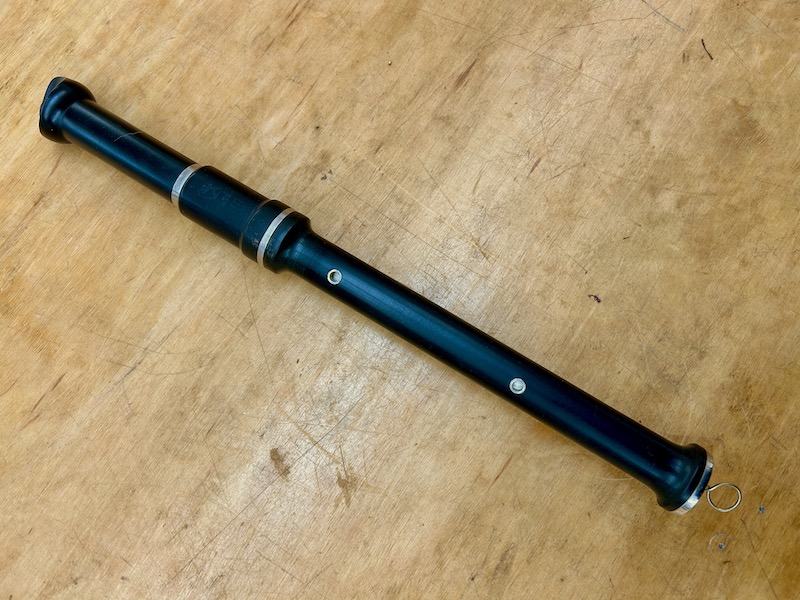
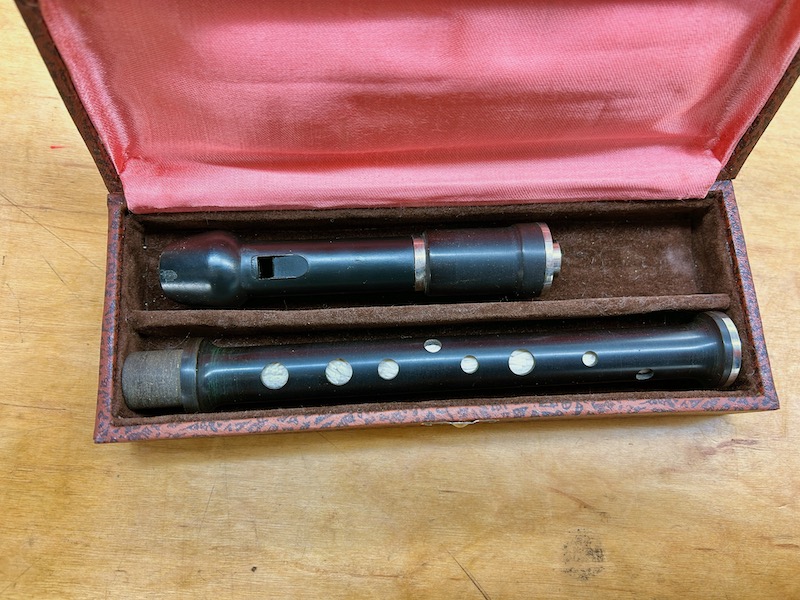
David, FYI the Sopilka that I have, which is more or less the same instrument we have been discussing, but pitched in C, has a bore of 14.8 mm. This is a nicely made, CCCP era instrument, made of ebonite. It has a large cylindrical bore and quite large tone holes, and has quite a nice sound. It even has a tuning slide.
Historically, the Sopilka had fewer holes. These 10-hole, fully chromatic, versions were invented in the 1960s. I got mine a few years ago on eBay, used. I bought it to satisfy my curiosity and because I was also experimenting a bit with adding extra holes to whistles. My guess is that this one is at least 40 years old.
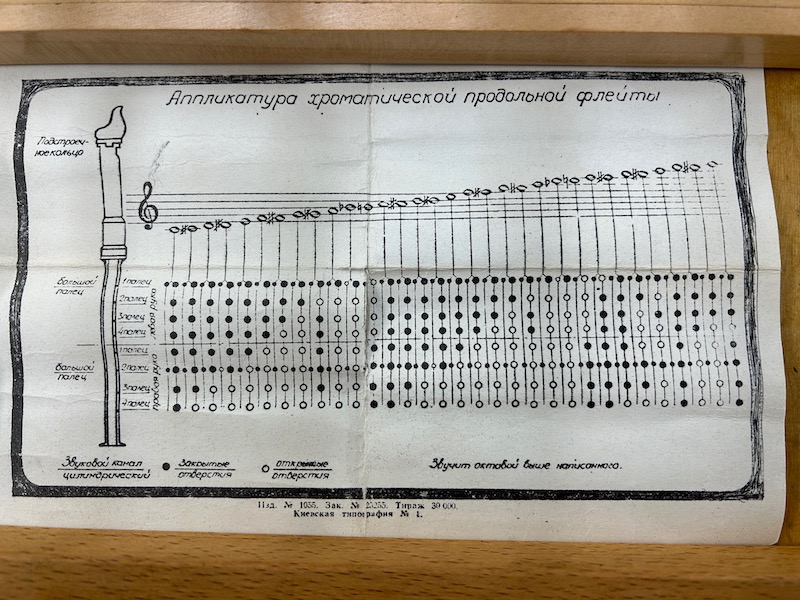
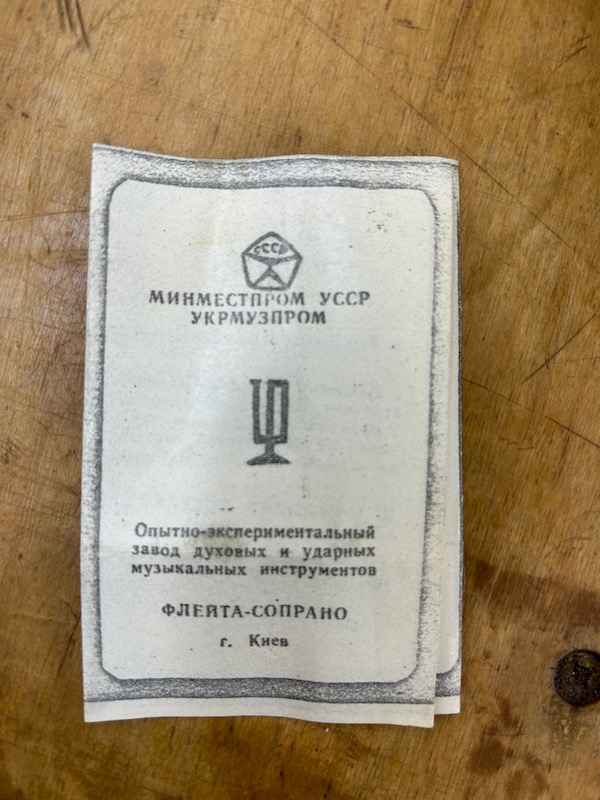
Here are some pictures of the instrument and some of the documentation that came with it, just in case it is helpful to you. I placed its white cleaning stick inside the bore to make the tone holes more easily visible.
In terms of ergonomics, I find that the thumb holes are out of position, compared to where I would really like them, by over an inch. So it really does have an impact for me.
I’m curious how the fingering works on that instrument. Can A, B, and C sharp be fingered with the left pinky down? Is cross-fingered C natural possible?
Note that this instrument is in C, so I’m going to assume that your question is asking about the A, B and Cnat notes as they would be fingered on a D instrument. Yes, the A, B and C notes are best in tune with the left pinky down. The hole for the left pinky is quite small, though, compared to the size of the other tone holes, so when it is uncovered it does not add a whole lot of venting. The intonation of those notes does seem better with it closed though. But this highlights the wide array of design choices with such instruments. Each note must be tuned based on a set of assumptions about which of the lower tone holes are covered or uncovered. As you add more tone holes you multiply the number of possible options, and each one is a separate fingering system that the player may have to learn. It is difficult to standardize this without it becoming an ergonomic problem for someone.
A cross fingered Cnat note (which on this C instrument is a Bb) is available, but not using the standard whistle fingering of 0XX 000 (ignoring thumb holes). The top vent hole is very large, so it pushes the note way too sharp when fingered that way. However, it does make it very easy to half-hole a Cnat, and that is an approach that is quite commonly used by Irish whistle players. John Sindt’s whistles are (used to be) tuned based on the assumption that you would half hole Cnat, and some people dislike this.
You can get a cross fingered Cnat on this Sopilka by using the pattern X0X 000, and opening the upper thumb hole. But experimenting with these options just reinforces my opinion that it is really awkward every time you have to release your support of the whistle to play a particular note. I find that it complicates things greatly.
Very interesting! Thanks for the info. Now I’m wondering if 0XX 0XX works for C natural (this is my preferred fingering) or even 0XX X00.
As for your continued remarks about the awkwardness, I’ll just reiterate that Ukrainians don’t seem to have any issues with this, and I doubt they’re all superhuman.
Ukrainians don’t play Irish traditional music on these! Different music has different requirements. And the traditional Ukrainian Sopilka didn’t have 10 holes like this. This is a modern invention to try to make it fully chromatic. No doubt the traditional instrument had better ergonomics, and this was likely a strong contributing factor in it having stood the test of time. If you study the evolution of musical instrument design you see that ideas like this come up frequently, but often don’t stand the test of time, for reasons that were not anticipated by their proponents. I think that is basically the discussion we are having here.
I played this for less than five minutes in order to answer your questions, and honestly had to put it down because of hand cramps. The problem for me is that the thumb holes are way too low down on the tube for my hands. For me, they need to be an inch or so higher up. If you look closely at the pictures you will see that the holes are already very small, and lined, and as high up on the tube as reasonably possible given the acoustic constraints. This is a real issue, and if the holes are in the right place for one person they will be wrong for someone else. Everyone’s hands are different. The conventional whistle design, with 6 tone holes on top, is very forgiving in this regard. Most people (but not all) can adapt to it. I do not think that is the case for these 10-hole designs. They are far too constrained.
But if your criticism about its supposedly being so inherently non-ergonomic were accurate, we’d expect Ukrainians to have just as much difficulty as you did. There’s nothing magic about Ukrainian folk music that would make people’s hands cramp less. If anything, they’d cramp more, because Ukrainian music uses more chromatics and thus requires more consistent use of more fingers.
Also, different people have different problems, I suppose. I played a whistle with an even lower thumb hole for years and my hands never cramped (they were slightly uncomfortable for a few days of playing and then I adjusted and it wasn’t a problem).
I see no evidence to support the argument that all Ukrainians can play this without having problems, or even that most can. The only evidence you have offered is that you yourself can play a whistle like this and have yet to experience hand problems. It is also clear that some Ukrainians can play their music well on this instrument, but the requirements as ITM are different, particularly with respect to fast finger ornamentation. I have no idea how proficient a player you are of ITM, so I don’t even know if your playing is at a level where you are encountering the limitations yet. So I think you have presented a very weak argument to support your claim that this should be a standard offering. I do have first hand evidence that it doesn’t work at all well for me, and I’m able to give clear reasons for why, that are inherent to the design. Also, there are a massive number of whistle players playing Irish Traditional music who have no problems with the conventional 6 hole design, so as a maker I have no difficulty in deciding which design to make as a standard.
But like I said, nobody is trying to tell you that you shouldn’t like your own whistle. This is more about answering your questions about why they aren’t widely used or available from whistle makers. You are welcome to try pushing the idea, of course, but you don’t seem to be getting much enthusiasm from this community. Maybe you’d have a better reception in a Ukrainian music forum and can go into production and make your fortune selling these to Ukrainians.
Thanks Paddler for doing all that work to help. I notice the writing at the bottom says something along the lines of “test-experiment factory wind and percussion musical instruments”, which ties in with it being a relatively recent development of the instrument.
That issue of it causing discomfort may be part of the reason why the upper thumb hole is for B flat rather than A flat - that’ll make it easier for the left hand. That said though, I don’t find it uncomfortable with my thumbs even a bit further down than holes 2 and 5 on a D whistle, but I’m not having to cover extra holes that way, so the way I end up having to apply pressure there may be quite different, and optimising the hole edge geometry may be important.
It’ll be relevant if I end up sending you one for evaluation purposes. I don’t know if import duty can be avoided by having an “Evaluation prototype” message embedded in the resin. Maybe I’d have to make it look ugly too, but that’s easy to arrange.
but I personally like as large a bore as possible, and with a fairly large windway. I want to run out of breath frequently, because I find that it helps with phrasing. I also find that larger bore whistles tend to be better at varying their dynamics (but this could be purely coincidental based on the particular whistles I own).
That’s good - I’m making 15mm ones at the moment for instruments in C, but I can narrow one a bit with another layer of resin.
That’s reassuring information as it’s closer to the size I had in mind. My only D whistle (Generation) is 11.5mm and I wondered if I should be aiming closer to that, but I like the sound I’m getting from my own 15mm instruments in C, so I was thinking of starting with 14mm.
Here are some pictures of the instrument and some of the documentation that came with it, just in case it is helpful to you. I placed its white cleaning stick inside the bore to make the tone holes more easily visible.
Thanks; that’s really useful. The thumb holes look reasonable for size, but I may make them a bit bigger by pushing them a very short way further down the tube. The fingering chart is useful too, and the top end may be important.
It likely won’t be soon though: bear in mind that I’ve only just started making prototype whistle heads, so there’s a lot of work to do there yet. These heads are going to be attached to quenas and quenillas using magnets (but the prototypes use Blu-tack and keep slipping), so they can be played as flutes or whistles. I’m getting superb sound quality from them over one and a half octaves with the prototype heads, but need to extend the range by refining the geometry and by making them more solid so that things don’t keep shifting out of place. An unconventional thing about them is that the heads don’t have a part that goes into your mouth at all, but instead you blow into a small chamber in the end which directs air up into the windway from below, so it’s more like blowing into a tube pressed against your lips - I wasn’t sure this would be viable, but it works brilliantly when you get the entrance hole the right size and shape.
Actually, I’ve hit a snag, so I may have to make more conventional mouthpieces instead. Once all the leaks in the head were sealed up, I found there’s an unwanted hiss. You can replicate this on a standard whistle too by directing a narrow jet of air into the end of it from your mouth, and I realise now that you normally breathe into a whistle rather than blowing into it. When I was testing things before, I was putting the whole thing in my mouth to stop air escaping out through some gaps and the sound was fine, but now that I’m blowing into the end properly with the gaps all sealed, the hiss shows up. Opening your mouth wider helps to avoid that, but you then need a wider mouthpiece, so I’ll have a go at that next. This matters because I’m using resin to make everything, and although it’s a food-safe type which some adventurous people are using to mend their dentures, I still don’t trust it enough to want to encourage anyone to put the stuff in their mouth, which is why I’m trying to develop an alternative kind of mouthpiece. The other option is to use some other kind of material, but I want to avoid that as it’s quicker to work with moulds, and more affordable for the customer. Maybe 3D printing’s the answer, though I’m not sure that stuff’s safe to stick in your mouth either.
Depends on the material you 3d print with. The most common, PLA, is a sustainable bio-plastic polymer typically made with corn starch or sugar cane and most reputable makers include an MSDS on their websites. It’s also used in things like clamshell food containers and medical devices. I figure it’s as safe to put in your mouth as any number of plastic whistles we buy where we have no idea the composition of the plastic that is sourced for the construction.
If there’s a big concern, companies can go through FDA testing to get certified “food safe”, and a number of PLA manufacturers have gone through the exercise. You can read about some of them here: https://all3dp.com/2/food-safe-filament-brands-compared/
Prototype #6 has just solved the problem: the mouthpiece now has owl-like ears/tufts which make it easier to keep your mouth open wider and still seal the gap when pressed against the edge, so no more hiss. I’ve got a good two and a half octaves from it too for the first time, and I can play it at the same speed as a normal whistle, so it’s now viable, and no further need for me to worry about whether food safe is actually safe or not.
Good point: old plastic whistle heads may be unsafe, and likely to be worse by the year, while no one’s likely to have tested them to find out. Bottled water has a use-by date not for the water, but for the plastic, and I read something the other day about there being quarter of a million particles of “carcinogenic” particles in every bottle. Even so, it’s highly unlikely that it’s causing a detectable or statistically significant number of deaths and diseases. I just need to be extra safe as I intend to market my instruments to children in connection with a book.
I’ve made a chromatic quenilla in C, starting by making the standard 6 top holes before adding the extra four. The quality of the bell note did sound better before adding those extra holes, but that may be primarily because it’s harder to cover all ten holes fully, so the problem may be tiny leaks. I’m working on adjusting the shape of the tops of the holes to make it easier to cover them reliably (the tube has thick walls, so there’s plenty of scope to improve things) - part of the problem was in not knowing how much to offset two of them to the sides, which is something which may vary a fair bit for different players, and if you get it wrong, it affects the placements of other fingers too. Now that I know which way to move them to improve comfort for me, the next one should be better. This one is playable though, so I’ll stick with it for now and take time to get used to it.
All ten holes are visible at once when viewing from the top because the two underneath are directly below standard holes #2 and #5, and they’re a lot smaller. I made the standard holes big in order to maximise the size of these smaller holes (holes on the top: #1=9mm, #2=9, #3=9, #3.5=7, #4=9, #5=11, #6=9, #6.5=8mm), and it was a good thing I did as both of them came out at only 4mm, but the sound quality of the notes they produce is good; better than half-holing. In flute mode it’s very hard to uncover the hole under the lower thumb as the instrument becomes unstable, but in whistle mode (with a mouthpiece attached) it becomes a lot easier as that provides more support.
Can I play it like a normal whistle? Yes - it’s a little extra trouble having those extra holes there as it seems to need extra pressure to keep them all closed, but that’s maybe because the placings aren’t optimised. The lowest hole doesn’t need to be covered all the time though as it barely affects the tuning of other notes. When playing that Turkish dances thing that James Galway’s keen on (you know the one: diddle-liddle , dum _ diddle-liddle , dum _ diddle-liddle , diddle-liddle diddle-liddle , dum _ dum dum , dum dum dum dum , dum dum dum dum , dum dum dum dum , dum _ diddle-liddle , dum…), you can play the first diddle-liddle (E D C# D) without covering the lowest hole at all. I can play most of the piece using half-holing just fine, but it’s definitely easier on this chromatic whistle. There are two awkward bits in the piece though where multiple half-holed notes occur in succession at speed and it’s hard to get them all in tune reliably (or you can use awkward and ugly forked fingerings instead), and that’s where this chromatic whistle really scores, because it forms clean, accurate notes for them that sound good, though it’s going to take me a while to adapt to the new fingering to play those bits at full speed, but I like it: this is definitely a weapon worth exploring if you want to play music that goes off piste.
So, I need to make them in D next, and although the one in C can play with ease in the key of D, you’re still going to want to play pieces with fingerings you already know well, which means you want a range of chromatic whistles just as you want a range of normal ones. One nice thing the new lowest hole does is allow you to decorate D by covering and uncovering the lowest hole repeatedly at speed without the risk of covering it too much. [Edit: actually the effect is so small that it’s mainly just affecting the sound by wobble, so it’s still better to use the hole above for decorations.]
I’m also still doing a lot of work on whistle head designs to try to nail every aspect of that, but the tone these things are producing already makes my old Generations sound poor, so I now understand why people go to so much trouble to tweak those. I’ve made one head that allows quiet playing at night that won’t disturb anyone else in the house, so I want each of my instruments to come with two whistle heads for different playing volumes. I’m trying to work out a way to mass-produce the parts while being able to adjust the windway position and alignment to tune it to a specific instrument before setting it in place.
Thanks for this update! I have a few random thoughts about this chromatic whistle issue that I thought I’d share.
First, I wonder if the fact that this is a quenilla rather than a whistle affects its playability as a chromatic instrument. I know nothing about playing quenillas, but my understanding is that they are very thick, have a large bore, and have very large holes compared to a high D whistle. So I can understand how it might be more difficult to seal all the holes on them. Moreover, with a whistle you get extra stability when you hold them, because the fipple is firmly within your lips, and that restricts the whistle a tiny bit and helps hold it up/in place. Since this isn’t the case with the quenilla (as I understand it), I can imagine it being harder to use the chromatic holes without losing your grip or the instrument sliding.
Second, the more I think about it, the more I see the rationale for a left-hand G sharp thumb hole instead of the pinky hole. Obviously, you’ve decided on your design and I’m sure it works great. But there are a couple of things that made me think that the left-hand G sharp thumb hole idea might make more sense than I originally thought. For one thing, I’ve leant my Morneaux to many people and none of them seem to have any trouble covering this hole while playing; this makes me question my assumption that many people might find it impractical/non-ergonomic. For another, a whistle could (theoretically) be designed with an angled hole and/or an inner channel (like on the Carbony low D) that could move this G sharp hole up the tube and make it more playable and more ergonomic. Finally, I’m not sure there’s really any point in having a thumb hole for B flat, because B flat can always simply be cross-fingered. I initially was thinking that a B flat key would be useful on low whistles, and since the design should be scalable, it would make sense to make a high D whistle with a B flat hole instead of a key. But since then, I’ve tried cross-fingered B flat on multiple low whistles, and it seems to be relatively in-tune and has a decent timbre. And it works fine on high whistle too. So don’t you think maybe it’s needless complexity to have a B flat thumb hole? Maybe a G sharp thumb hole, like what I have, makes more sense after all.
Third, I’m curious if other cross-fingered options open up when you add the extra holes. I’m guessing you added a bottom hole so that the instrument could play down to a whole step below the tonic, correct? Does having this extra hole allow you to play a cross-fingered G sharp (or I guess an F sharp, since this is a C instrument), like XXO|XXX|X ? [EDIT: oh, I see, it looks like maybe you made the bottom extra hole a C sharp hole after all. Makes sense.]
If you cut off the fipple end of a whistle at the top of the window, the lower part is essentially a quena/quenilla/quenacho (the difference between the three being the size). I’m making adaptors which are like the cut-off part from the top of the window upwards (which is essentially just the windway and endplate to seal the top of the tube), so I’m making quenas that are also whistles, and I call this type of instrument a kenny whistle. With the whistle adaptor fitted, it becomes more stable to hold, just like a normal whistle.
(The inner “bisel” (bezel) of the wedge is normally parallel to the windway in a whistle, while the external bisel (ramp of the wedge) slopes outwards, but my quenillas are slightly different from that as the internal bisel slopes inwards a little while the external bisel still slopes outwards, so I have the windway pointing slightly down to be closer to parallel to the internal bisel, but this makes no significant difference beyond making it more playable in quena mode - it’s just about providing comfortable directions for blowing the jet of air for low vs. high octaves.)
I’ve continued to modify the external hole shaping to make it easier to seal them all without needing excessive pressure and it’s working fine now - it’s become a really comfortable instrument to play. Again though, this suggests that the buyer and maker may need to work together to tune the shapes to the individual player, which pushes the cost up a bit, unless the buyer learns how to do their own shaping - it’s mostly about feeling where a finger is having to press too hard at one edge of a hole and removing material from there to let it settle further in without so much discomfort, thereby enabling a better seal at the opposite side. With a thin-walled whistle, you can’t make such alterations, so you need to get the hole placement absolutely right for the player first go, and that’s precisely why I made this prototype with thick walls to guarantee that I’d end up with a playable instrument.
Second, the more I think about it, the more I see the rationale for a left-hand G sharp thumb hole instead of the pinky hole.
I’m puzzled by that, because I have both of them, and I like them both too: the pinky gives you a good F# (on the C whistle) and the thumb provides a good G# with superior quality to the cross-fingered alternative, so it isn’t a question of having one or other.
Obviously, you’ve decided on your design and I’m sure it works great. But there are a couple of things that made me think that the left-hand G sharp thumb hole idea might make more sense than I originally thought. For one thing, I’ve leant my Morneaux to many people and none of them seem to have any trouble covering this hole while playing; this makes me question my assumption that many people might find it impractical/non-ergonomic.
I find having the thumb directly under hole #2 is perfectly comfortable. By rotating the hand a bit it could potentially be moved even further down the tube and made bigger too and still be comfortable, so it might be worth doing that for an instrument with smaller holes to prevent the thumb hole being excessively small. I’m sure it wouldn’t be to everyone’s taste though to make that twist, and perhaps it’s unnecessary; what I think of as excessively small might actually work well enough on an instrument with smaller holes - I just like them big.
For another, a whistle could (theoretically) be designed with an angled hole and/or an inner channel (like on the Carbony low D) that could move this G sharp hole up the tube and make it more playable and more ergonomic.
This kind of thing would again suit 3D printing best where there’s a lot of potential for improving the ergonomics of low whistles without pushing the prices up. On these high whistles though where there are no stretch issues there isn’t the same need to have channels or angle the holes unless you’re trying to design something for someone with a missing or disabled finger.
Finally, I’m not sure there’s really any point in having a thumb hole for B flat, because B flat can always simply be cross-fingered. I initially was thinking that a B flat key would be useful on low whistles, and since the design should be scalable, it would make sense to make a high D whistle with a B flat hole instead of a key. But since then, I’ve tried cross-fingered B flat on multiple low whistles, and it seems to be relatively in-tune and has a decent timbre. And it works fine on high whistle too. So don’t you think maybe it’s needless complexity to have a B flat thumb hole? Maybe a G sharp thumb hole, like what I have, makes more sense after all.
Do you mean Bb on a D whistle or C whistle? There seem to be two ways to go with this and different players may diverge in their preferences. You can either have (on a C whistle) a thumb hole for Bb or G#, and my personal preference is for G#, but that’s not based on experience, and the designer(s) of the Sopilka clearly had the opposite preference. It’s no great trouble to offer both though and drill the buyer’s chosen hole on demand without adding to the cost.