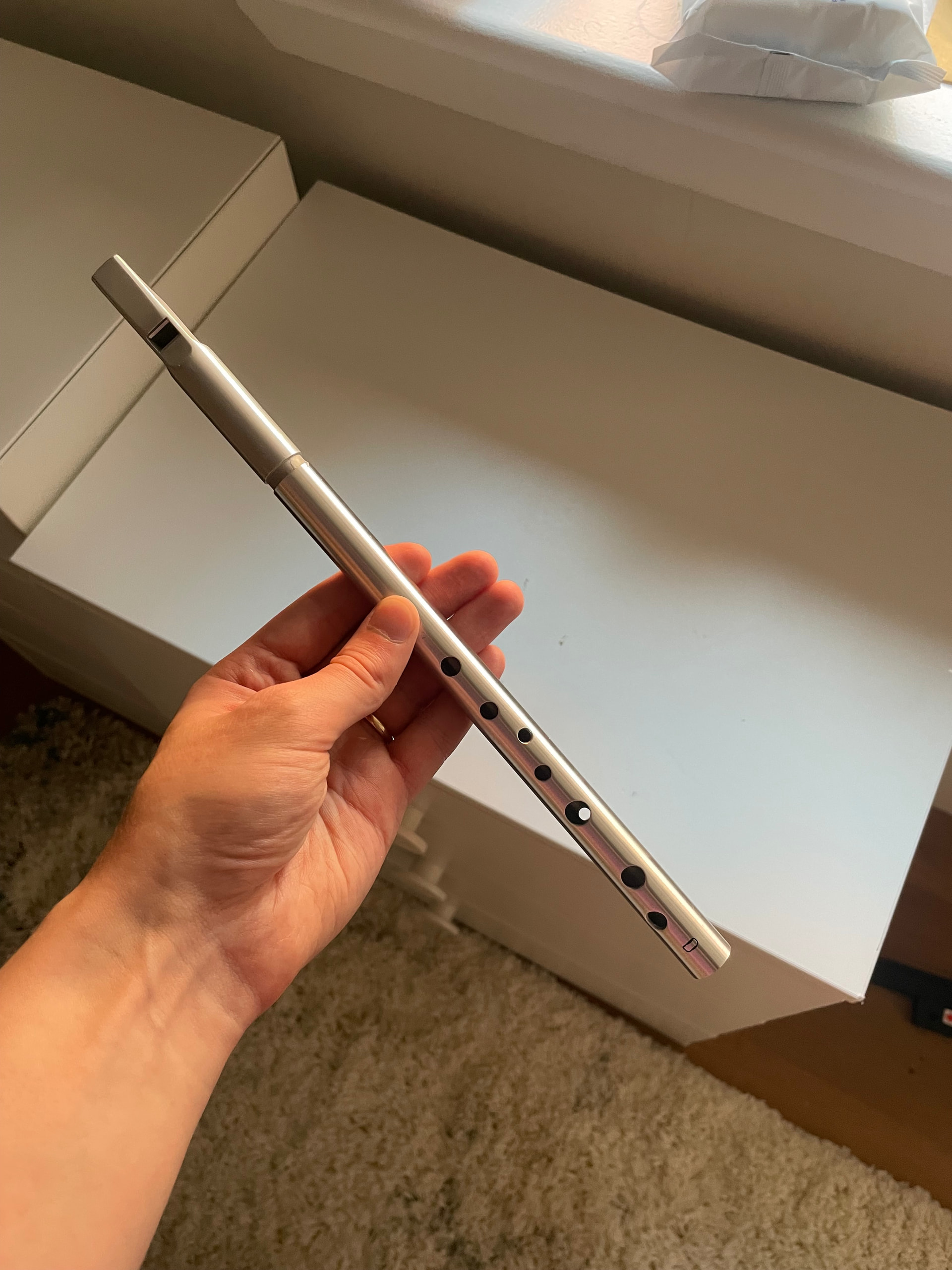
In short… Do you have an Irish flute? How are things going with half-covers? The answer is no. We have bad sound!
On elliptical holes, we maintain the shape of the hole by reducing it with our finger. Like a recorder’s bottom holes
On the Irish flute we get a thin gap - but the air doesn’t like that! This is a thumb hole recorder effect.
Therefore, on my Irish flute in D, I want to make the lower hole E elliptical as well! Like the top one. It let me the better control on D# and the 2-nd octave (like recorder’s thumb hole), when it’s necessary.
On half of my flutes (quenas and quenillas), “half” covering the lowest hole creates a better note than normal - it seems to hit a particularly strong resonance in the tube which makes half-holing that note extra attractive. I normally make my flutes with big holes though (e.g. 11mm for the lowest hole), so even when half-holing there’s still a good size of opening left, and all the notes work well that way. Making some of the holes more elongated would likely do no harm though, and should have benefits on smaller-holed instruments, so I’ll try it. Having elliptical holes aligned with their longer length round the tube should also enable big holes that are easier to cover, making more powerful instruments practical for people with thinner fingers, though it may cause a bit more disruption to air flow within the tube - not a problem for the lower holes, but such a degradation in sound quality may add up to a significant amount if it’s done for all five of the full-tone holes.
It’s exactly like a 10-hole fife except (1) it has a venting hole (which also functions as a back D) instead of a Bb/Cnat hole, and (2) it has a closed G# [EDIT: I’m wrong, it’s actually an open G# lol. I’m mixing up my terms]. So you have to cover G# with your pinkie all the time, unless you’re playing a G#. Kind of strange, but you get used to it very quickly.
I’d call that an open G# system, at least going by the nomenclature of Boehm flutes. On an open G# flute the keyed hole that vents G# is standing open by default, so you need to keep your pinky on the key touch to close it unless you want to play a G#.
Ah, excellent point! I always get those terms backwards. Yes, pancelticpiper, it’s an open G# system.
One question I have for you, paddler: I’ve read that Boehm originally used an open G# system, but are we certain of which kind of open G# he used? There are two different potential ways of doing it. One is as you described, and the other is making it so that the G# key flattens an A into a G# when pressed down (and is pressed down only for that one note). Of course, this latter approach would only work with a complex keyed system like Boehm’s - and perhaps it’s overly complicated in any event. But it gives you a fully vented A, which some might see as an advantage.
I never could nail down exactly which of these Boehm used. Are you sure it’s the one you’re describing?
If so, my new whistle is extremely original-Boehm-esque! Only F, Bflat, and Cnat are played differently from original Boehms.
If the G# key was operated by the little finger and flattened A to G#, then it would seem to violate the underlying principle of Boehm’s flute design which is that the first open tone hole fully vents the note (terminates the bore). This principle is why he needed the tone holes to be keyed, because to terminate the bore their size, relative to the bore diameter was too large to be closed by fingers. In other words, he was creating a flute that had no cross fingering (closing a hole below the first open hole had no effect).
Anyway, in Boehm’s system, the G# key stands open and covers a hole which fully vents G#. It is operated by the upper hand little finger. So to play G natural you have to close the upper three tone holes (all keys in Boehm’s system) using the upper hand index, middle and ring finger, plus use the little finger to close the G# key. If you don’t have the little finger down, then you get G#, unlike simple system keyed flutes which would give you G, due to the G# key having a spring that keeps it closed unless it is explicitly opened by pressing the key touch.
It is this difference in fingering, compared to the older flutes, that led to other makers modifying Boehm’s system to have a closed G# key. It works either way, but many players preferred not to have to make such a change to their fingering.
In Boehm’s book he describes his approach in detail, and talks about various advantages of his approach and discusses it compared to a couple of different closed G# mechanisms. He points out that with his open G# key the little finger must close the key for 21 of the 39 possible notes on the flute. In contrast, with the closed G# approaches the little finger is only required to open the G# key for 5 of the 39 notes. That sounds like a big win for the closed system, but he points out that the open G# key can have a lighter spring action than the closed one, and the open G# approach apparently simplifies the mechanism significantly. Significantly enough for Boehm to prefer it, I suppose, but the change in fingering required was apparently too much of a hurdle for it to win out in the long run for many players.
Anyway, both systems work and continue to exist. I view it as yet another example of how flute design embodies many trade-offs.
What I’m suggesting wouldn’t violate that. The G# key would flatten A to G#. If it was not pressed, the left ring finger key would hold it shut. Lifting your left ring finger would thus open two holes, sharpening a G to an A (fully vented). Closing it would close only the further up of these two holes, flattening the pitch to a G# (still fully vented). (If I understand correctly, this is exactly how the long F key works on Radcliffe system flutes - it flattens your fully-vented F# into a fully-vented F).
Anyway, good to know that this isn’t how it worked! I was always curious.
Okay, then the remaining question is: What about when you play A or higher? You still have to keep your pinkie lifted, right?
Because that’s not how my whistle works. On mine, even for notes above G#, you have to keep the little finger covering the hole. So A, B, and C# actually aren’t fully-vented. They’re technically played cross-fingered, because your pinkie is covering a hole while they’re played.
I asked for it this way specifically, because I have no problem resting my pinkie over that hole 99% of the time, and I find that much easier than learning to move it exactly in sync with my ring finger every time I shift from a lower note to an A (or vice versa).
So this is actually the main way my whistle differs from an original Boehm, come to think of it.
Or, in my case, for 2 of the 24 notes (this whistle doesn’t really have a third octave). Only the two G#s (one in each octave) require me to lift my pinkie. The only tradeoff is that I have to move my 3 main fingers on my right hand while keeping the pinkie hole closed. I find this extremely easy, so it’s barely a tradeoff for me (though I could see it being awkward for some people).
OK, I see what you mean. In this case you would have a different fingering for G# than either the simple system approach (which requires all four left hand fingers down), or the Boehm open G# approach which requires the first three left hand fingers down and the little finger up. In your case, G# would seem to require the first two left hand fingers down and the little finger down, but the ring finger up.
In Boehm’s case the key remains open. Since the tone holes terminate the bore it would not necessarily make any difference were it to be closed, but of course, the detail of how the key linking mechanism works would influence whether other tone holes were closed when the G# key was closed. The fingering charts state that that the key does not need to be pressed for the notes higher than (and including) A.
Yes, that would be a significant difference in the fingering.
For the sake of consistency with the way we have been describing the other systems, I’d say that your approach requires the pinkie to be used on 22 of the 24 notes, since the hole is open, by default, and requires use of your pinkie to close it. And as you said earlier, this needs to be done even for notes such as A and higher.
Hmm, you’ve lost me here. Under your terminology, a key that is normally depressed but is lifted for only 5 notes is “only used for 5 notes.” I’m using that same terminology, only I only lift my pinkie off the hole for 2 notes. So I’m not sure what you mean.
For a closed G# system (such as simple system flutes) the G# key remains closed under the pressure of its spring, so the pinkie finger is not needed for any of the notes that do not need the G# key to be open.
As we discussed earlier, your system is not a closed G# system. You pointed out that on your whistle the pinkie finger is needed to close the hole for all notes except for the G# in the first and second octave. Hence, it is needed for 22 of the 24 notes on your whistle.
You may be only thinking about the pinkie finger when you need to lift it. However, this is the opposite of the way the terminology we have been using so far in this discussion works. And opposite to how typical fingering charts work. When a finger is used to close a hole that would otherwise be open, that counts as using the finger.
So, I’m just pointing out that we need to be consistent if we want to make comparisons between these systems.
In Boehm’s open G# system (where the G# key is standing open by default) it is not quite as bad as your situation (i.e., pinkie finger not needed quite as often), because the G# hole does not need to be closed for notes A and above, as the first open hole terminates the bore. Hence, you can do what you like with your pinkie finger for those notes on Boehm’s flute, but not on your whistle.
The closed G# systems require the least use of the pinkie finger because it is only engaged to open the G# key for G#, and not needed for all other notes.
Think of it this way, someone who did not have a left hand pinkie finger would be able to play all the notes except G# on a closed G# system flute, whereas they would only be able to play G# on your whistle, and all other notes would be out of tune.
Oh, I see. I misread your original comment - you were saying Boehm’s original system required the pinkie to press down on 21 of 39 notes, and the modern one only requires it for 5. That makes sense.
I’d object to the term “not quite as bad,” because that assumes it’s a bad thing to have to cover a hole with your pinkie for most notes. I don’t find it bad or annoying at all. I just leave my pinkie there 99% of the time. (In fact, I prefer this to pressing down a spring-loaded key for G#.)
And also, if you think of things in terms of “how much does my pinkie have to movie” instead of “for how many notes does my pinkie have to cover the hole,” my whistle has an advantage over the original Boehm design. The pinkie simply doesn’t move nearly as often.
But I get what you’re saying. Thanks for clarifying.
Indeed, Boehm didn’t consider it a bad thing to require the pinkie to be use for 21 of the 39 notes, but on balance enough players did for the closed G# system to win out in the end.
But there are people who like the open G# system, and like you, do not consider it a hardship to have to keep the pinkie down. And when pancelticpiper introduced the term “open G#” into the discussion, I understood that he was alluding to the fact that he (as a closed G# player) did not find it very hard to adjust to keeping his pinkie down.
Anyway, my point was just to observe that the choice you made to require the pinkie to stay down even for notes A and above, pushed this issue even further along the spectrum, requiring the pinkie to be down for all but two of your notes.
One advantage I can see for this particular design choice is that it allows you to tape that hole closed if you don’t want to use your pinkie to cover it, and the whistle will then play like a more conventional whistle that doesn’t have a G# hole. Had the tuning of the higher notes been dependent on that hole being open, it would not be an option to switch off the feature by using tape in this way. Notice, I said “feature” not “bug”!

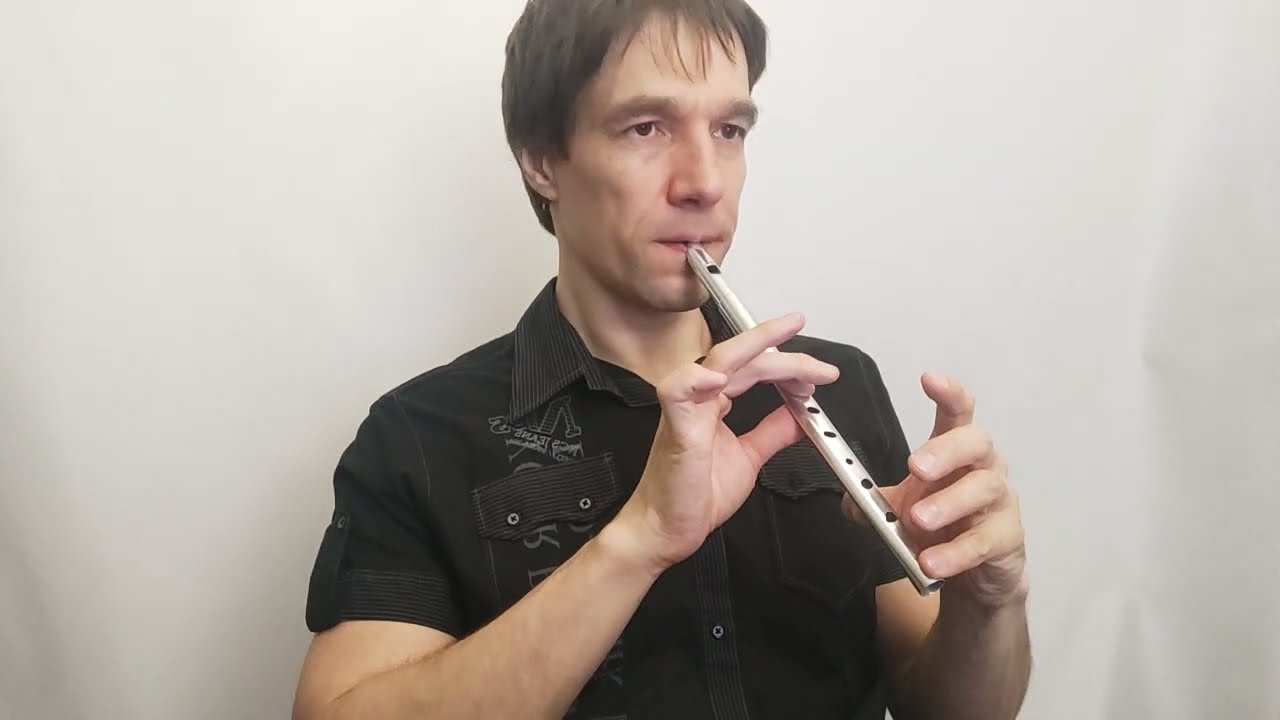

 Colin Goldie is such a boss. Fully chromatic, and with a venting hole for the right thumb!