In our ceilidh band our melodeon player writes a lot of our tunes for dances, the only problem is they tend to change key from A parts to B parts usually from G to Dm or Dm to G
Yes I know I could half hole the F nat but at speed playing EFG FEF as an example I can’t get the accuracy on the F, this really showed up recently when we were doing some recording and I had to use a C whistle on the Dm parts. Not an option when playing a gig.
So I’m thinking F nat thumb hole.
I can do this myself but just need pointing in the right direction as to where to start, basically where to put it.
Thanks for that DrPhill
I couldn’t remember the name of TWJCalc.
I expected it to be somewhere there so I’ll just have to get used to it. It’s only for a couple of tunes so it’s not like I need it for a whole gig.
When I’m trying to learn a 48 bar jig that goes from Am to Dm back to Am with G# accidentals then finishes in Am it’s crossed my mind, but they are great tunes and fit the dances perfectly.
Mary Bergin suggests an excellent exercise for half holed notes, C nat, F nat, and G# probably being the most common. Try transitioning from each note on the whistle to the Fnat, individually, i.e. B>F A>F G>F F#>F E>F D>F C#>F C>F . Once you get comfortable with that, try it sequentially, i.e. B>F>A>F>G>F>F#>F>E>F>D>F>C#>F>C>F. Once you are comfortable with that, you can try more complex transitions and such. Good luck!
Here’s a set with whistle/flageolet head, and piccolo head
Or you could put a whistle head on a piccolo body, probably.
Though through sheer practice you could probably get very good at half-holing. I heard an Asturian piper play loads of tunes with that minor 3rd, the equivalent to your F natural, half-holing them with astonishing speed and accuracy. It sounded like he had a hole drilled for that note. I saw his pipes, he did not. It was just skill. (The Asturian pipes can’t crossfinger the minor 3rd like the Galician pipes do.)
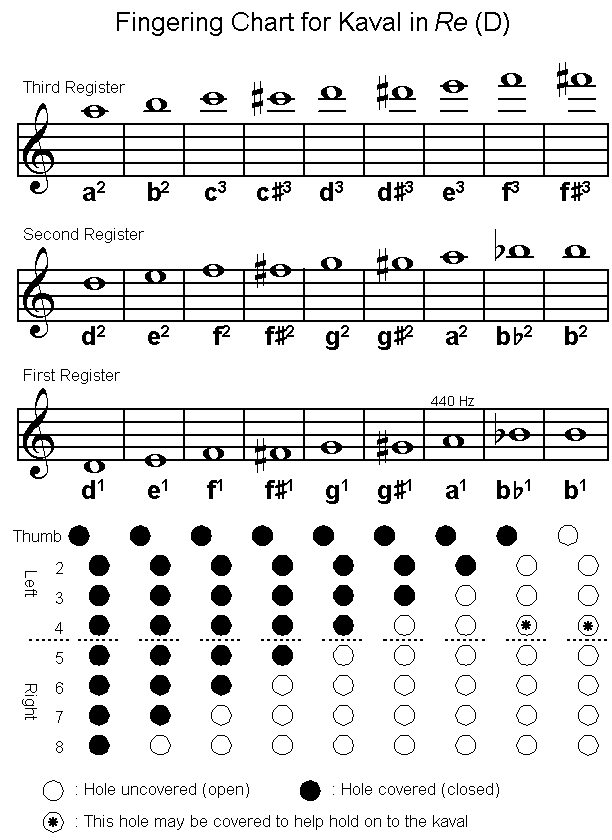
About Kavals, a D Kaval gives you, in the same range as a D Irish whistle, these notes, with no crossfingering or half-holing necessary, all of these notes having dedicated finger-holes:
(be aware that a D tinwhistle’s lowest note is actually the “D2” of this chart.)
I watched a TV program with a truly exceptional Japanese Shakuhachi player - I’ve never heard anything similar from any other player (I’ve not seen that many players though, but nothing I’ve heard sounds like that guy). He demonstrated how he played the Shakuhachi as a chromatic instrument, with half- and quarter holing, to be honest I’m not sure exactly what he did, but the Shakuhachi has only four holes plus a thumb hole. It’s a tricky beast to play.
Yes exactly, if I was doing those gigs I’d get one of them O Brien Whistle things. If it’s Boehm system, I’d prefer that O Brien head on a Simple System piccolo body.
Though I do wonder if a Low D whistle could be made with the Kaval-style fingerhole arrangement- it would have to be a rather narrow-bore Low D, because you’re playing in the 2nd and 3rd registers the whole time.
In folk music (whether English/Irish/Scottish) we tend to be a bit loose about the use of the word “minor”. Loose and usually incorrect.
I have to keep reminding myself of these things. We often talk of E minor and A minor, when in fact we mean E dorian and A dorian; I know, it’s easy to do. Though I’ve mostly stopped my self doing it these days, I still get people in sessions and band members referring to minors when they mean dorian. No wonder guitar players get so mixed up and new ones get things wrong.
This is true of the vast majority of trad tunes that we play that sound a bit “minor”.
I could try go into all the technicalities, but I’m not the best person to do that. This is a pretty good page dealing with the whole modal thing:
btw. You could replace every mention of Irish or ITM (Irish traditional music … not a contraction I’m too fond of) with “English” or “English traditional music” and every word of the article is still correct.
So, what you are playing in is D dorian not D minor, confirmed by the fact you can play the tune on a C whistle ie. F natural, but also B natural not flat as it would be in D minor.
PS. someone often comes in with the argument that a particular tune simply leaves out the B/B♭ so the tune could be D minor or dorian. My point would be that the starting point for most of the “minor” tunes in the tradition is dorian, and also that just because a version (or manuscript) of the tune leaves out the B doesn’t mean that every other one does.
\
I did go into a load of Melodeon based musings, but this is a whistle forum.
Or E Aeolian and A Aeolian. Or other modes. You’re just adding to the confusion by equating ‘minory’ modal with Dorian.
PS. someone often comes in with the argument that a particular tune simply leaves out the B/B♭ so the tune could be D minor or dorian. My point would be that the starting point for most of the “minor” tunes in the tradition is dorian, and also that just because a version (or manuscript) of the tune leaves out the B doesn’t mean that every other one does.
Since tunes sometimes also include the note that defines them as Aeolian rather than Dorian, my point still stands.
Just for clarification I’ve looked at the dots for Grassholm
A part is in Dm with one flat the B.
B part is in Em with one sharp the F
Here’s the ABC for those interested
X:1
T:Grassholm
M:4/4
L:1/8
K:Dm
D4 d2EF|G2F2 E2F2|D2d2 d2c=B|c4 c4|
d2D2 D2de|f2e2 d2e2|d2A2 d2fe|d4 d4:|
K:Em
e2B2 A2B2|A2B2 e4|b2c’2 b2a2|g2f2 e2d2|
e2e2 B2B2|e2e2 g4|1B2A2 B2d2|e4 e4:|2B2A2 F2G2|E4 E4|
Won’t a caret make it B-sharp, not B-natural? “=B” is ABC for B-natural.
I admit I haven’t read this thread carefully, but if your tune is switching from G to Dm, consider using a G whistle, which has both F-sharp and F-natural.
Sorry about that. Fingers went faster than brain. Was thinking (?) initially that the “^B” would sharpen the note, not that it would show as a B#. Thanks for correcting.
Point well taken, in that any sort of chromatic work, for a person used to diatonic whistleplaying, is going to take a load of practice.
But if the implication is that half-holing and keywork are equally effective ways to achieve chromaticism, a couple centuries of experience of many thousands of musicians, and my own experience, say otherwise.
My background has allowed me to experience the evolution of the flute in European music first-hand, because I started out on keyless Irish flute, then was for a time a Music Major at university on Baroque Flute (on which highly chromatic music is played with only one key, using a large number of complex fingerings and “rolling” the flute in and out), then played a vintage 8-key London-made flute for around 30 years (on which I used all the keys) and spent considerable time on Boehm C flute and Alto flute (with some Bass flute thrown in) plus a year or so playing a Radcliff system flute.
Putting 8 keys on the old keyless/1-key flute made chromatic playing far easier. The Boehm system makes it easier yet, much easier.
The outlier is Kaval. Unlike the Western European flute, which had to evolve in various ways to handle the new chromaticism, Bulgarian music has AFAIK always been chromatic, so their traditional flute is chromatic without needing any keys.
People can dismiss my Kaval suggestion out of hand, but the Kaval route enables chromatic playing with complete ease and facility due to the flute having a chromatic scale built-in. All one would need to do is put a whistle head on top, I would think.