I was just looking at the Glenn Schultz flute on Doc Jones’ eBay list.
I see that the starting bid is already close to $1000.00.
I was wondering (and I imagine I’ll get all kinds of answers) why flutes are so much more expensive than whistles.
Just to clarify, I’m not referring to flutes with a bunch of additional keys or those made out of silver. Just for comparison purposes, let’s consider a basic wooden D flute (no keys) and a wooden (although I don’t know of any out there but I’m sure there are) low D whistle. They are about the same size, have the same number and size of holes… The only difference is the head. There’s even a few makers out there that have interchangeable heads so the difference should be minimal. So why do you think flutes are almost always more expensive?
(By the way, I started on flute then picked up the whistle so I’m not biased either way)
Probably a bunch of reasons. 1st of all I think a low D wooden whistle would be significantly more expensive than a metal one. I’m sure there are wooden low D’s altough I can’t think of one right now. Appart from being very expensive to aquire, wood needs lots of seasoning, rereaming and stuff which takes lots of time. 2nd is prabably things like the embouchure hole, undercutting of tone holes and stuff like that which has to be done carefully by hand, takes lots of time. There are simply more feathures with a flute, like making the different sections fit, tuning slide etc. A flute usually has 5 sections (Rudall and Rose body) that needs to fit together with corc wrapping etc. Then they are conical, so are lots of whistles but I haven’t seen a conical wooden whistle yet.
For comparance, you might want to look at the delrin flutes and compair them to low whistles, the delrin flutes, which are amazing value and pretty similar to the wooden ones except for the material costs around $350-400, no problem finding a low whistle in that price range. There are also the cylindrical PVC flutes that goes for under $100.
That’s not entirely true. Wooden simple-system flutes all have, as far as I can tell, a
conical bore. This is much, much harder to make than a cylindrical-bore Low whistle.
(Someone correct me if I’m wrong).
There’s that too. Casey](http://www.caseyburnsflutes.com/ff.php%22%3ECasey) Burns’ Folk Flute is essentially what a wooden low whistle would be:
2 pieces, no keys, nothing too fancy in the head… and it only costs $250, which is probably
far less than a wooden low whistle would be (heck, most wooden high-D whistles are more
than $250)
Terry McGee has said he thinks whistle heads are much more difficult to make than flute heads (or something close to that although it could have been about rec***ers).
The one that is listed as being “developed from a Rudall & Rose 8 keyed flute dated 1837.” It is quite similar to his low D in finger hole size and spacing on my first glance.
YES, I found it on our front porch just now. The post office is soooooo stupid. We don’t have a doorbell, but I don’t think they even knocked. People were home and outside or in the living room ALL DAY!!!
Wow, that keyless Bleazey is more affordable than I expected… (at least, it will be when the
$ is stronger) I can’t seem to find on his flute page what materials he makes the flutes from.
Is it delrin?
“We use timbers which are not endangered and which come from managed sources, ensuring a sustainable supply for the future. We normally work in the following woods:
African Blackwood, Boxwood, Mopane and Yew.”
Phil doesn’t like working in delrin, he used to work with the stuff as an engineer in a previous life.
It’s also worth dropping him an email about his ‘used’ instruments too. He’s a thoroughly decent chap.
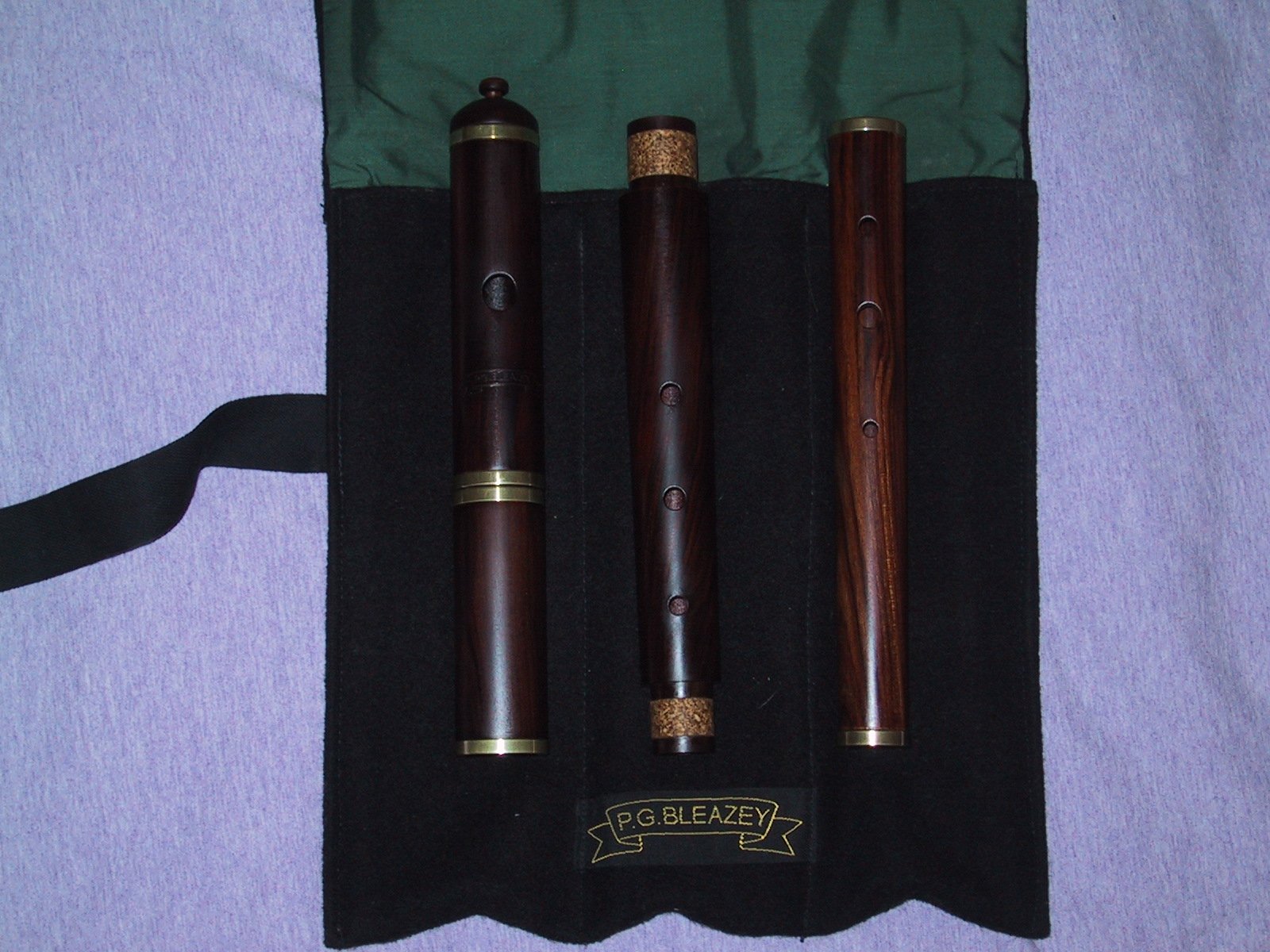
I’ve been playing one of Phil’s flutes for just over a year now (mopane, but with brass furniture unlike Steve’s silver). Tis a lovely flute. Here’s mine disassembled: http://www.gjk2.com/flute/bleazeyd.jpg
The Bleazey is a ‘short foot’ flute, so there’s no redundant footjoint with the open C#/C holes. By way of size comparison, if you click on the link below you’ll see the Bleazey D on the left is actually shorted than the Allan Eb (which is next to a Carl Bell Bb). http://www.gjk2.com/flute/d_eb_bb.jpg
(I haven’t embedded the images here, they’re quite large, but clicking on the links will bring 'em up in your browser if you’re interested!).
http://www.sweetheartflute.com/
Resonance Model Keyless Flute $325.00
Resonance Model Low Whistle In D $395.00
Extra Whistle Head $235.00
Extra Flute Head $165.00
For a high D
Chris Abell. D whistle $350
Skip Healy (didn’t he learn from Abell?) Piccolo (D) 6 hole - $325
Another thing that makes good flutes more expensive than low whistles is undercutting of the tone holes. That’s one place where the inexpensive flutes differ from more expensive flutes. It will make a subtle difference in the tuning of the octaves relative to each other. For a beginner there’s no effect at all, but once you can really push a flute, it may become noticeable and you might have to lip a little more than you would with an undercut flute.
Glenn Schultz’s flutes have undercut holes, as do Olwells, Grinters, etc.; Bleazeys and Sweets (at least the one I have) don’t; I don’t believe my old all-wood Burns did, either.
To add to your list - Des Seery undercuts, too. I’ll have to look at my Sweet - I think it’s undercut on some holes - but I’d have to check to be sure.
Could you define “undercut”? Is this cutting the holes smaller than usual (as in “understeer”),
or cutting from the inside of the flute (like “underwear”), or some other “under-”?
Undercutting tone holes is when instead of a straight hole into the bore, the maker cuts the bore side of the hole (but not the part on the outside) which effectively improves the tuning of the note in the upper octave without changing it in the lower octave.