Based on experience with a large number of instruments in different keys, and reports from others over the years (both makers and players) I think it is safe to say that the optimal bore aspect ratio varies both with the key of the whistle/flute and with its intended usage (musical genre). This has been discussed in earlier threads here, and I seem to remember even seeing a plot of the curve representing someone’s notion of optimum bore aspect ratio vs pitch.
That maybe Hans Brackers plot
1 Like
The quena has many of the advantages that the bansuri has in terms of tuning, those being quite large finger holes relative to the diameter of the bore, and having the “stopper” (the player’s chin) right up against the embouchure hole. If the quena has a bore that is not too wide, getting them in tune is quite possible even though they have a cylindrical bore.
Something that is also a useful trick (but I don’t see anyone doing it on metal whistles) is to use oval holes. I’ve done this with xiao in the past and it works very well. I had read at one point that the optimal location for a finger hole is different for each octave. So the optimal location for the second octave is going to be just a trifle farther down the bore that is optimal for the first octave. This is why “undercutting to the South” favors the second octave. So I made finger holes that spanned both of these locations. The difference in spacing between the two octaves was not huge–maybe a couple of millimeters–and by placing my finger holes just right and then making them into ovals I was getting great results in tweaking the two octaves into balance.
If someone is making wooden whistles, this would be easier to experiment with, but the holes can’t be too large because then sealing them (as ovals) becomes more difficult.
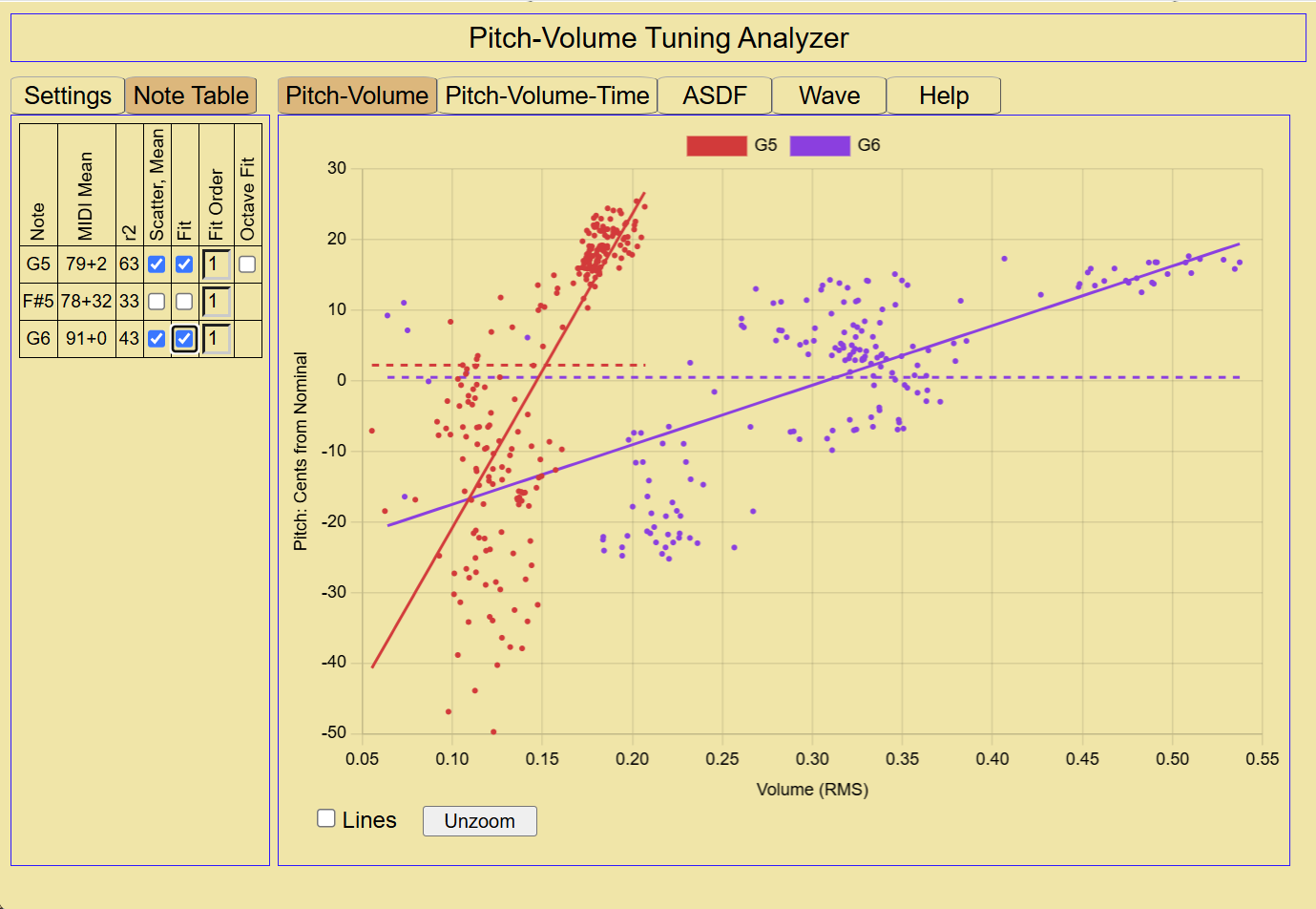
When I look at this, I see zones, not lines. Some zones are line-shaped and others aren’t. IE, I think what we’re seeing here is that the pitches changes on a step pattern, not a linear one.
I have a couple Burkes here, I’ll assure the bores that everything is going to be OK.
2 Likes
It depends on what is meant by “bore modification”.
The Overton lineage has the top of the bore pressed in on the sides, and my Goldie plays in tune in both octaves. But is that area the “bore” or the “head”?
In many whistles that portion would be part of the head, the bore being a simple tube. Where does the bore end? Where the windway begins?
Interestingly I made a Kaval from a piece of PVC pipe and it was in tune in both octaves. I don’t know why that works, a straight tube all the way through.
I think if it’s past the window, it counts as the “bore.”
Yeah, but it still shows you that the second octave is flatter most of the time the notes are played.
1 Like
The bore ends at the stopper, so the squashed part, which extends well beyond the stopper and window is certainly part of the bore from an acoustic standpoint.
Also, regarding the continuing confusion about cylindrical bores causing flattening in the second octave, let me reiterate again that the flattening is not due to the shape of the bore. The flattening is due to the open tone hole lattice being perceived differently by high and low frequencies when the tone hole size is insufficient to terminate the bore acoustically (which is the case most of the time).
This should be apparent by the fact that the first and second (and third) octave D are in tune, but notes such as high A and B are not. The D notes are vented by the cut off bore end, ie there is no open tone hole lattice below them. All these notes share the same cylindrical bore shape.
Hmm. If that’s the case, then why do flutes - even those with gargantuan holes - have the exact same problem?
Case in point: cylindrical Boehm flutes. They have a pinch in the head, which (I’m told) is to correct an otherwise overly-flat second octave. Yet they have holes that are so utterly massive that your fingers can’t cover them.
This depends on the whistle. It’s true that second octave D is usually in tune with first octave D, but I’ve played many whistles where this isn’t the case UNLESS you vent second-octave D - and in that case, it’s the venting that causes it to sharpen into tune.
Moreover, for many of those “flat second octave” whistles, it’s high E and F# that are egregiously flat. This is true on high D Susatos, for example. E and F# are flatter and less in tune than A, in my opinion (though maybe not as bad as B). This doesn’t necessarily contradict what you’re saying, but it does cut against it a bit, don’t you think? High E doesn’t have much of a “lattice” below it, and the E hole also tends to be quite big - yet it’s still flat.
I’ll also note that the tone hole size cannot be the entire answer, because (as I’ve mentioned), some low whistles actually have overly-sharp second octaves, even with no bevels/perturbations - low D Susatos are like this. And I don’t think your hole size explanation accounts for that - low Ds have, if anything, smaller holes in relation to their bores, so you’d expect them to be flatter in the second octave, not sharper. So it seems there must be that there’s also some kind of bore-to-length ratio thing going on, or some other factor, that’s changing the octave spread - not just hole size.
1 Like
They do not have the exact same problem.
The flattening in the second octave on a purely cylindrical transverse flute happens due to the portion of the bore that sits above the embouchure hole. This is a key difference between transverse flutes vs whistles and vertical rim blown flutes. The latter has no bore above the window or embouchure end.
Why this matters is that on a transverse blown flutes, the embouchure hole does not terminate the bore acoustically at the top end, and since it is not large enough to do so, the returning wave perceives it differently depending on its frequency, just like with tone holes. The high frequency waves, which, on their return, more readily pass the embouchure and continue up the bore, are thus affected more by the extra bore length above the embouchure hole, and perceive the bore to be longer than the low frequency waves do. Hence they are flattened more.
When you reduce the size of this top section of bore, by moving the stopper closer to the embouchure hole, you find that it brings the octaves closer together. Push it all the way to the embouchure and the tuning problem is gone, but the flute doesn’t speak well. The explanation for why this is the case on transverse flutes but not vertical rim blown ones is tricky. I have some theories, but they are probably beyond the scope of this whistle forum thread.
Modifying the head bore profile in a suitable way can offset this flattening.
2 Likes
This gets back to the very first thing I said, which is that the extra air flow required to push up to the second octave (which is dependent on head design) can be such that it pushes the second octave notes sharper than the first. This is behavior I would expect if you make the tone holes too large.
This observation also helps shed light on explanations for the other issues you raised. Once you realize that the harder blowing of the second octave can push those notes sharp, it should be clear that making a tone hole too big can exacerbate this, and making it too small can over compensate for this. These effects can be different for each note, since each note has its own venting tone hole.
A whistle maker must find the appropriate balance for every note, and when tone holes are sized such that they do not fully terminate the bore, the tone holes below the first vent hole also have some impact. So the equations that need to be solved for each note can not be solved independently.
2 Likes
Having spent several hours playing 32 Low D whistles over the last few weeks, a recurring theme I’ve noticed is everything being in tune except the Ds, with Middle D being slightly or more than slightly sharp and Bottom D being in tune or slightly flat.
I suppose it’s makers striving to get all the fingerhole notes in tune in both octaves, and it’s Middle D that gets left behind.
About sharp 2nd octaves, around 15-20 years ago when I had a half-dozen MK Low Ds they all had a slightly sharp 2nd octave, easily enough blown into tune.
The three Susato Low Ds I owned back 20 years ago had great tuning. A new Susato I have to hand at the moment has random octaves: a couple low octave notes overblow flat, a couple in tune, and a couple sharp. Thus the low octave is nicely in tune and the 2nd octave is all over the map.
1 Like
I think this is consistent with the assertion that blowing harder to achieve the octave jump from bottom D to middle D pushes the tone sharper. All other things being equal, this is what should happen. With all the other notes that have a tone hole vent, you can size and position the tone hole to help offset the sharpening from blowing, but not middle D.
If you don’t vent the top tone hole, then there isn’t much you can do about it, since backing off the blowing will cause an octave drop at some point.
If you do vent the top tone hole for middle D then presumably the fact that the hole was positioned to vent C#, helps to flatten the middle D. But I’m not sure how the wave balances the tension between wanting to resonate at C# in its top half and a bit sharp of D in its bottom half.
I do know though that if you push that top hole much further down the bore, it soon loses its ability to vent middle D effectively. I discovered this when making prototype flutes with a minor instead of major scale, and hence with a flattened 7th vented by the top tone hole.
Yes, this is the typical way that Baroque instruments and Renaissance flutes were tuned. I kind of hate doing it, because it is relentless work to get a whole instrument working… The flutes of Claude Rafi, a French maker of the 16th century, have particularly nicely undercut tone holes.
Depending on exactly where you undercut, you affect the second octave more than the first. (I think the rule is that undercutting the north side of the hole affects the first octave, undercutting the south side, the top… I may have got that the wrong way round) So it’s not a question of changing the bore, it’s a question of adjusting every single note. And even then, most Renaissance flutes need a lot of ‘lipping’ in and out to get the notes perfectly in tune.
I make them. I love listening to them, I loathe having to tune or play them! 
2 Likes
I discovered something today. When calculating the effective length of tube for the fundamental you calculate the end correction. From this, you subtract the calculated end correction number from both sides of the tube. The ususal end correction factor is 0.6.
SO… to calculate length of tube you first calulate the half wavelength of the fundamental frequency, then multiply 0.6xthe radius of the bore. The result gives you end correction. You multiply this x2 and then subtract that amount which gives you the cutting length for the tube.
However, the toneholes use a different correction factor (0.75) to tell you where to place the holes. This 0.75 factor I have been using to calculate my toneholes and each hole gets progressively flat moving up the bore.
Next instead of using 0.75 correction factor for toneholes, I used 0.6 instead. And to my surprise the finger hole placements calculations told me to move the holes further up towards the mouthpiece thus sharpening them.
I wonder if using the pipe end correction factor for tonehole placement (that is using 0.6 instead of 0.75) is an important piece of the puzzle to first build an instrument in tune to begin with.
Correction!!! using the 0.6133 correction factor for toneholes actually positioned the holes further DOWN not further UP.
@ He-who-dares How do the results of your hole position calculations compare with those from the various ‘calculators’ that use Arthur Benade’s equations? I think the most recent online one is Hans Bracker’s at Bracker Music As well as incorporating the influence of closed tone holes above and open tone holes below the one of interest the calculations are done in a way that avoids the complications that go on at the head end, which vary with head design.
(If you are happy to look at web page source for the details of the calculation the original Flutomat is an easier start)
Hi, my name is Marcus. I’m new here so I just saw that introduce myself. Hope you don’t mind me giving some advice as I’ve made whistles many of them over around 32 years.
I’ve made many whistles tune perfectly and although the bore can have an impact on the tuning of any whistle it has a lot to do with what shape length width size of the Embouchure or air window of the whistle head & the first and second octave pairing has a lot to do with the inside of the whistles airway. Usually it should be larger at first and then taper smaller before the “lip” angle /also the sharpness of the lip section or govern how quickly you can jump into the second octave from the first and if it’s too sharp, it’ll make the first octave two week because the second October kicks in too quick..ie: also is the embrochure area square or slightly triangular from the finger end to end to the other end ? This also has an effect on tuning between octaves … Among a few other factors these are the areas to play with in order to make a decent whistle 
I have used TWJcalc and the older flutomat (which i think is the bracker simplified version). I also used a plan on the internet which was instructions on how to build all keys. All of these calculators and softwares, plans have given me pretty much the smae results. But I have not tried the new braker calculator since it felt too complicated for me to use. I looks great though and I can appreciate the huge amount of work that went into it.
I have looked into the benade and other older resources but instead used the online instructions, calculators.
Thanks David, I will take a look at it
1 Like
Thanks for this MR reeds,
Valuable information there for me to experiment with. I have done many experiments in the past with position of fipple block but the other fators you mention are well worth investigationg. Thank you for your input