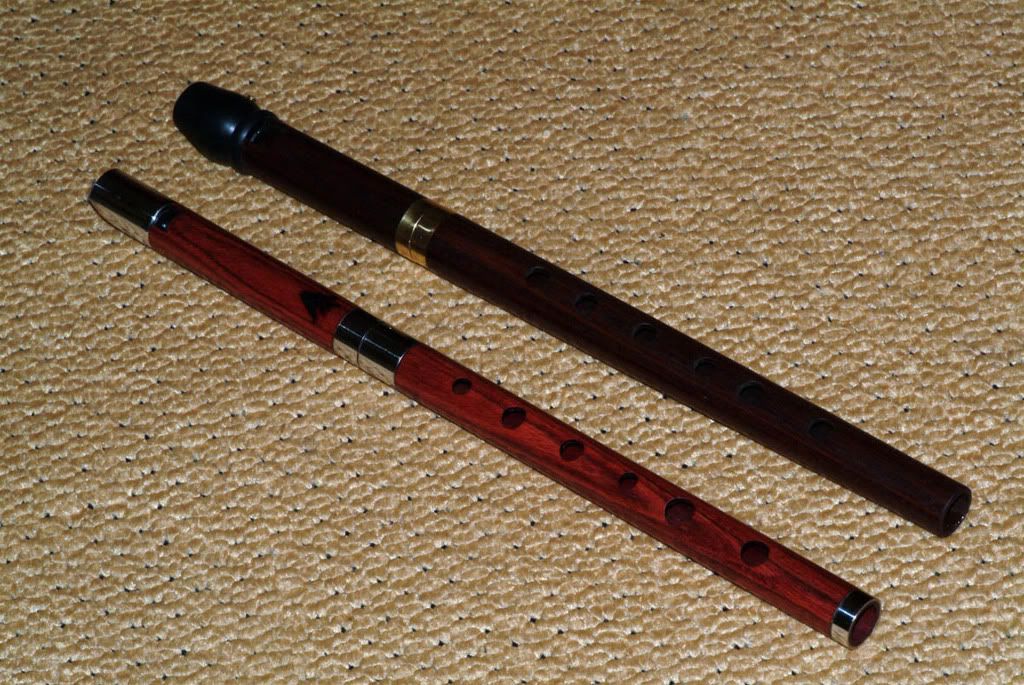
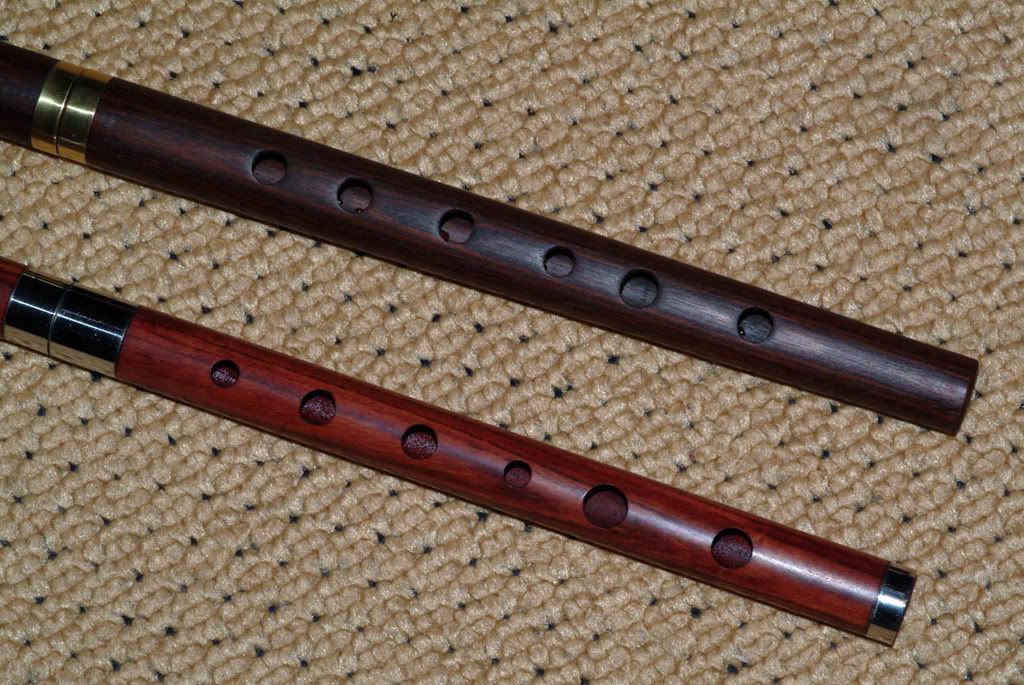
I don’t do these very often, but 2008 marks 20 years of making instruments for me. To celebrate, not only did I return to my roots and do a batch of wooden whistles in D, (Lancewood by the way), but I also learnt how to post pics of them. Here are what remains in stock after our festival season. Another small batch is well underway.
Brad, if we lived a little closer to each other you could have a go on mine.
I got one of Erle’s lancewood whistles a couple years back. It’s a nice piece of work and thanks to that brass pin in the head, it doesn’t roll off the table when you set it down. The tulip shaped head is a nice design feature. In case anyone wants to know. If you have played Erle’s Syn whistles but you want a wooden whistle with a similar feel - this is it.
I don’t know whether this particular lancewood is the acacia shirleyi . Australian red lancewood is Archidendropisis basaltica and I think thats what Erle uses (and also Terry McGee and Paul Serov, both ozzie flute makers).
Seeing as you are a wood worker I thought you might like to look into this and correct me if I am wrong. Ms Wren, the Botanist, is not contactable today …
Talasiga, as you can see by the photographs below, i lashed out and purchased one of Erles Lancewood whistles (wonderful whistle Erle!, i love the strong clear voice). I have compared Erles Black Lancewood whistle (Acacia shirleyii) with the Red Lancewood (Archidendropsis basaltica: aka “Dead Finish”) that i am soon to be sending back on the Anderson whistle tour. As you can see the red lancewood lives up to its name and is considerably lighter in color then the Black. Both are wonderful tonewoods, very stable and attractive. Hope this clears things up for ya
I’m sure those play as well as the tour whistle did several years ago. I’ll always remember how great that one was to play. Gives me something to dream about.
@shadowformz.
thanks for responding shad.
I am a bit confused now because the lancewood C whistle
I have from synwhistles is more a reddy/brown colour
(just like in the maker’s first post above. )
I also have a lancewood Bb head also (with alum. body).
The wood has a peppery smell.
So I took it that it wasn’t acacia.
But in your first post you referred to those reddy/brown
whistles as acacia whereas in your second post
you seem to be saying that the black lancewood is acacia.
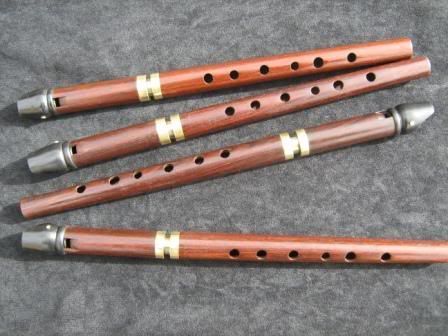
Tricks of the light I think talasiga, as far as the colours are concerned anyway. The whistles in the first pic are made from the same batch of wood as yours and in actual appearance are probably midway in darkness between the two pics. There is variation from piece to piece of course, but in general, the ‘red lancewood’ timber is much lighter and redder in its complexion. I understand that the batch of lancewood that I am working is an acacia species, but don’t have any experience or info myself on the red lancewood.
(The whistle in Brad’s pic is the one at the bottom in my original pic.)
This is important for me because at one stage
I was going to order a flute in australian lancewood
from a maker on the basis of my nice impression
with the lancewood in synwhistles.
 . Shore would like to have a closer look at one
  .
.