Well I’ll be darned, so it is!  Should have remembered the genus separation, can’t keep up with all the lumping and splitting of non-native invasive aliens.
I’m a lumper personally but I was just trying to show off. 
Here’s some more foxglove pics from last June.


None of the other pics were particularly close to where I live so here’s a pic of the cliffs near my house.

Bude.

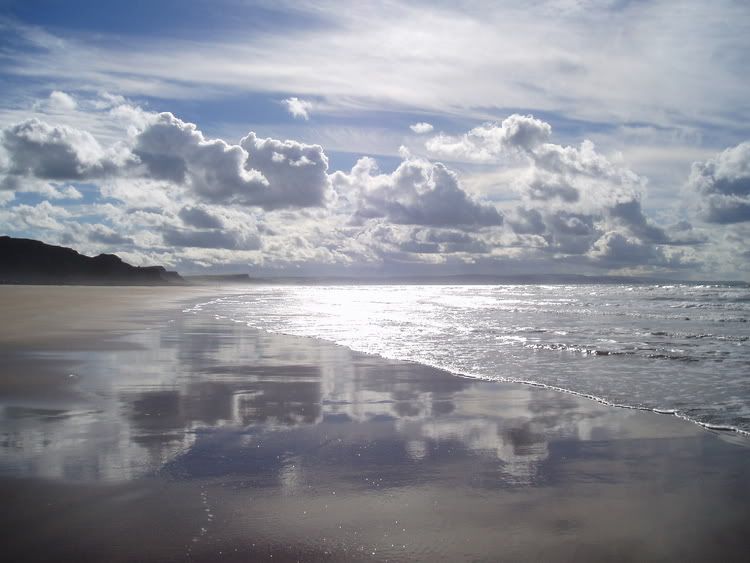
Beach a couple of miles away.

I got a “chive w/bee” left over from last year…

yeah, I know…I’m just tryin’ to convey the excitement level I’m dealin’ with here 
Well in honor of this thread I am going to make my wife cornish hens for dinner with fresh cranberry sauce, sweet potato risotto, and baked artichoke hearts with gruyere, plus a bottle or two of a blanc de noir brut cuvee, none of which have anything to do with Cornwall. BTW all my foxglove are just little yellow pills.
Ha, you’re just jealous of Cornwall’s superb cuisine. You haven’t lived until you’ve eaten a Crantock bakery or a Barnecutt’s pasty, to be followed by scones with jam and clotted cream topping. I’ll leave you to discover whether the pasty should be crimped across the top or down the side (one’s the Devon way and one’s the Kernow way), or whether the jam goes on top of the cream or the cream goes on top of the jam. And did you know that the word foxglove has absolutely nothing to do with our cunning bushy-tailed friends and everything to do with the fairies?
Here’s Gaia, in the Abbey gardens on Tresco, Isles of Scilly.

That’s me at the early Bronze Age monument Men an Tol (Cornish for “stone of the hole”) in western Cornwall.

Lanyon Quoit, a neolithic dolmen which has sadly been messed around with so much that it bears little resemblance to its original form, despite the best intentions of the Victorians. That’s the Ding Dong Mine in the background, one of Kernow’s most iconic tin mine ruins.

Reflections on Bude Canal, built to take shell sand from the Atlantic beaches inland to sweeten the heavy clay soils of the culm measures of north Cornwall and north Devon. My veg plot was similarly treated a hundred years ago, not by sand carried on horse-drawn barges up the canal but by the incredibly shell-rich sand from Widemouth Bay brought a mile uphill to my garden on innumerable donkey trips from the beach. Ah, cheap labour!

The view from Compass Point, just south of Bude, northwards up the coast of the Bristol Channel.

The beach just north of Bude on a summer’s day. If you time it right you can walk three or four miles along this beach at low spring tides, which occur just after the middle of the day for a few days every fortnight, and then walk back along the cliff tops (or vice versa). I can think of no better place I like to be on a fine summer’s day.
Canadian flute player & fantast Charlest de Lint stole set a part of his novel The Little Country at that rock, by the way.


Hahah, many’s the theory of Men an Tol’s alleged fertility symbolism, and it ain’t hard to see why.  It seems plausible to me, though as far as I know there’s no real evidence for it. Far better to let the imagination run riot I reckon!
This reminds me of a memorable event. When I was small, I saw something much like this on a powderpuff bush near my home–a bee headfirst in a poofy red bloom. I thought the bee looked wonderfully soft and fuzzy. I also thought the bee would be too busy in that flower to notice my finger reaching up to see just how soft and fuzzy it was. As it happened, the bee was too busy to notice, and I did get to see just how soft and fuzzy it was, and then all heck broke loose.
The worst of it was that my family told me the bee would die without his stinger, which was lodged in the tip of my index finger. I felt just awful.
You just might be surprised how much Cornish cuisine is found in Wisconsin, our home state. Our state’s nickname is after all the Badgers, which honors the early Cornish miners who immigrated to the state and lived in tunnels until they could build proper homes. Pasties are still a common food in the state, even the Yuppers eat them.
Just as I thought although it’s a somewhat puny specimen.
When I was in England, I thought that one of the nicest things about Cornwall was how little it resembled the Riviera. Tourists apart, of course, and that’s how I usually like to take tourists.
Canadian flute player & fantast Charlest de Lint stole set a part of his novel The Little Country at that rock, by the way.
I’m not sure who coined the term “Cornish Riviera,” but it refers to the southern coast of Cornwall which is slightly milder and softer in aspect than the sterner, rockier and (in my view) more magnificent north Cornwall coast (But I would say that I suppose). “English Riviera” has long been used to characterise the area of south Devon around Torbay, Paignton and Brixham. I imagine the term was used, in hope, more to make people think the climate was Mediterranean-like, rather than in an attempt to evoke images of the pseudo-sophisticated, occasionally trashy resorts of the continental “rivieras.” The palm trees helped, and the cabbage palm is often known as the Torbay Palm because of the plethora of them planted there. Unfortunately for Torbay, it’s been discovered that this particular plant is hardy in most of the UK, contrary to what old gardening books would have us believe. I’ve seen a good few thriving even in the draughtier areas of northern England.
The illustrator’s imagination somewhat ran riot! There are only two upright stones, not three, near the holed stone and they are aligned with it, unlike in the picture. No matter. When you stand in a place like that, especially when the weather and sky are slightly elemental, you’re entitled to let your fancy take flight. Take a flask of tea with you.
I’m seeing a third stone in your photo. From here it’s not obvious that the rock over your left shoulder isn’t a fallen standing stone.
The top illustration is the UK edition, while the bottom the US. As you’d expect, the british illustrator got the better likeness given that it’s a british site.
Maybe the soccer balls are some sort of cold war era radar housings…
That’s pretty much what I would have expected. What’s so bizarre to me is that that part of the world can’t attract all the people it could ever want just being itself.
They can’t have done much homework on cabbage trees if they thought they required warmer weather. They are just about everywhere on the Sth. Island of New Zealand which is closer to England in climate than anywhere else I’ve lived. I thought they were NZ natives rather than Aussies but I really don’t know. In the South Island they are well aware that comparisons with other places aren’t necessary to sell the place as an attractive holiday destination.
They are, cabbage palms, a NZ endemic, and they grow in the north of Ireland too. One of my sisters is leaving in a few days for 8 weeks in NZ, I am more than a little jealous. She rubbed salt in the wound by mentioning they were going to stop in Tahiti on the way down for some R&R.
“Australis” in the Latin name just means “of the south” and doesn’t necessarily link the plant to Australia.