The above are clips I recorded after playing the carbon fiber flute from the Pipe Maker’s Union, LLC, for about 30 minutes off and on today, so take into account that I’m still getting used to it.
The flute’s a little awkward feeling in position because its head is much heavier than its bottom. But I was able to play it no problem. I like the strong low d, but the next note seemed to be weak and sharp. I was able to blow it in tune by concentrating my air stream as if I was going to go up an octave, which I thought would make it sharper. Maybe it’s just finding the right embouchure…
Overall, I think it has a nice tone and volume.
I’ll comment further after playing it more.
edit: This is the second flute – the one with a thickened head joint.
mmm i can hear that you’re not used to the flute yet, it sounds to me that you don’t fill the flute properly.
anyway, what’s the name of the first jig? i learned it some time ago and i’ve never known the name…
That’s the Swallowtail Jig. I learned that one a long time ago, too.
Thanks for commenting about the clips. I agree that it feels like I’m not filling the flute properly. We’ll see if I can figure it out, or if “others” can do it tonight.
I’m not a flute maker, so I wouldn’t know how to improve the flute’s intonation, but it needs some improvement in my opinion. I’m ready to pass it on to the next person on the list.
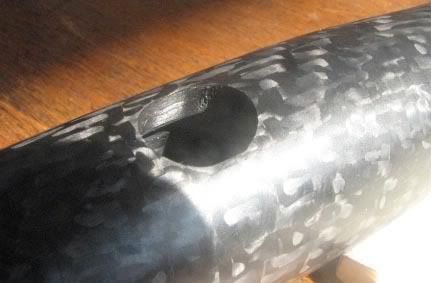
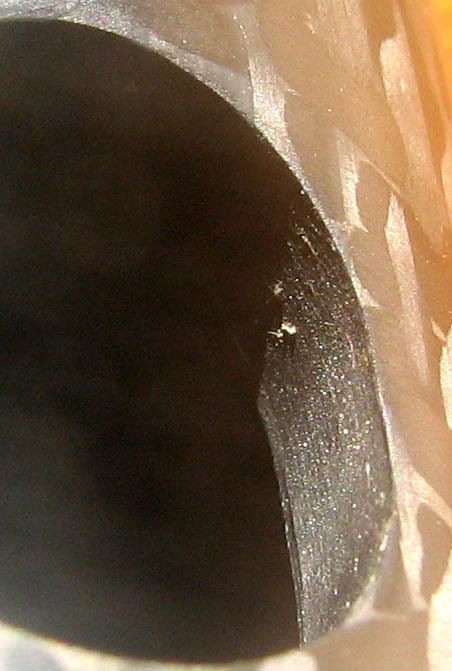
Some observations: the embouchure hole is a bit larger compared to other flutes I’ve played, and the body of the flute is very thin. Also, I notice that the embouchure hole doesn’t seem to be undercut, which has left an edge down inside that I’m wondering about; would the intonation improve if this edge was smoothed off?
It took a bit of practice to get the flute to play for me. The intonation is a bit unstable.
It’s tunable, but takes a lot of torque to twist the joint and make it move. There seemed to be some kind of lubricant on it. Maybe it needs some more.
Length of flute from center of embouchure to end of flute is about 523 mm.
Length from end of stopper to middle of embouchure is 17 mm.
I took some pictures, but I’m having trouble getting to imageshack.com. Isn’t that the correct url?
Michael let me try this flute out as well, and I echo his concerns about the embouchure hole. It’s very large, and rather unrefined in how it’s cut. I found it hard to get a decent tone on the flute, though someone used to blowing on original-style embouchure cuts, i.e. with a much more vertical blow, may have an easier time of it. Additionally, the thin-ness of the body makes the instrument feel and respond much more like a Shaw low-D whistle with a flute head on it. I guess this is the nature of the beast, considering the construction method; questions of taste aside, the embouchure cut is going to prove problematic for most players, beginner or otherwise. Cheers,
The thing to do with the Carbony flute, IMO,
is to get it into the fins of an expert flute maker,
or at least somebody who knows how flutes
are made. Then s/he can advise the maker
how to make the flute better. Jon C
comes to mind.
A question: how will this compare with wood,
soundwise? How good can this be?
I sent an email to Rob of the Piper Makers Union LLC telling him I posted comments. I’m not aware of his flute making experience, but what Jim Stone said sounds like a great idea, if acceptable to both parties.
I haven’t played the Folk Flute in months and it took a while to adjust my embouchure, so I thought it might be fairer to compare that with the Carbony.
Comments?