In my quest to gain knowledge and build a set of pipes, one of the issues is what wood to use to make the chanter. I know that the preferred woods are things like ebony and African Blackwood. Last night I was thinking as I was driving along, “I would like to make them out of all native to Michigan species”. I will research more, but offhand does anyone know if there are any native species to the Midwest United States that have the appropriate specific gravity to be used in chanters?
Dear Mick,
As soon as I get off my lazy duff, I’m going to try Michigan grown cherry wood. Seeing as Michigan produces so many types of fruit (cherries, apples, peaches, nectarines, appricots, plums etc) our best bet would probably be fruit woods. Maybe crab-apple if you could find a strait enough trunk? Black walnut might be a possibilty, but the dust is poisonous. Don’t put the scraps in the compost heap as the oils they release could have the tendancy to poison the whole batch and anything you mulch with it. I was thinking of using black or honey locust, but someone on this board warned me that it tends to split easily. Rock maple and other Michigan maples may be dense enough, but heavy as well. (Good for common stocks?) If you live near Detroit or feel like a long field trip, Public lumber on 7 mile and I-75 carries a wide selection of rare hardwoods. Let me know what works for you.
Marc
[ This Message was edited by: marcpipes on 2003-02-10 13:43 ]
There’s a pipemaker in California who’s had success making narrow bore D chanters in cherry
Plum, cherry, and apple have all been used to make pipes in the past.
They need to be very well seasoned, however.
Cherry is good for mainstocks…
Apple is excellent, but ABSOLUTELY needs to be thoroughly dried. If you intend on making a chanter from apple (VERY beautiful and excellent tone overall) be sure to oil/treat the bore as it is a bit too soft otherwise…
DB
Davey, given the fact that I am a neophyte at this, could you give me more information on oiling/treating the bore. Are there several ways? What type of oil? Why would you treat it, is it the porosity? Well seasoned…what exactly is that? I know what we mean by seasoned, but what is the criteria for well seasoned?
I appreciate folks that share their knowledge so freely.
Mick,
Apple is a pretty wet wood…and cracks horribly as it dries..it’s tough to find well-dried apple that isn’t so cracked it’s unusable. It should be thoroughly kiln dried. If possible try to get apple that’s been air dried for a few years as well…this is rarely possible. If you get apple “green” or fresh cut, you can often find lumber people who have access to kilns. This costs about $180 to dry a couple of logs of apple (7 foot 12" dia. logs).
In terms of treating the bore. It’s not due to porousness, it’s primarily an issue of hardness and smoothness of the bore. The least “intrusive” method is to simply oil it with almond oil, linseed oil etc. A somewhat more aggressive method is to carefully lacquer the inside bore. This will harden and smooth the bore and create a crisper, more in-tune tone. Apple can be tricky, but it can also be an absolutle gorgeous wood. I call it the “poor man’s boxwood”
I JUST got 6, 12" dia. logs about 5 feet long. I’m having them sawn up and kiln dried soon. I’m planning on using the current batch of apple for bellows sides and mainstocks. I’ve already got a large supply of well-dried apple sitting up in the rafters of the shop.
Hope this helped!
DB
I used to have a Cillian O’Briain chanter he made out of Holly. It was a really lovely chanter. Unfortunatly I had to give it him back when my blackwood chanter was ready. Shame.
Persimmon wood is a native wood also known as American ebony. It’s natural color is amber with occasional dark streaks. We use to have a domestic tree (fruit was tiny) growing in our yard in E. Washington State, so I know it’s not just a Southern US climate tree. When I cut it down, years before knowing anything, I remember the core being very black (probably an 7" dia. tree)

I think the top flutes (fifes) are them, the blacker ones grenadilla.
http://www.hmtrad.com/instr/winds/flutes/fifecoop.html#sound
Hmmm…Persimmon? I have a hand-forged knife with a lovely persimmon handle…I’ll have to check that out. I’m ordering some blackwood, boxwood and mopane today..I’ll see if they have any persimmon as well…I’ll turn a B chanter from persimmon and get back to you guys on the results with pics!
p.s. Don’t even THINK about osage orange..what a huge mistake THAT was…
[ This Message was edited by: Davey on 2003-02-12 08:00 ]
[ This Message was edited by: Davey on 2003-02-12 08:00 ]
Native or home grown timbers like cherry, apple, plumb and pear are fine to use as long as you seal them properly once they are made, fruitwoods are more pourous than the likes of ebony and blackwood and can require extra finger pressure over the tone holes in order to seal them off properly.
You can use sealants like Danish or Tung oils to seal them, these two aplications contain drying agents that when dry leave a nice hard matt shine/sheen finish which can be added to later if needed.
Pay paticular attention to the bore of the instrument by adding very small amounts of
oil each time, allow them to penatrate fully, because thicker aplications/layers can build up inside the bore altering the overall settings there.
Davy.
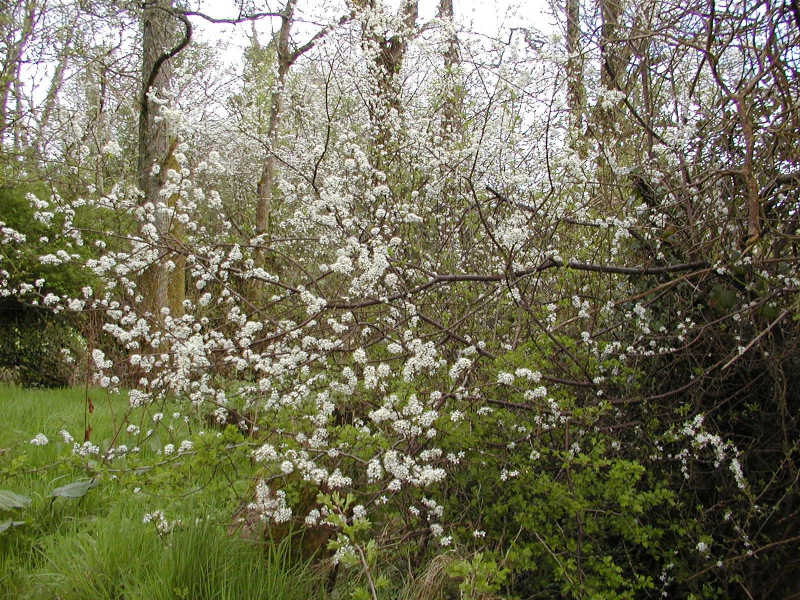
I was looking through Davy’s website (bagpipeworks) and noticed
again that he mentions Blackthorn as a wood for his pipes. The
Blackthorn tree is another thornbush that grows up the creeks
and valleys of Eastern Washington. I imagine it does in the mid-
west too. I lived around it for years, and cleared a lot of land,
and saved these trees for firewood long before I became aware
of it as a blackwood. It’s extremely dense and heavy, and the
long rigid thorns acts like poison if they puncture your skin (bad
memories of these things!). I use to wonder about the dark and
light colors in the trunk of the tree. Some of these trees get fairly
large. They have these white blossoms in the spring, and black
berries in the summer. Now I’m curious…I’m going up to the
foothills tomorrow. I couldn’t find a real good picture on the net
but this might do:
In regard to fruitwoods, pearwood is a very common one in recorders. Most modern recorders made from fruitwoods are impregnated with paraffin. I’ve read that it’s mainly to prevent penetration of humidity, but it also probably helps deal with porosity and perhaps even allows a slightly smoother finish. I know my pearwood recorder has a pretty smooth finish on the outside, and I don’t think it has any finish to make it that way.
I’m not sure how much this all applies to UP, since there’s no humidity involved, but I thought I’d at least throw in my two cents.
Hey, while we’re on the subject of woods, I have a question. In recorders, grenadilla (African blackwood) seems to be the ideal material. It projects the best and generates the most pleasing harmonics and stuff. In UP, though, I’ve seen lots of makers focusing on Ebony. That’s interesting, because in regards to recorders I’ve seen ebony described thusly:
Ebony, a softer blackwood from Africa or India, is not as satisfactory tonally but is occasionally used as a grenadilla substitute. (> http://www.aswltd.com/guiderec.htm> )
Now is this different attitude because of the difference in humidity? In fact, in recorders one has to take great care to keep grenadilla and other tropical hardwood instruments humidified or they can be permanently damaged. I assume UPs made of tropical hardwoods require the same care, but I find it interesting that I haven’t seen any mention of that on any of the web pages I’ve visited…
-David
Recently, I read where some pipemaker used wax during the reaming process to make the process easier with a type of wood, I can’t recall who or which wood.
Davy (bagpipeworks) had a good description of ebony vs. African blackwood in an earlier thread:
http://chiffboard.mati.ca/viewtopic.php?p=104455&highlight=ebony#104455
I have a japanese Plum in my front yard that died last year, should I cut it down and hang on to it?
Timmy