Any sets in this key exist? I’ve heard of G, Bb, B, C, C# and of course D..
-Eric
Any sets in this key exist? I’ve heard of G, Bb, B, C, C# and of course D..
-Eric
Is this a windup? 
C flat is B, and B# is C.
Really.
B and C are half step apart. So yes, Cb is B and B# is C.
You can see this on a keyboard.
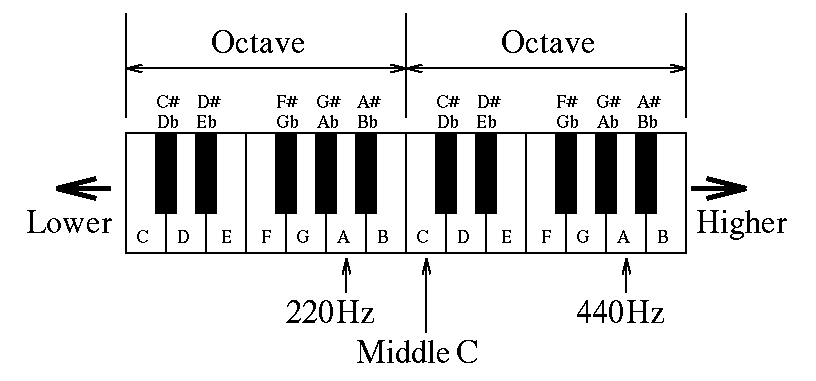
Nope - cause the tones don´t exist
What about Cb Major ? 
… the tones don´t exist
They to exist.
If you have B on your chanter then you have Cb
If you have C on your chanter then you have B#
…this is silly. It’s like asking do I have half a dozen or just 6 ?
…this is silly. It’s like asking do I have half a dozen or just 6 ?
I can see how this would be confusing to people. Especially if you’ve never learned music theory.
Well, of course you all have figured… But yes, I never once had a music theory class, otherwise I wouldn’t have asked such a silly… question. Wasn’t trying to waste anybody’s time.
-Eric
'Tis always better to Bb than to C#!
Can a C double # chanter be considered a flat set? Or do I have to stick with my E double flat? I’m confused!
Well, of course you all have figured… But yes, I never once had a music theory class, otherwise I wouldn’t have asked such a silly… question. Wasn’t trying to waste anybody’s time.
I don’t think this question is silly at all. If fact I think its a good question that actually has some substance. I really did mean it when I said that I think that this could be confusing.
You certainly weren’t wasting anyone’s time. I think we can all agree that there are plenty of other threads that have little or no value at all. I don’t feel this is one of them.
Can a C double # chanter be considered a flat set? Or do I have to stick with my E double flat? I’m confused!
Wow, sounds like Kevin’s been drinking again.
I just figured there’s usually a half-step between notes right, such as between A and B, or C and D for example, only reason I asked.  Learn something new everyday I guess.
Sign thee up for a music theory class 
Cheers,
Don’t even worry about it. It was a perfectly fair question. Asking questions is a sign of thinking and brain function, and a desire to learn. Some people tend to forget (I know I do too) that we are all at different points on the ‘road to enlightenment’, if I may use that term. What’s common knoweledge to some is not to others. Meself, for example, am not too good in the spelling department
Enharmonic spellings can be a bit confusing to get ones head around. And technically, yes, a Cx (double sharp) chanter would be the same as a D chanter, which is the same as a Ebb (double flat) chanter. I’ll just call it D.
Enharmonic notes are not necessarily the same pitch, they are in an equal tempered scale, with other temperements they may differ in pitch, on many instruments one can adjust to compensate, with fixed pitch instruments this is not generally possible. Early attempts to get keyboard instruments to play ’ true’ in diverse keys led to some astonishing developments, http://en.wikipedia.org/wiki/Archicembalo shows one of the most famed and the keyboard layout shows the enharmonic notes with different pitches. I heard one of these being demonstrated once ( in fact was privy to parts of its construction), regular pieces from the period sounded fine, pieces composed to show off the possibilities of the 36 note octave were rather odd with strange microtonal dissonances and resolutions, all sounded very avant gard, pretty wild for mid sixteenth century and arguably not revisited in the classical world until the early 20th C.
Cheers
Charlie.