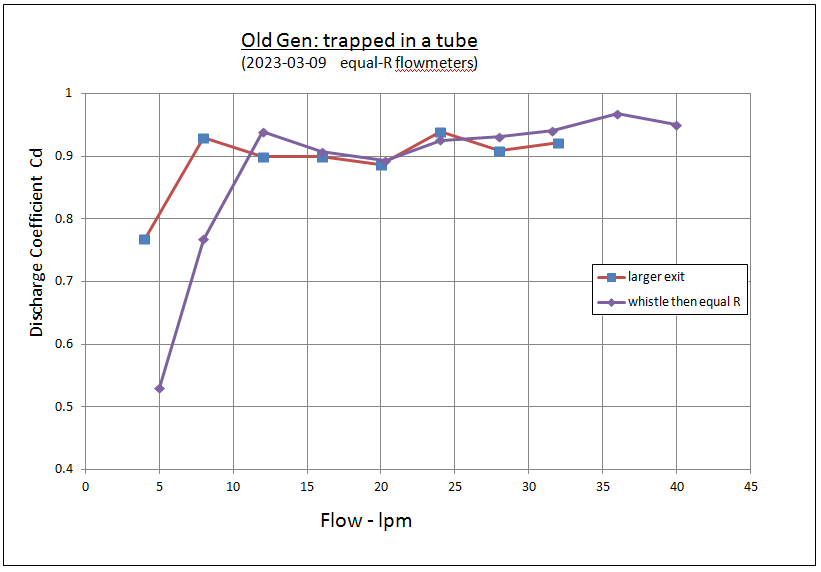
Also, looking at the spec sheet for the meters, it looks like the upper limit on supply pressure is 0.6mPa.
If possible, stay well within that cap.
Also, looking at the spec sheet for the meters, it looks like the upper limit on supply pressure is 0.6mPa.
If possible, stay well within that cap.
Hah hah, mud wasps, that would explain a lot. That’s what we would call “Bugs in the system”. But no sign of them. I think they must be seasonal.
Now those not used to doing science might be surprised (appalled?) at how long we’ve been spending on getting our basic set-up working and confirmed, and of course we’re not out of the woods yet. It did occur to me that while we’ve looked at the equipment and the environment (temperature, pressure, altitude etc), there is one further factor we hadn’t tested. The operator, ie me. Hey, I’m 75, am I still up for this? And, as it often does, fate comes to our aid…
In Australia, when you reach 75, you become entitled to a free health check every year. The aim is to keep you healthy, and identify any assistance you might need to keep functioning in old age. Help with shopping, showering, getting dressed, etc. I’m halfway through my first checkup. The first part is a screening test, conducted by a trained nurse. It aims to identify issues that the doctor who carries out the remainder of the checkup might need to focus on. One of the tests she submitted me to was the MoCA - the Montreal Cognitive Assessment. So when I saw the doctor a few days back, I asked him how had I gone. Looking it up, “30 out of 30, full score”, he said, “Impressive!” (It did make me wonder what he might have expected!) So hopefully we can also rule out “Bats in the Belfry” for the time being, and concentrate on sorting out the hardware!
Hmmm, now going back to the test I ran earlier where the Calibrator was now upstream of the Flow Meter rather than downstream, a sudden thought. That test might have had the benefit of letting the Flow Meter(s) vent to atmosphere, rather than operating up at the Calibrator’s increasing back pressure. But is it a valid test of the Calibrator’s back pressure if it’s conducted up at the Flow Meters’ increasing back pressure?
That’s 60 metres of water, we should be safe enough!
Terry,
First off, I’m very glad to hear that you’re checked + healthy !
2nd, I’m not at all surprised. Your playful sense of humor is the first marker of mental sharpness.
In addition to that, your persistence, and above all - ingenuity in trying to solve things has been inspirational !
Truly, we whistlers-with-spreadsheets are fortunate indeed to be co-conspirators with you.
Happy Birthday 
If the two meters are in series in step 1, closing either needle valve will reduce the flow, effecting both meters. So I removed the stop valve and put a length of tubing in its place. And got an initial imbalance of 19.3 left with 20 right, pressure 185.
Rebalancing at 20 + 20 = 40L using the RH needle valve gave these results:
Flow Meters in parallel, no stop valve
LH	RH	L+R	Press.	Res.
20	20	40	192	0.346
18	17.6	35.6	153	0.347
16	15.8	31.8	126	0.353
14	14	28	100	0.357
12	12	24	68.5	0.345
10	10.2	20.2	51	0.354
8	8	16	29.5	0.339
6	6	12	15.3	0.326
4	4.3	8.3	10.5	0.390
2	3	5	8	0.566

Average Resistance	0.37
Average Resistance above 4L/Min 0.35
I then put the stop valve back in place, with it open and checked the above. The results seemed indistinguishable.
The stop valve is a ball valve, with a 6.5mm hole through the ball, but with a 5mm hole through the output connector. None the less, it’s resistance is negligible compared to that of the flow gauges. And it’s really handy for when you pass 20L/Min. I think it can stay.
Thank you. For last New Year’s Day actually. That’s why it’s a holiday around the world, to celebrate my birthday…
I’m thinking that when all this is over, we should ask the University of Limerick’s Physics Department to grant us all Honorary Doctorates. PhD Physics (Whistle).
I’m picking on them as they have the trad Irish music course. Surely that foot in the door should start to infect all their departments? Whistle History. Whistle Geography. Whistle Physics. You know it makes sense…
OK. I stand humbly corrected.
If you are still taking requests, I’d like to submit the following:
Within reason ?
OK this may not be exactly what you asked for. I’ve left the Regulator running directly to Whistle Connector and then into the Old Gen head. I ran some 19mm bore poly irrigation tube over the rest of the head and taped it on to the whistle connector. So, in theory, any air coming out of the window or the bore would be collected by it. The weak point is that it only just passes over the bulge in the whistle head, so there might be added resistance for the air trying to come out of the window. This fatter tube then gets reduced down to the usual diameter and feeds both Flow Meters in parallel, with no stop valve. (You’ve really got it in for that poor stop valve, haven’t you!) And the needle valve on the RH Flow Meter is still set to equalise flow as best it can. Here are the figures:
Old Gen head in 19mm bore tube connected to Flow Meters in parallel, no stop valve, then atmos.
LH	RH	L+R	Press.	Res.
20	20	40	358	0.473
18	18	36	280	0.465
16	15.6	31.6	228	0.478
14	14	28	183	0.483
12	12	24	136	0.486
10	10.3	20.3	104.5	0.504
8	8	16	63	0.496
6	6	12	33	0.479
4	4	8	22	0.586
2	3	5	18	0.849

Average Resistance		0.53
Average Resistance above 4L/Min 0.48
Compare with our recent Old Gen in Depth measurements, which were done with the whistle at the end of the food chain:
Old Generation in depth
Flow	MM(H20)	√A/P	Resistance
0.5	0.5	0.71	1.41
1	1	1.00	1.00
1.5	1	1.00	0.67
2	2	1.41	0.71
2.5	3	1.73	0.69
3	3.5	1.87	0.62
3.5	5	2.24	0.64
4	6	2.45	0.61
4.5	7	2.65	0.59
5	8.5	2.92	0.58
------------------------
6	10	3.16	0.53
7	13	3.61	0.52
8	17	4.12	0.52
9	22	4.69	0.52
10	29	5.39	0.54
11	32.5	5.70	0.52
12	38	6.16	0.51
13	46	6.78	0.52
14	53	7.28	0.52
15	61	7.81	0.52
16	69	8.31	0.52
17	78	8.83	0.52
18	88	9.38	0.52
19	100	10.00	0.53
20	113	10.63	0.53
--------------------------------
20	100	10.00	0.50
24	143	11.96	0.50
28	207	14.39	0.51
32	272	16.49	0.52

Average Resistance	0.60
Average Resistance using just 20L gauges 0.52
Wow, that was fast !
Thank you !
Well, that’s an understatement.
So, if I understand:
a) the whistle is between the regulator and the flowmeters.
b) the whistle is *completely enclosed by tubing: 1) same input dia as before, 2) new output enclosure 19mm.
Question 1) So, how is the pressure-measure hooked up ?
Honestly, looking at the delta-p’z, I’m guessing: differential across the head ?
If the above is true: one thought I have is that the absolute pressure of the gas flowing into the windway will be higher than before, cuz the flowmeters have so much resistance. My conscience is squirming over that. Might have to alter the density in my calcs.
Question 2) May I inquire what the motivation was for the re-plumb ?
I’d like to make an appeal: please re-plumb with the whistle after the flowmeters, venting to air.
Rationale:
Have mercy on a weak soul. Please re-plumb + re-run.
Correct on both, except it’s only the whistle head, as we seem to have proven previously that the tube makes no difference to “resistance” measurements.
Question 1) So, how is the pressure-measure hooked up ?
Honestly, looking at the delta-p’z, I’m guessing: differential across the head ?
Correct again. From the spigot on the Whistle Connector, to the stem of a T-junction at the top of the line then running to the Flow Meters.
If the above is true: one thought I have is that the absolute pressure of the gas flowing into the windway will be higher than before, cuz the flowmeters have so much resistance. My conscience is squirming over that. Might have to alter the density in my calcs.
Yeah, that was the point of my query earlier today in regard to measuring the back resistance of a Calibrator at that point of the chain.
Question 2) May I inquire what the motivation was for the re-plumb ?
On your test? It wasn’t actually a replumb as it was still set up with the Calibrator. And I wanted to answer the question is it possible to test a head upstream from the flow meters. And it appears to have answered yes, although with that proviso that the window has poor access to the outlet end.
And you didn’t specify you wanted it at the end of the food chain! (I often think I’d make a good politician, as I can always find a way to shift the blame…)
Yeah, no worries. It’ll be later tomorrow as it’s getting dark now and I’m out on the waterfront playing music with my box player in the morning.
Rationale:
- the whistle venting to air is closer to how they’re played.
- the whistle venting to air is how they were measured before
- the results as plumbed-above are freakin’ me out.
Have mercy on a weak soul. Please re-plumb + re-run.
OK! But I think we have to recognise we are still a bit in shadow. We now know if we put the Flow Meters first, their accuracy will be affected by whatever back pressure the test item throws up. And because the back pressure builds quickly (at the square of the flow), it won’t be a simple offset error, it will be a compounding error.
What we don’t know is does the whistle suffer the same effect? The flow meters have much more resistance than whistles, and again, it will be a compounding effect.
I’m imagining that we need to connect the end of the food chain to a servo-controlled vacuum source, connected to sense the pressure at the junction between whistle and flow meters, and strive to keep that at zero by cranking up the vacuum. That way both whistle and flowmeters will be functioning at atmospheric. This is the kind of stuff I used to have to design and build back in the Research School of Physical Sciences and the Research School of Earth Sciences at ANU. But fortunately fate intervened, and I became a fat-cat flute maker instead. Ahem…
[composed offline and maybe crossing with Terry’s last post]
I’ll try to summarise - tell me if I have misread.
With two flow meters in series the air in the upstream one will be at a higher pressure even if they are only connected by a tube because the downstream one restricts the flow. With a clamp or a calibrator in between the pressure difference with be higher. The upstream one is observed to read lower than the downstream one.
The air will be denser in the upstream one. Two reasons why identical meters would read differently are:
The flow dynamics round the floating ball will be different with denser air. From the calibration equation given by another manufacturer (up the thread) even the 1300mm of H2O (127mb) that Terry can take the manometer up to would only produce a 6% change in reading (one way ot the other - we are not convinced which)
Although the same mass of air is going through both meters it takes up less space in the upstream one so that will - correctly - read lower than the downstream one. I’ll do some numbers on this when I have had coffee and been to the lane to see if we are snowed in again.
With the original setup of: regulator → flow meter(or two in parallel)) → manometer takeoff → calibrator only (1) above would be in play and only up to about 2% over the range we are interested in. The flow meter would read the volume flow into the calibrator correctly (within its accuracy and maybe up to 2% bias at full scale). The volume flow out of the calibrator would be greater because the air has expanded. This will be something that Tunborough’s modelling takes into account. So that setup should work.
Putting the flow meter after the calibrator and the manometer in differential mode cross the calibrator might work. We will be measuring the exit flow from the calibrator (so less than the entry flow) but we know the pressure difference so Tunborough can still do the modelling. The exit flow won’t be at atmospheric pressure but will be what is going into the flow meter, which is designed to work with a pressure differential. The exit pressure could be measured (if needed) by repeating with the same flows but the manometer connected on the exit side and to atmosphere.
I still think a thin disk with hole in it would identify any irregularity in the flow meter and/or manometer scales. Calibrators and whistle heads are so near to square root relationship that the pseudo orifice plate can be expected to be better.
Very interesting. The earlier measurements (those with the digital manometer) seemed to put the samples in two different camps: the Feadog and all calibrators needed an extra adjustment to make them line up with theory; the rest of the whistles lined up with only a little adjustment. The new measurements on this calibrator with the flowmeter after rather than before move it from the first camp to the second. Is it possible that the failure to line up with theory is entirely an artifact of the flowmeter readings? Other than this, the characteristic that seems most closely connected to which camp the sample lands in is the height of the windway exit (not the area or the shape, just the height): windway exits higher than 1.4 mm are in the first camp, lower than 1.4 mm are in the second. I’ve no idea why the height of the windway exit would reflect back on the readings from the flowmeter.
ETA: I’d say the cylindrical calibrators we’ve already got are at least as good a standard for measuring flow as a thin orifice plate would be.
ETA2: I checked our lane. We are snowed in.
I agree, so long as you no longer suspect that odd things on the flow - pressure curve may be a result of a change in flow regime, which is less likely with just the orifice.
If it was a 3.9mm hole we would then have three sets of measurements for the windway discharge to atmospheric pressure part and three for the ‘pressure drop along a windway’ (Darcy-Weisbach) part. I am thinking that Terry’s Resistance is a combination of those two things both with an expected linear flow v sqrt(pressure) relationship (all other things being held constant)
Can we think of this* as a truncated cone described by three geometrical parameters (length and the areas of the ends) with an orifice plate across the end having one parameter, area (which might be the same as the narrow end of the frustum)? The calibrators would be that simplified down to two parameters - length and the three areas all being the same. Somewhere I may be able to find again I have seen an adjustment factor for flow in a tapered tube (involving the ratio of the end areas raised to various powers) that might apply here.
Still haven’t done the volume calcs. Done a lot of shovelling though.
Thanks Tunborough and Trill for the explanations.
That’s where it gets meaningless for me as I’ve no idea what the numbers for that mean. I’ve tried researching it, but this browser crashes over and over again on the slightest thing and I haven’t even managed to get far enough to find out what value represents atmospheric pressure.
I was also hoping for an explanation of √A/P.
Does that answer your curiosity ?
Once I understand what the numbers represent, I think I’ll be able to follow things properly.
How long have you played whistles ?
Forty years. I only have Generation whistles (Bb, C, D, Eb, F and G) - got a set of them just in time to avoid the new type.
ps: my dad was a machinist, so I grew up around tools. So, of course, I’ve tried making whistles ! What prompted you to order an auger ?
I always wanted to have a go at making a quena, and eventually got round to trying it by drilling out wooden rods with an auger. Augers don’t seem to like following the grain though and can’t be steered, so I also got a 400mm Speedbor with 16mm head which can be steered down the middle of a 25mm birch rod using magnets to detect and correct for sideways wanderings. That worked well, but I had to put a lot of craft resin (epoxy) down the bore to stop the wood soaking up the sound waves, and I then switched to making quenas entirely out of craft resin by pouring it as a liquid onto a rotating silicone bore mould, building it up in layers. I’ve had to stop making them over the winter as the house is too cold for the resin to set properly - it does set, but with a wrinkled surface. I’m getting good third octave notes (clear and in tune), but the highest notes of the second octave aren’t right yet as I either get a component of the note an octave below them mixed in with them or a lot of unwanted hiss. I’d like to try making deeper whistles too, but I want to get the quenas right first.
pps: do you prefer “David Cooper” or “David” ?
There’s more than one David on here, so most economical would be to use DC if you need to.
There are equations describing the flow of gas through pipes where the pressure change has a linear relationship with the square of the velocity, or putting it another way, the velocity has a linear relationship with the square root of the pressure. Tunborough needs the velocity of the jet of air from whistle windways for modelling. Most of us are interested in the pressure because that’s what we feel when blowing. The velocity is hard to measure but is directly related (via the area of the windway exit) to the flow rate of the air through the windway.
Terry is developing a setup to measure the pressure and the flow rate and is encountering all sorts of technical idiosyncrasies and suggestions from bystanders.
Millimetres of water are commonly used as measure of pressure because a water filled manometer is a simple and accurate bench top way of measuring smallish pressure differences. Terry has one and used it early on, latterly to check the calibration of his digital manometer which is easier to use. Aneroid barometers normally read in both inches of mercury and millibars; atmospheric pressure is normally within 950 -1050 mb, ‘one atmosphere’ being 1013.25 mb (a nice round 760mm of mercury). Convert mm of H2O to millibars here: https://www.convertunits.com/from/mmH2O/to/millibar. One atmosphere is a bit over 10 metres of water.
Thanks, but the fog still isn’t clearing. What does the A stand for in √A/P and where do you get the right values from to feed into that? If ten metres is an atmosphere of pressure, that’s ten thousand mm, so 100mm would be 1% more pressure than normal air pressure, so I want to know how that feeds into the P in √A/P and where you get the A from.
Sorry, that one’s my fault. √A/P is not a formula, just a minimalist abbreviation for “Square Root of Air Pressure”. So it’s just the square root of the preceding column. So to clarify we have:
Treat the “Resistance” as an interim indicator of resistance for the time being. We may come up with a more soundly-based indicator as we progress.