Blowing machine

Now, I’m struggling with this. But we have to keep in mind that my background is in electronics, not fluid dynamics, so I have a very simplistic view of the relationships between flow (current), pressure (voltage), and resistance. Ohm’s Law. But my feeling is that we shouldn’t need to worry about any resistances or imbalance in resistances above the take-off point for the pressure meter.

This would be my logic. If you say set up a flow of 20L/Min (using just one gauge, let’s keep it simple at first), and then squish the tubing along the way, sure the flow and pressure will drop, but you’ll see that on both gauges. And when you add a bit more supply pressure to compensate for the increased resistance, then all will be well again. Right?

Well, it turns out, sometimes. And this could be important.

I went downstairs to prove/disprove my assertion. I plugged in the 4mm x 30 calibrator, and dialled up the flow to 20L, on one gauge. Pressure read 79.

Then squished the tube feeding that gauge with a small g-clamp until it read about 10L/Min. Then cranked up the Pressure Regulator until we’re back to 20L/Min. Pressure across calibrator now reads 76. Near enough, given the crudity of our devices.

Wind it back down to around 10L/Min, release the clamp, massage the tube to be approximately round again, and crank pressure back up to give a flow of 20L/Min. 75.

Repeating gave the same range of results. QED. Inserting resistance requires more supply pressure but the same final flow always generates the same back pressure.

So, now, I think to squish the tube running from the flow gauge to the whistle connector. My electronics brain tells me that I’ll get the same results. Doesn’t matter which side of the ammeter you put the resistance. But no, once I crank the flow back up to 20L/Min, I get a backpressure of 178!

Now do I remember david_h warning us of this - that the rotameter (floating bead) flowmeter might well prove sensitive to operating pressure. I can’t think of an alternative explanation at this time, but happy to hear theories!

If that’s the case, we then have to determine what the impact of the back pressure on the flow meter is. And compensate. Or find another way to measure flow.
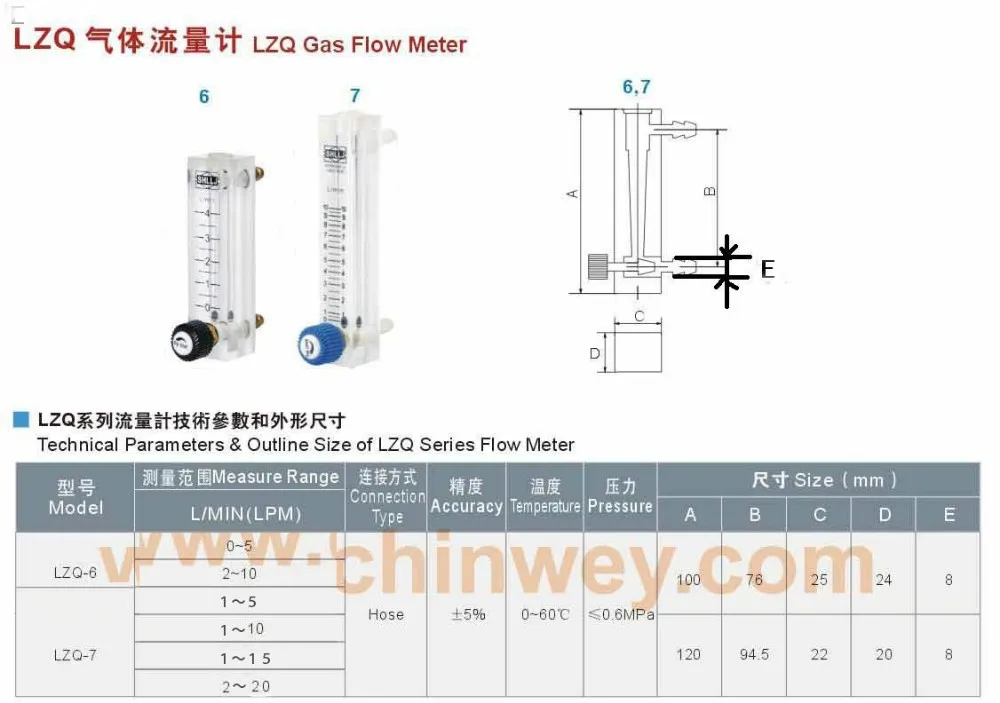
trill’s image of the flowmeters prompted me to see if we could work out how they derived that really weird scale.

Measuring off screen, I plotted these distances against the scale indications:

Flowmeter Scale		
Ind.	mm	Trend
2	0	0
3	3.3	
4	6.6	
5	10	
6	13.5	13.5
7	19	
8	25	25
9	31.5	
10	38	38
11	43	
12	47.5	47.5
13	53	
14	58.5	58.5
15	63	
16	67.5	67.5
17	73.5	
18	79.5	79.5
19	87	
20	94	94

And plotting them, I could see that they form a series of straight lines, approximating a gentle curve. I’ve identified the points at which these straight lines meet in the third column above. You can see there are 8 straight lines! Although a single straight line from 6 to 18 fits reasonably well. The big deviations are at each end.

Presumably inside the perspex block, the bore in which the beads run have been reamed to match.

Having been shown those pictures of Terry’s flow meters again I had another search.

It’s linked on on an aliexpress.ru page with text (via Google Translate) that says “Air flow meter, with adjustable valve for oxygen content, with adjustable flow meter, 2-20 l/h (H = 120 mm), with flow control”.

Other pictures on the search trail include a 20 l/min one like Terry’s. No accuracy figure on the ? distributor’s page http://www.chinwey.com/aspcms/product/2012-4-13/264.html

So maybe calibrated for air and accuracy stated as +/- 5%

The thing about the significant figures on the square root is that without the extra one the residuals from the fitted line lie on a series of exactly straight lines, without the detail that Tunborough’s have. I only noticed because I was being lazy.

Now, thinking some more about this possible sensitivity to operating pressure, is this a way to prove/disprove/quantify it? (It’s a bit late to be running compressors, or I might try it!)

Put the two 20L meters in series, with the second one free to atmosphere. Run the flow up to 20L/M on the first one in line, what does the second one show?
Now reverse them and run the flow up to 20L/M on the first one in line, what does the new second one show? Is one of them always more sensitive than the other? Or is the back resistance of the second flow meter enough to upset the first one’s calibration? (Make sure the needle valves on both are open!)

Use the manometer to document the back pressure/back resistance of a 20L/Min flow meter?

Now put say the 4 x 30mm calibrator in series between them, and run the test again. So the first one in line is now operating at the calibrator’s back pressure plus the other flow meter’s back pressure. The manometer can read that pressure. The second flow meter is running at atmospheric. Compare their readings. Swap the meters if in doubt.

If not enough difference, move to the 3mm or 2mm calibrator. Can we prove/disprove/quantify the operating pressure effect? Enough to come up with a correction factor?

Or better ideas?

Hmmm, at this point of the evening, everything suddenly descended into chaos. I’d opened my office door to let the Fat Cat out. This can take a while as the Fat Cat is a Scaredy Cat. Then the Skinny cat who had been outside slipped in the door, with a mouse in his mouth. Fortunately I spotted it and slammed the door to the rest of the house. I got him to drop the mouse which ran thankfully under the desk. Now the Skinny cat is working his way through everything under the desk looking for the mouse. But I spotted the mouse heading across the room to the computer desk, tried to catch him but he was too quick. So now it’s a waiting game…

The analogy between electric + fluid flow is used all the time, but . ..

What ! ? Wow ! That’s huge .

Well, with the added resistance downstream of the flowmeter, that will raise the pressure in the flowmeter, which will raise the density of the gas. I’m just surprised it’s that much. Hmmm. . .

Honestly, my original guess was much more mundane: if there is an difference in the resistance downstream of the 2 flowmeters, that could yield a small difference in the readings from the two meters.

Let me rephrase: at 24lpm, do the two flowmeters read exactly the same ? Are they within a half-ball-diamter of each other ? Within a quarter-ball-diamter ?

Well, with electrical analogs in mind, what’s that formula for resistances in parallel ? The total R will be less than either 1 . . . hmmm. . . if we consider the flowmeters as resistance elements . . . ?

maybe the mouse just ran into my brain . . .

I’ll need to read through Terry’s rearrangements of the plumbing carefully again. I suppose it’s not surprising that floating the little bead takes some pressure.

To refer back to that slightly questionable calibration equation. As a round number ambient pressure will be somewhere around 1000mb. 360mm of water is 35mb. So the correction factor at the high flow end of the readings will be sqrt(1035/1000) which is 1.017, or about 2% compared to the bottom end of the scale.

Whichever way up that calibration equation should be it’s not going to be a game changer but maybe is enough to matter in the modelling.

Excellent idea !

No new materials needed !

Can you confirm I am reading this right?
Regulator → clamp → flowmeter at 20/ l/min → manometer takeoff → calibrator → atmosphere gives 75 mm H20
Regulator → flowmeter at 20/ l/min → clamp → manometer takeoff → calibrator → atmosphere gives 178 mm H20

So the flowmeter must be under-reading by quite a lot? Maybe I misunderstand the setup.

How about:
Regulator → manometer high pressure side → flowmeter → clamp → manometer low pressure side → flowmeter
and/or if the fittings allow
regulator → manometer high pressure side → flowmeter → clamp → calibrator → manometer low pressure side → flowmeter

So you know one flowmeter is open to atmosphere and by adjusting the clamp and regulator you can see if the other flowmeter reads differently under pressure. With the calibrator in you wouldn’t need to need to tighten the clamp as much.

I am looking forward to getting to whistles, but I think you have already found from the calibrators that for ‘backpressure’ windway exit size has more influence than length.

I may have missed explanations somewhere along the way, but for many pages (which are often entertaining reading) I’ve had no clue as to what all those numbers actually mean and what they reveal about the whistles being tested. Is anyone able to write a little guide to get people up to speed with this?

So now I’m going to ask you for the dimensions of the flageolet windway: height and width at entry and exit, and length. I’m not going to try to model the beak or the windcap. I’m also not going to ask for the detailed profile of the windway, since my modelling isn’t sophisticated enough to use the information.

Those tubes should work nicely, as long as you don’t mind going high and loud with the short one. Let’s start with the Feadog mouthpiece, with the tube pushed all the way in. I’ll want to know what the length ends up between the splitting blade and the end of the tube. For this, remember, we’re measuring frequency as well as flow and pressure, going up as high as you dare, and back down again, to test the limits of the hysteresis in the register shifts. Because we want to get as close as we can to the register shifts, we can’t limit ourselves to fixed intervals like 4 L/min.

That’s a fair request. Most of the numbers so far say very little about the whistles themselves, and more about the testing process. I’d say we’re working on two questions now: (1) How accurate are the flowmeter readings? (2) Is there a dependable relationship between flow and pressure, so we only need to measure one and not both?

I think the answer to the second question is Yes, but it depends on the whistle. Each whistle has a constant that controls the relationship, and the constant depends on the mouthpiece geometry. I’m still working on how to get a good estimate of the constant for every whistle from measurements of its mouthpiece.

Hi David Cooper,

Well here are some basics:

Flow: volume-flow of air: liters-per-minute (lpm)

Pressure: mm of water (for comparison, most weather reports use “inches of mercury”).

Cents: A measure of frequency-difference. 1 cent = 1-one-hundredth-of-a-semitone. Divide the difference between F# and G into 100bits.

Resistance: a measure of how hard it is to blow into a whistle.

Most players find that there is a wide range of variation in how much air a whistle needs and how hard it is to push that air. Think of blowing up a balloon. A balloon made with soft rubber would be an “easy blower”. A balloon made with stiff rubber would be a “hard blower”. “Whistle Resistance” is a number used to quantify that. A related term is “backpressure”.

Does that answer your curiosity ?

How long have you played whistles ?

trill

ps: my dad was a machinist, so I grew up around tools. So, of course, I’ve tried making whistles ! What prompted you to order an auger ?

pps: do you prefer “David Cooper” or “David” ?

OK. First the good news. Morning here now and no sign of mousey. I left the outer door open all night, and the inner door closed and blocked, so I’m hoping he took advantage of the opportunity and is now regaling his friends with stories about how he single-handedly beat the two monsters.

And now the start of the experiment I outlined above…

I have the pressure regulator feeding the LH flow meter and then the RH flow meter in series, then open to atmosphere.
The RH meter gets to 20 first, the LH one reading 19.3L/Min.

I swap the order. I now have the pressure regulator feeding the RH flow meter and then the LH flow meter in series, then open to atmosphere.
The LH meter now gets to 20 first, the RH one reading 18L/Min. Yes, I check that again!

So:

  • we have a disagreement between the two meters, and
  • prima face evidence that they are sensitive to operating pressure

I explored further the difference noted in the “RH meter first” case:

Flow Meters in Series, RH first, LH to atmos.	
Left	Right 
20	18
18	16
16	14.3
14	13.2
12	11.6
10	9.8
8	8
6	6
4	4
2	2.6

So then explored the matter of adding resistance:

  • squishing the feed tube from the Pressure Regulator, then cranking the pressure up to compensate, we get back to LH reads 20, RH reads 18. No change. As expected.
  • squishing the tube joining the two flow meters, then cranking the pressure up to compensate, we back to LH reads 20, RH reads 12.7L/Min.

So we have confirmed that the gauges are sensitive to operating pressure, with the gauge at the elevated pressure reading less than the gauge at atmospheric.

Now, squishing the tube to halve the flow is a pretty mean test - what the lawyers would call reductio ad adsurdum. The question we now have to answer is what degree of error does introducing a whistle windway (or its more easily definable and manageable surrogate, a Calibrator) induce. I’ll need to do some mucking about…

How about connecting the manometer one side or other of the ‘high pressure’ flow meter, before the clamp? You know what range of pressures are needed. You will go easy on the squishing to start with I am sure.

That is a huge difference. And, if I understand the setup, in the opposite direction to what trill and I expected, as in the calibration equation

Next exciting installment. What pressures can we read across the lower flow meter, the one that vents to atmosphere? Here’s the numbers:

Flow Meters in Series, pressure across lower flow meter			
LH	RH	Press.	Res.
4	4	149	3.052
8	8	372	2.411
12	12.3	903	2.443
14	14.5	1300	2.487
			
Average Resistance	2.60
Average Resistance above 4L/Min 2.45

Notes:

  • I couldn’t get above 14 L/Min without overloading the Manometer.
  • The resistance is high. Compare with whistles - more in the range 0.44 to 0.67
  • So having the two meters in series is going to affect the upper meter much worse than having a whistle to blow into. Many times worse.
  • Again we see that the meter that vents to air reads higher than the one at pressure. In this case it’s the RH meter, and the difference is visible from 12L/Min upwards.
  • And that was with the needle valves on both gauges wound right out. (I should have stipulated that earlier!)

I haven’t read that last post as I just got out of bed to say “Duh, of course the low pressure meter reads higher. There is more gas flowing - it expands after the clamp.”

Blundering on…

I rejigged it to allow me to have the Calibrator above the Flow Meter, rather than making it the end of the chain. This allows the Flow meter to vent to atmosphere. This involves pressure take-offs from both sides of the calibrator going to the two inputs on the Manometer, and setting it for Differential readings.

Here’s what we got:

4 x 30mm Calibrator above Flow Meter			
Flow	MM(H20)	√A/P	Resistance
10	15	3.87	0.39
20	56	7.48	0.37
30	122	11.05	0.37
40	204	14.28	0.36
			
Average Resistance	0.37

Compare with earlier results for the same Calibrator, but with it at the end of the food chain…

30 x 4mm Calibrator			
Flow	MM(H20)	√A/P	Resistance
5	4.5	2.12	0.42
10	19	4.36	0.44
15	43	6.56	0.44
20	80	8.94	0.45
25	111	10.54	0.42
30	165	12.85	0.43
			
Average Resistance	0.43

Note the difference in resistance readings, not dramatic but noticeable. A narrower bored Calibrator, or a narrow windway whistle like the Killarney would bring out a greater difference. This suggests to me that we need to find a way to deal with the issue. What do others think?

Terry,

Have you checked for mud wasps in that LH meter ? :slight_smile:

But seriously,

How about this:

  1. Find needle valve settings that equalize the resistance of the two meters.
    (Re-do the series-swap, closing off RH needle just enough to equalize).

  2. Wire the two flow meters in parallel again, but leave out the shutoff valve.

  3. Re-do a sample of cases (whistles+calibrators), see if the bumps at 24 lpm go away.

  4. Watch the flow-balls closely, note any disparities.