Greetings Folks - I am a newcomer to this forum and have been sitting “on the sidelines” for a fair amount of time. But now I have a question or two that I hope can be answered by those that have more knowledge than yours truly. The Civil War series by Ken Burns had a mournful beautiful song/air entitled Ashokan Farewell. Needless to say the song/air really moves me and I would like to be able to play it on the whistle. I have found the sheet music on the internet but various parts of the piece seem to be out of the range of a whistle. Some questions:
Is Ashokan Farewell truly in range and can it be played on a whistle?
Are there any recordings of this piece played on a whistle?
If playable can any of you musicians put this tune into sheet music form? (ABC method is a technique that I have not yet mastered)
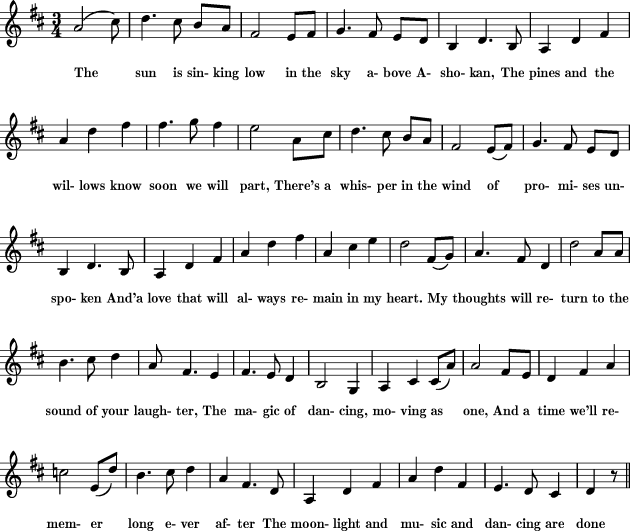
Ashokan Farewell is invariably played in the key of D by fiddlers, as shown in the music above.
It obviously doesn’t fit the whistle that way, because too much of the melody drops off the bottom, and the tune really doesn’t work without those lovely arpeggios that walk up from A and G. Played up an octave, you loose important stuff off the top.
But if you transpose the tune to G it works. IIRC, there is one note that doesn’t fit, but you can substitute around it satisfactorily.
If you find on the net, or someone sends you, abc notation for a tune, you can paste it into the box at the above link, hit a button, and see the tune as sheet music. There’s a further button to get a clean PDF file of the sheet music, and another button if you want to hear a midi version. The downside is that the print is pretty small.
ABC is really easy for jotting down simple tunes – that’s what it was designed for.
John Chambers’s ABC Primer at http://trillian.mit.edu/~jc/music/abc/doc/ABCprimer.html
is a good introduction and can have you writing out simple tunes pretty quickly. I don’t own any music notation software, so on the few occasions when I want to produce standard musical notation, I just write it out in abc and use the ABC Convert-A-Matic.
Yes, to play it in G, where it works just fine you need one low C note. Matter of fact, that note in that tune was what gave me the idea to make my D+ whistle. As noted above, you can easily work around it in several ways.
Sure, this works. There are ABC’s for a whistle/flute version of this tune on thesession.org. Take a look at the discussion at http://www.thesession.org/tunes/display/4997. The version posted by ceolachan works just fine for me. Turns out very well on a whistle.
T:Ashokan Farewell
M:3/4
L:1/8
K:D
Ac|:d3 c BA|F4 EF|G3 F ED|B,2 D3 B,|A,2 D2 F2|A2 d2 f2|
|1 f3 g f2|e4 Ac :|2 A2 c2 e2|d4 FG ||A3 F D2|d4 A2|B3 c d2|
A F3 E2|F3 E D2|B,4 G,2|A,6|A4 FE|D2 F2 A2|=c6|
B3 c d2|A2 F3 D|A,2 D2 F2|A2 d2 F2|E2 D C2|D4 Ac
Can someone please explain to me how to read/play from this kind of notation?
I first heard this tune on the Civil War soundtrack, and it sounded so Scottish to me that I assumed it was a traditional Scottish air.
It was full of the typical Scots fiddle air stuff, the “Scotch snaps” and turns etc.
However the sheet music above, and the way I’ve heard Irish fiddlers play it, removes all of that stuff and rounds it out into a waltzlike thing.
I play it on an A whistle and preserve the snaps and turns like I originally heard it.
To hear what I mean, follow the YouTube link above but scroll down to the videos that use the Civil War soundtrack version. The pair of pickup notes are slightly snapped, the third beat of the first bar is snapped, and there’s a fat turn in bar two, and so it goes.
I saw an interview with Jay Ungar saying he liked how the Scots and Norn Arish played it, with the snap, and that the Southern Irish musicians didn’t give it that extra edge.
Ah, thanks for pointing out that clip. I have squirrelled away the first two times through for future ‘study’. I had read Jay Ungar’s comment somewhere but found his own playing of it available on youtube a bit too fancy to for me to want to follow. Played as a waltz (or as syrupy as the orchestration at the end of that clip - but it does contrast well with the photos) I can see why many people don’t like it. Do many traditional tunes have things like that almost two octave rise though ?
What two octave rise, David? Do you mean that arpeggio flourish at the end? If so, that’s not really part of the tune - that’s just a sort of embellishment that might have been put on the end of any performance of any piece, trad or otherwise. Johnny Doherty used to do that sort of thing quite a bit. To show off, I think.
I meant the A, - g ( arpeggio ?) in bars 6-8. Maybe rise wasn’t the right word. On a whistle this the commonly used range plus, briefly, one more (yes, I know its a fiddle tune). Playing it in G on a flute I find myself thinking “unusual this, good exercise but glad I am not on whistle”. I have read somewhere that putting in a flat seventh near the end of the tune is Scottish sounding thing.
Is it? I’m assuming you’re thinking of playing it at pitch on an A whistle (or playing in in G on a D whistle), in both of which cases it only goes up to the natural seventh of the whistles scale. I count the whole two octaves as the “commonly used range” of a whistle and, if you’re playing a low D, for instance, you’ve got quite a few notes above that.
Well, an octave and a seventh is “almost two octaves”. How much more almost can you get ? Most traditional dance tunes seem to use D-b. If it goes above that whistlers start nattering on forums about fingering and the fiddlers about position changes.
But it was the straight ‘bottom to top’ aspect that struck me as being conspicuous.
I wasn’t arguing about it not being “nearly two octaves”. Of course it is. But that’s all within the “commonly used range” of a whistle isn’t it? Or am I missing something?