I’ve just combined the headjoint, slide and top section of my George French cocus with the bottom two sections of my Wylde cocus, and… it plays beautifully!! The internal tuning is far better than the two donors as tested on Flutini The D is less flat and the A and B are far less sharp. Anyone else tried that and got a better flute?
It is surprisingly common, I’ve found this happens a lot. It totally screws the majority of hot air about flute design and the finer points discussed on this site. It’s one of the reasons I use the sign-off below.
H
Save your hot air for blowing down your flute
Holmes Mooney & Wood play; The Laird Of McNabb - http://www.box.net/shared/5tx0jxtd7cbbgjfsjkp0 (Holmes McNaughton D Blackwood eight key circa January 2011).
http://www.myspace.com/therubb circa 1988 (Hawkes Eb mostly on these samples The Rub & maybe a D Wilde - too long ago to remember)
http://youtu.be/zrNs33H7uxY (Wilkes 8 Key circa 1994)
Does a change occur in the C#-D# length when you swap the parts?
Terry
Yes Terry: French/Wylde = 257mm French = 264mm
Wow, that is a big change, isn’t it. And certainly goes a long way to explaining the improvements you noted in intonation.
Interesting to look at those numbers in the light of our recent analysis of changes in scale over the period:
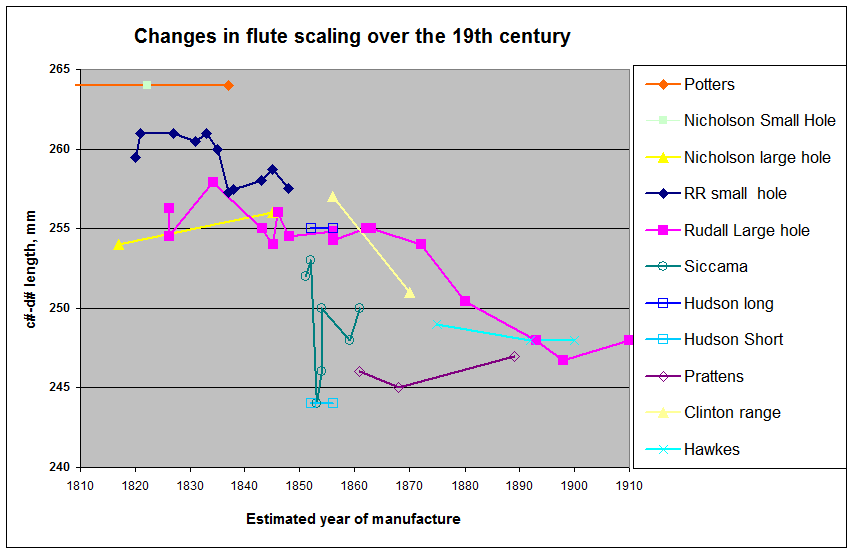
Your French, at 264 is like Potter’s flute, in orange at the top. The composite French/Wylde lies between Rudall large and small holed flute scalings.
Terry