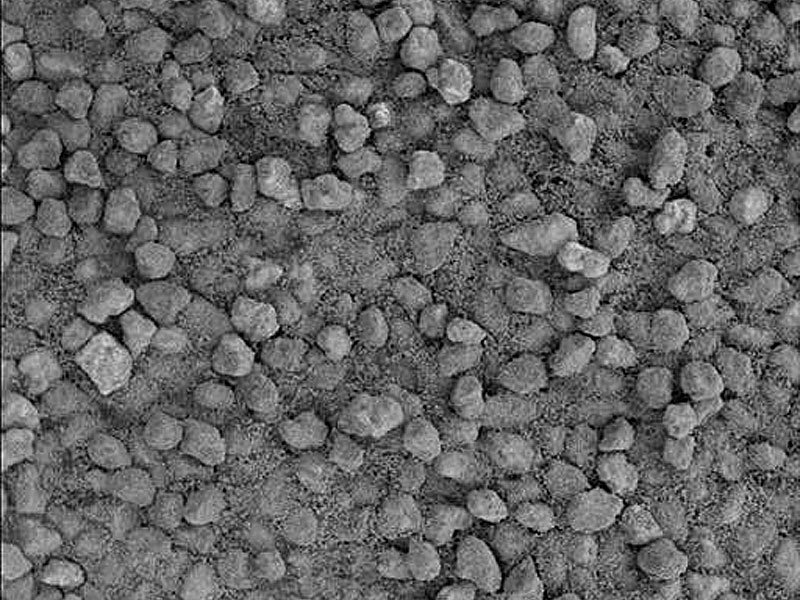
I find this one dull and unremarkable, but I’m sure you don’t care. 
In a way I did too.
You are correct. 
Given that it shows an area about 3 cm wide, the part that’s not grains of sand must be extremely fine dust of some kind.
The texture of that dust is very interesting. What kind of process would lead to such a texture?
You must just be too young and blasé, Cran. Personally, I find even the existence of such a detailed photo of the surface of Mars exceedingly remarkable. We didn’t have such things when I was in college.
That’s absolutely fascinating! The texture is intriguing. There’s so much to be curious about in a photograph like that . . . chemical composition, mechanical forces, is there a tiny pair of eyes peeking out . . .
Sorry, but I see no evidence that this was, in fact, photographed on Mars. It could just as easily have been taken behind my fridge. 
djm
Robert Heinlein was still using Martians back then…

Wasn’t everybody? Except for those who were using Venusians/Venerians–or even Lunans.
Before we finally got to see the far side of the moon, there was a cartoon in one of the sci-fi mags (probably Analog) that showed the first spacecraft coming around the back of the moon. It showed the moon as canvas, stretched over a wooden framework. The back side was open, and on one of the struts was printed somethig like: “Act 1, Scene 2”.
It looks like an ill-cleaned catbox.
Meow.
Yes. After the liquid has settled. So, is there urine on Mars?
For some reason, this quote next to Cranberry’s avatar makes me giggle.
Dunno, but I hear there are rings around Uranus. 
ahhhhhhhhhhhhhh!!!
that’s so bad…
I am intrigued by the picture; the angular grains themselves and how and where it was taken. I’m not blasé about things; hell, I still think FM stereo is cool! But I also want to point out that Angular Sand on Martian Hills sounds like a contemporary Celtic song title.
Rod