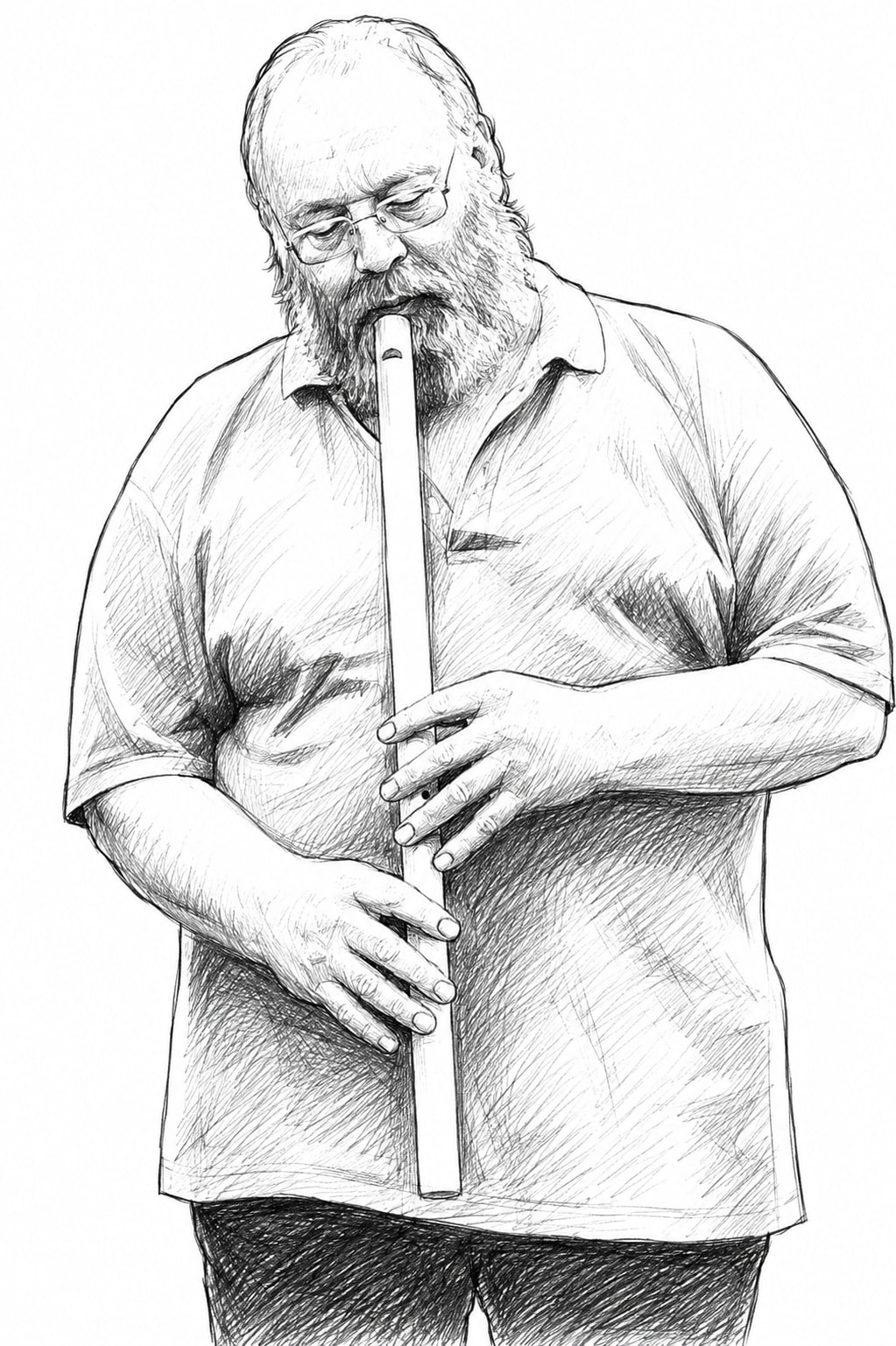
An Interview with Finbar Furey about Bernard Overton

After several days of transcribing, editing, and fact-checking, I’ve finally completed my interview transcript with Finbar Furey.

Finbar and Sheila Furey have now reviewed it (twice), suggested corrections, added clarifications, and graciously given me permission to share this edited excerpt from our conversation.

The interview focuses on Finbar’s recollections of Bernard Overton, the development of what Finbar consistently calls the Overton Flute, and the lifelong friendship between the two musicians that helped bring this remarkable instrument into the world.

This transcript is just one chapter in a larger research project I’m currently writing on Bernard Overton and the legacy of the modern Low D whistle.

(As you’ll discover in the interview, Finbar would probably remind me to call it the Overton Flute! :blush:)

What began as a search to better understand the haunting, hollow aluminum whistle voice that first captivated me has become something much richer. As I explored the music of artists such as Brian Finnegan, Ali Levack, Ross Ainslie, Fraser Fifield, John McSherry, Tyler Duncan, and many others, I gradually realized they all shared an unmistakable voice.

Following that sound led me to Colin Goldie’s whistles, then back through their lineage to Bernard Overton, and ultimately to the remarkable friendship between Bernard and Finbar Furey that brought the instrument into being.

Along the way, I discovered that someone in the whistle community had affectionately dubbed the sound “The Cosmic Drainpipe of the Universe.” I can’t think of a better description.

If you’d like to read the interview, it’s available here:

I hope you enjoy it as much as I enjoyed helping preserve this small piece of musical history.

6 Likes

It’s more about Finbar than Overton, isn’t it. But that’s fine. It tells a version of the genesis of the low whistle as we know it today.

But you have him saying ‘My pipes were in E’. That strikes me as very unlikely and something that isn’t borne out by his 1970s recordings (this, for example). His chanter may have been slightly sharp at times, a lot of period concert pitch chanters seem to be happiest in old philharmonic pitch, but E would be an oddity.

.

Yes. I decided to title this excerpt An Interview with Finbar Furey about Bernard Overton for that reason.

We spoke for about an hour, and the conversation ranged over many other subjects. For this excerpt, however, I wanted to preserve Finbar’s recollections of Bernard and the development of the Overton Flute. It is part of a much larger project I’m working on that I hope to call Bernard Overton and the Legacy of the Modern Low D Whistle.

I agree that the reference to his pipes being in E seemed odd. My original transcript actually had D, but when Finbar reviewed it, he specifically corrected that passage from D to E.

He was an absolute pleasure to speak with—a wonderful soul with a big heart.

Comment edited for clarity.

Peter, I had to go back this morning and listen to a portion of my interview with Finbar that I haven’t transcribed yet, and it explains why he corrected my transcript from D back to E.

Finbar explained that when he was touring with Eddie, he needed to play in different keys to accommodate Eddie’s singing. He made his own reeds and would actually tune his pipes up from D to E when he needed that key.

So his chanter was a D chanter—which is why he later describes designing the Big D from his D chanter—but his pipes could indeed have been set up in E when he was touring with Eddie.

I’m glad you questioned it. It made me go back and listen more carefully to that part of the interview.

Commented edited: And I should add that he also talks about having a few different sets of pipes. I am not familiar with the Uilleann pipes. But, as I finish transcribing the interview, I will listen closely to how he words this.

I never heard of Bernard Overton until I seriously took up the whistle a decade ago, (well, it IS kind of a niche…) but seeing as we share a surname, my interest is piqued every time I see his name.

1 Like

Thanks John! A lovely interview and now that Bernard is gone it’s great to have an eyewitness account.

One quirk is Finbar stating that they used the fingerhole layout of his uilleann chanter to reckon the Low D whistle fingerhole layout.

The two instruments are so different that that wouldn’t work. Besides there would have been other existing resources to give a far more accurate guide, for example the Bansuri flute and Boehm’s schema.

I heard the story somewhere- I have no idea where- that Bernard based the Low Whistles on the thousand-year established specs of Organ pipes, giving precise dimensions for every possible size. I once heard somebody call Overtons “Organ pipes with holes”.

About E pipes, back in the 1980s Joe and Antoinette McKenna were frequent visitors to California and part of it was Joe advertising his pipemaking.

He had evidently got enamoured with high-pitched uilleann pipes and he was offering pipes in E-flat and E-natural. This is from conversation with him; I can’t find any price-list and I don’t know if he was actually making pipes in Concert E natural.

2 Likes

Another curious/ambiguous area is Phil’s statement about the early Overtons having extremely high backpressure due to being made “to suit pipers”.

This obviously conjures up Highland pipers, who do indeed prefer a “satisfying” amount of backpressure on the instruments they blow, directly stemming from the backpressure of Highland pipes.

But…all those early owners were uilleann pipers, and there’s no backpressure stemming from the uilleann pipes as far as your lungs and mouth are concerned.

Another thing is I wonder exactly what Finbar meant when he spoke of Bernard making a “set of flutes”. 13 whistles D to D? I doubt it, but it’s possible.

One would think touring musicians would travel light, but when you think of The Corries…

I know squat about uilleann pipes, so I don’t want to pretend I can resolve the technical questions being raised here. :grinning_face_with_smiling_eyes: This is part of the reason I requested the opportunity to interview Finbar in the first place. These are his recollections, and I want to preserve them as accurately as I can while allowing people who know far more than I do to examine them.

This earlier interview with Finbar might be helpful. Take a look at about 8:20–8:52:

There he talks about being limited by keys when touring with Eddie, making his own reeds, and tuning his pipes up from D to E when he needed a different key for Eddie. He then goes directly into talking about the development of the Overton flute and the additional range of keys it gave him.

I should also add that Colin and Brigitte Goldie were kind enough to arrange my interview with Finbar, with the idea that his recollections would help inform my future conversations with Colin about the specifics of Bernard Overton’s legacy in the development of the modern Low D whistle.

I’m excited to learn more from Colin and from others who know this history. Ultimately, I hope to write it up and make it freely available to anyone who becomes as fascinated by this instrument and its history as I have.

1 Like

Yes, great stuff, John! Both interviews were very interesting and informative. I liked Finbar’s sense of humor, and it seems his generosity too. I didn’t realize he was so involved with the development of the “Overton flute”! It’s really a great story, and a look into the lives that made it all happen, so thank you Finbar and Bernard for giving us this lovely instrument, and thank you John for posting the interviews. It really is something of enduring value, you bringing it all to light and to our eyes here on Chiff! I had to go grab a Low D flute (ha! he’s got me saying now!) to hang onto and then play after I read it all. Not a real Overton, but what are you going to do? We sure are blessed for it! What a time to grow up, having them all at hand now from various makers, unlike it used to be! Thanks again; fantastic job!

1 Like

I might add it’s nice to hear Finbar repeatedly making clear that Bernard did the actual making, Finbar doing the designing.

I say this in this time when musicians who I am sure never got near a lathe are given credit for “making” instruments.

BTW about Finbar making an uilleann chanter function well a full tone higher by changing the reed, I’d like to see this discussed on the uilleann forum.

1 Like